

AI-ready delivery data: shopper, retailer and carrier intelligence explained

Anastasiia Starchenko

AI-ready data for delivery is shopper, retailer and carrier data that a system can act on at the moment of each order. Because every outcome feeds back into it, each delivery decision is better informed than the one before.
Most conversations about AI-ready data in retail start with the product catalog. Retailers clean up attributes and restructure feeds so an AI shopping agent can read what they sell.
Delivery gets far less attention, even though the decisions behind it shape whether a shopper buys and whether the parcel arrives when it was promised.
Those decisions run on data too, and in most retail operations it sits in places that rarely meet. Agent-ready delivery starts with the data underneath it.
AI-ready delivery data is shopper, retailer and carrier insights that a system can act on at the moment of each order. Because every outcome feeds back into it, each delivery decision is better informed than the one before.
What is AI-ready data for delivery?
AI-ready data is data that fits the decision it's meant to support. Gartner describes it as data that is representative of the specific use case, including the patterns, errors and outliers a model needs to see. In delivery, the use case is a decision made on every retail order: which options to show, what to promise, which carrier ships the parcel and at what price.
That determines what ready means. Delivery data reviewed in a monthly report can tell a team what went wrong last month. Data that's ready for AI has to be available while the shopper is still in checkout, because that's when the delivery offer needs to be calculated and the decision needs to be made.

Table comparing shopper, retailer and carrier intelligence: what each answers, the data it provides and the delivery decisions it shapes
Why delivery data sits in silos
Delivery data spreads across teams that measure different things. The e-commerce team tracks conversion in checkout, while the logistics team tracks carrier cost and performance in a separate set of tools. The shopper's history lives in CRM and loyalty systems. Although each view is accurate on its own, none of them meets at the moment the delivery promise is calculated and presented to a shopper.
The result shows up in the checkout. According to Ingrid's research, 68% of orders go out on whatever delivery option the retailer already pre-selected for shoppers, so a one-time default leads up to most of the delivery decisions. Our report on delivery in agentic commerce sets out where retailers start with untangling it.
"Most retailers already have the data they need: in checkout performance reports, carrier invoices or CRM exports. They need to bring all this data into the moment delivery systems calculate a delivery offer for their customers, with a real-time promise they can keep."
— Stephanie Branston, Sr. Product Marketing Manager, Ingrid
What is shopper intelligence?
Shopper intelligence is what a retailer knows about who is buying and how they prefer to receive orders. It's built from two kinds of data.
Structural data describes who the shopper is, such as home and work postal codes, preferred pickup locations, lifestyle patterns and such.
Behavioral data describes what the shopper does: the products they view, what they buy, how they pay, what they send back and how often, etc.
In a data-driven retail environment, first-time visitors vs. loyal returning shoppers, or those who keep most purchases vs. serial returners, face personalized versions of the same delivery offer. The preference is real: 53% of shoppers would wait an extra day to get their preferred carrier, according to Ingrid's research.
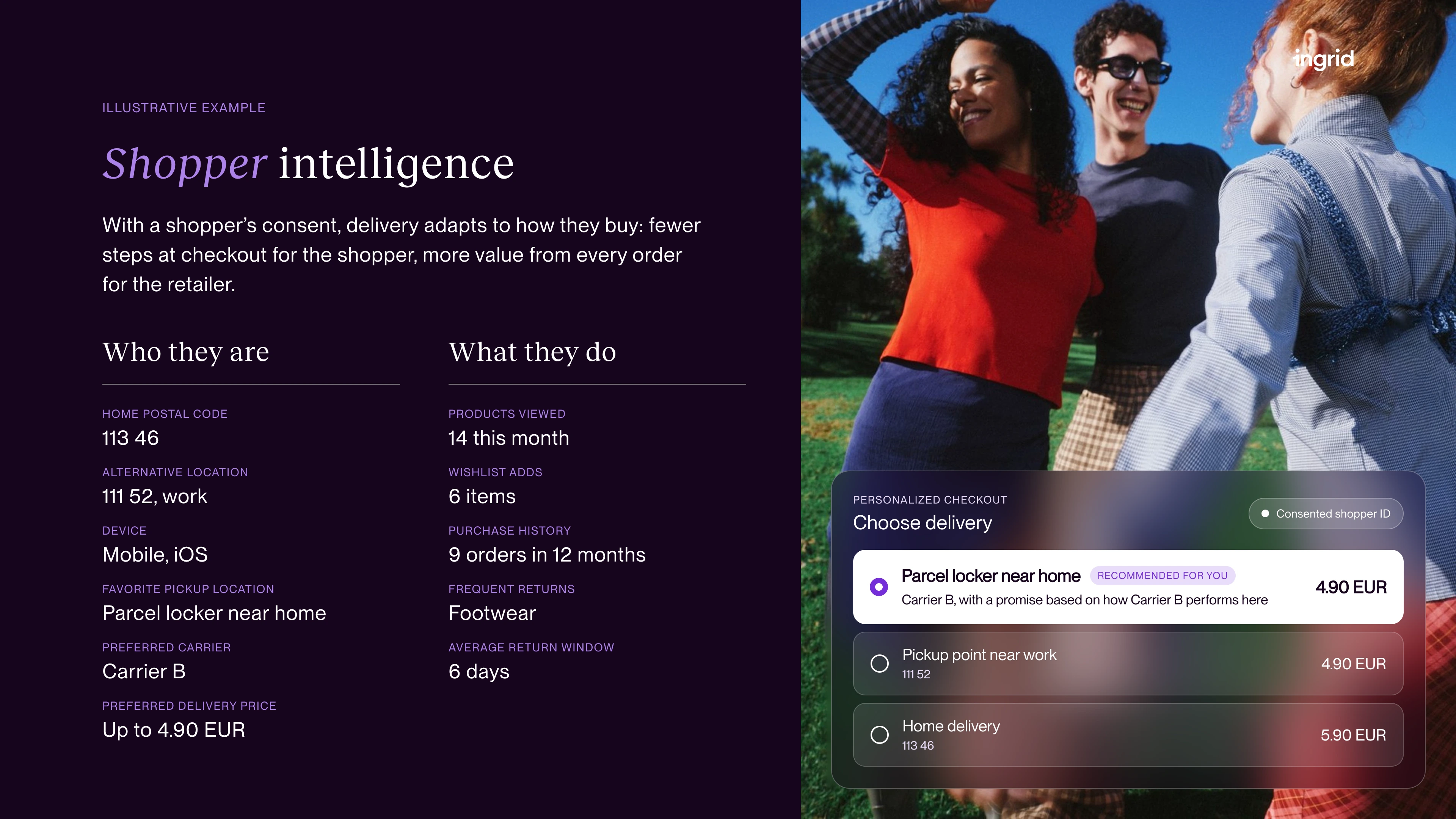
How shopper intelligence works, from identification to delivery
Shopper intelligence works as a sequence of four steps, each one feeding the next.
- Identify: recognize the shopper, with their consent.
- Profile: bring what's known about them into one profile.
- Promise: shape delivery options and the promise around that profile.
- Deliver: learn from what actually happened, and carry it into the next order.
How far a retailer can take it depends on its e-commerce, delivery and payment setup, and in particular on whether checkout and payment partners can share a consented shopper ID with the delivery system.
In the last step, shopper intelligence meets the rest of the delivery operation. Each delivery outcome tells the system something about the shopper, and it also tells the system something about the carrier and the retailer's own margin.
Shopper’s consent plays a key part of the definition. Payment and delivery systems use shopper data only within the consent it collected, so retailers can explain to their shoppers what's collected and why delivery decisions look the way they do, while offering legally compliant retail experiences.
Adlibris added Ingrid to Kustom Checkout, so identification, payment and delivery run in one flow, and checkout conversion grew by 11.5% in an A/B test. With a connected checkout, retailers can act on consented shopper data for delivery. Read the Adlibris case study
What happens when the shopper is an AI agent?
Even with more shopping running through AI agents, shoppers behind those still have delivery preferences. Someone who always picks a parcel locker will expect their agent to choose one, too. Delivery systems will need to recognize that person through whichever agent they shop with and serve the same options and promise they'd see at checkout.
How agents get that information is a question of API-first delivery infrastructure: it lets AI agents read delivery information as data, so they can answer shoppers' delivery questions, shortlist brands and products in the chat or evaluate the same options into the cart and checkout they build on someone’s behalf.
What is retailer intelligence?
Retailer intelligence defines what a retailer learns from its own orders and outcomes, from the delivery promise made at checkout up to a potential return.
It covers the promise against what actually happened; the delivery options shoppers chose; delivery pricing they opted for; order and delivery margin; return windows, return reasons, exchange rates, and more.
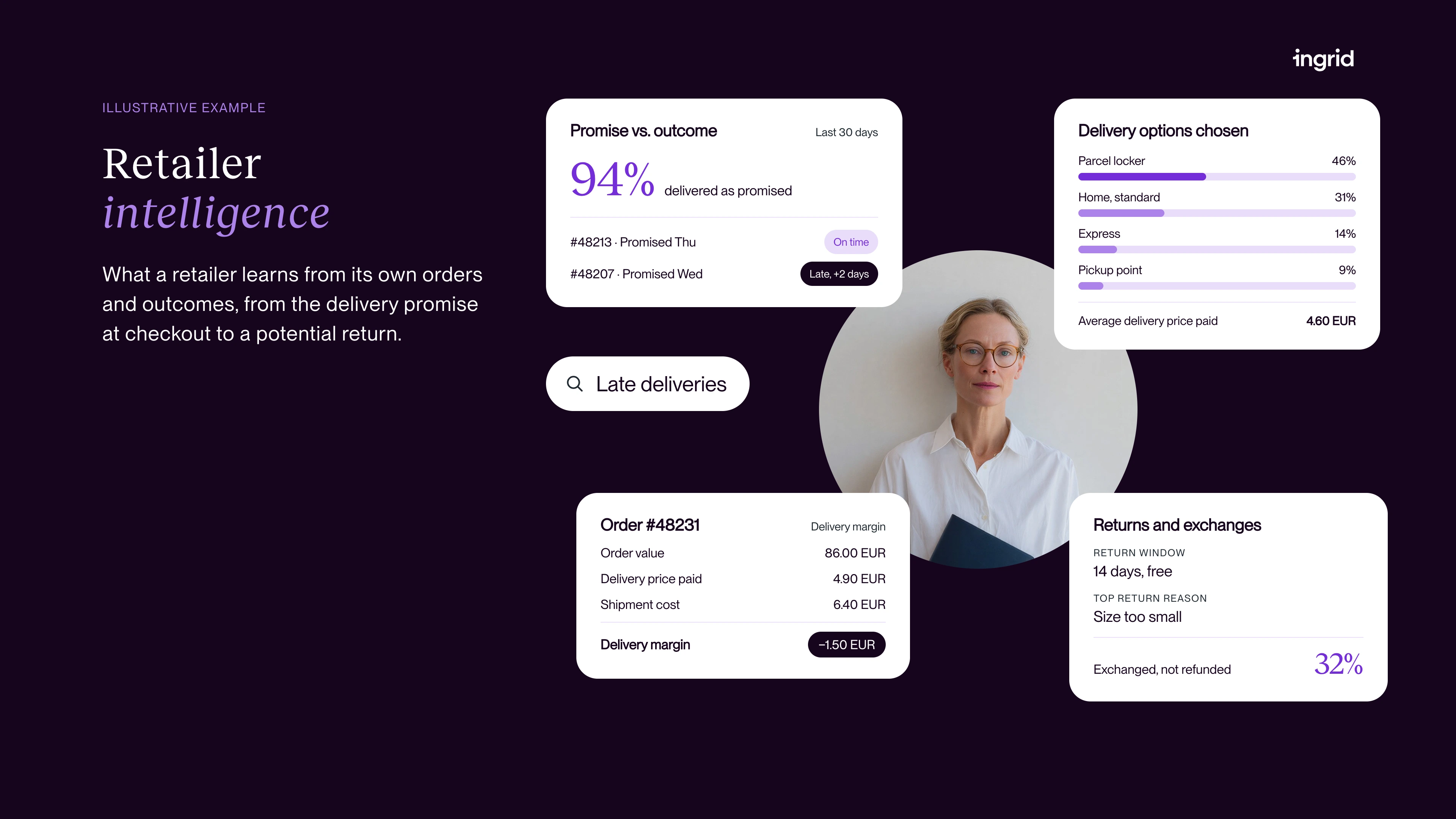
Retailer intelligence also holds the retailer’s own rules. Some protect delivery margin, like never offering free express delivery on an order that would lose money on shipment cost. Some come from carrier contracts, like sending bulky items only with the carrier that handles them.
“The biggest opportunity in AI for retailers is in day-to-day operations, where AI can reason about each situation and act across the whole flow. That's a shift rule-based software has never been able to make.”
— Piotr Zaleski, co-founder and Chief Product and Technology Officer, Ingrid
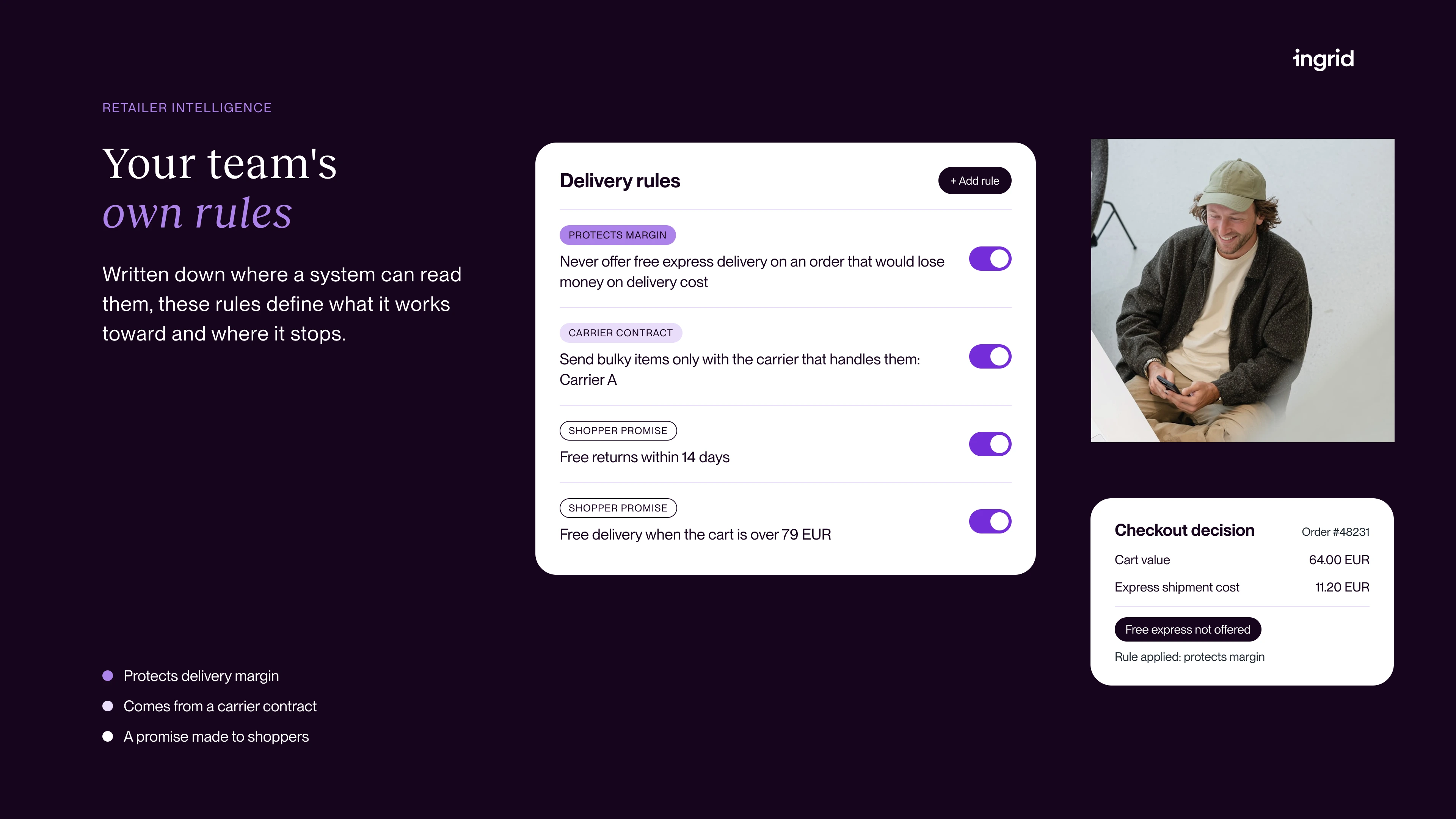
Others are promises made to shoppers, such as free returns within 14 days or free delivery over a set shopping cart value. Written down where a system can read them, these rules define what it works toward and where it stops.
Most retailers already collect much of this data intelligence, although it typically lives across fragmented e-commerce systems, to be reviewed after the fact. Connected through APIs, the same delivery data can reach CRM, customer service and loyalty systems.
With Ask Ingrid, retail teams can ask questions about their delivery operation and get answers drawn from live data.
What is carrier intelligence?
Carrier intelligence refers to what a retailer knows about real-time carrier cost and performance, measured per shipment, lane and season.
Rate cards and averages give a rough picture: the set price per parcel by service, weight or size band, as well as zone or destination, usually in the contract with the retailer.
They can't say, however, what a particular cart costs to ship to a particular address, or how a carrier performs on one route in December compared with the rest of the year.
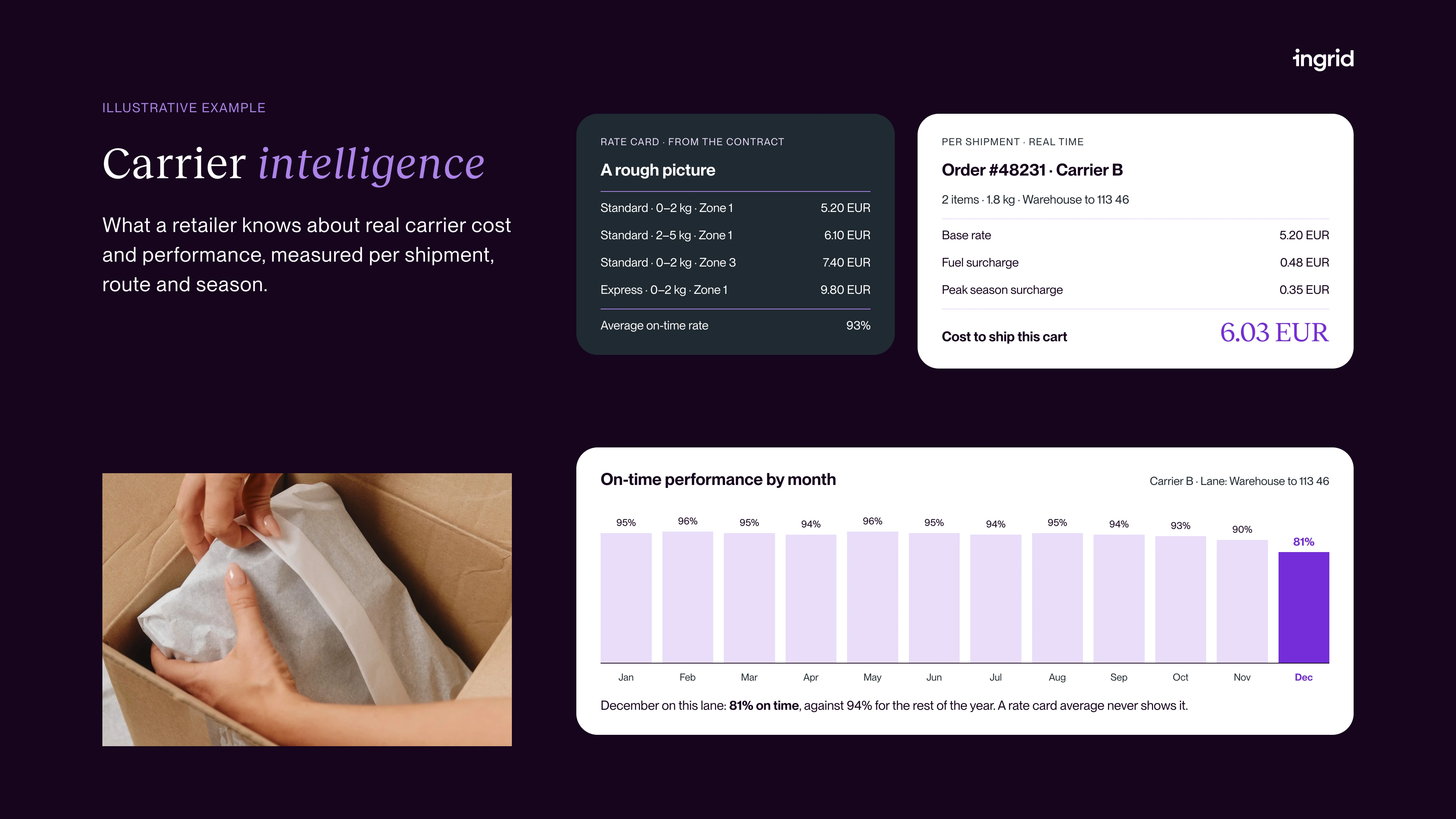
Promise accuracy ties it together. It's the record of what was promised against what happened, kept for every order, and it's what makes a delivery promise one that a shopper, or an agent acting for them, can rely on.
Shoppers notice when promises slip: 55% name inaccurate delivery times as their single biggest delivery frustration, according to Ingrid's research.
Ingrid's predictive delivery times already work this way. They predict a window for each order from warehouse fulfillment and carrier performance, and adjust on their own when either changes.
How do shopper, retailer, and carrier intelligence work together?
Each kind of intelligence answers part of the same decision, and only together do they answer all of it. Here’s how it works in a single checkout, for example.
When a shopper reaches checkout, the system decides which delivery options and pickup points to show, in what order and at what price. It picks the carrier, sets the promised date and carries tracking and returns terms through to the door.
Shopper intelligence indicates which options this shopper is likely to choose. Carrier intelligence shows what each option costs and whether its promise will hold, while retailer intelligence sets what to optimize for and which limits apply.
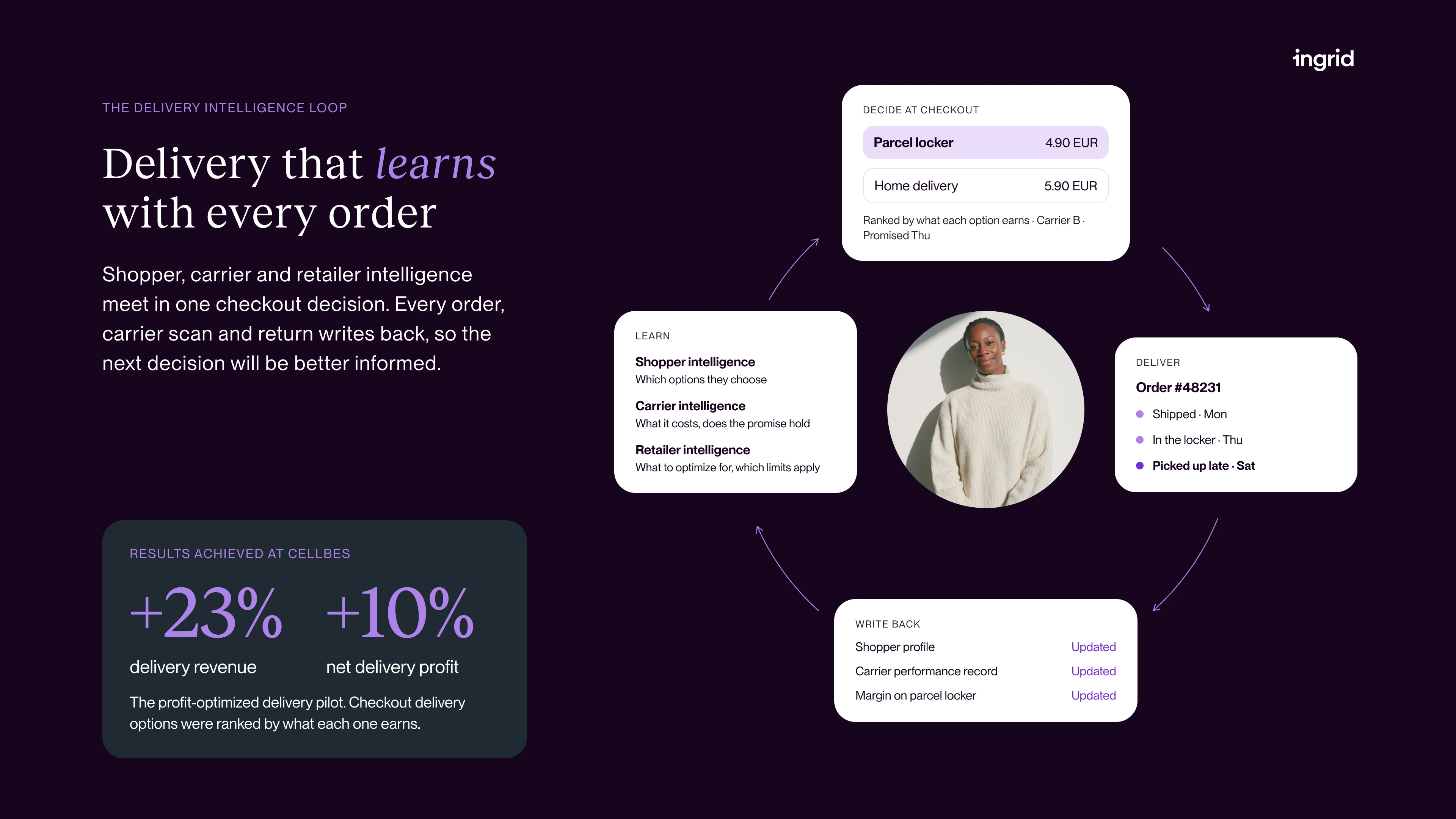
Remove one layer and the decision weakens. Without carrier intelligence, checkout can promise a date the carrier rarely meets. Without retailer intelligence, nothing tells the system that a popular option loses money on every order.
Weighing delivery revenue and delivery cost in the same decision is already live in Ingrid. The system’s profitability ranking arranges the delivery options in checkout by what each one earns, and that’s how Cellbes grew delivery revenue by 23% and net delivery profit by 10% in a profit-optimized delivery pilot.
Every order, scan and return then writes back. A parcel picked up late from a locker updates the shopper's profile and the carrier's performance record at the same time, and its final cost updates what the retailer knows about margin on that option. The next decision starts better informed. That's the delivery intelligence loop, and it's what separates a system that learns from a rule that repeats.
"Every order teaches the system something about the shopper, the carrier and the retailer's own operation. When all three meet in one decision, delivery learns on every order instead of repeating rules written months ago."
— Piotr Zaleski, co-founder and Chief Product and Technology Officer, Ingrid
Is your delivery data AI-ready?
As more shopping runs through AI agents, the quality of the data under a delivery promise becomes easier to see. An agent comparing retailers will weigh whether a promised date holds up, and shoppers already respond to the difference: 75% trust a brand more when its delivery estimates are backed by real-time data, according to Ingrid research in 2026.
The direction is a delivery operation that increasingly runs itself. The retailer sets the ambition and the boundaries, and the system makes the daily decisions inside them, with every decision logged. For how agents read and compare delivery today, see how AI agents rank delivery and our article on the Shopify MCPs and Claude commerce agents.
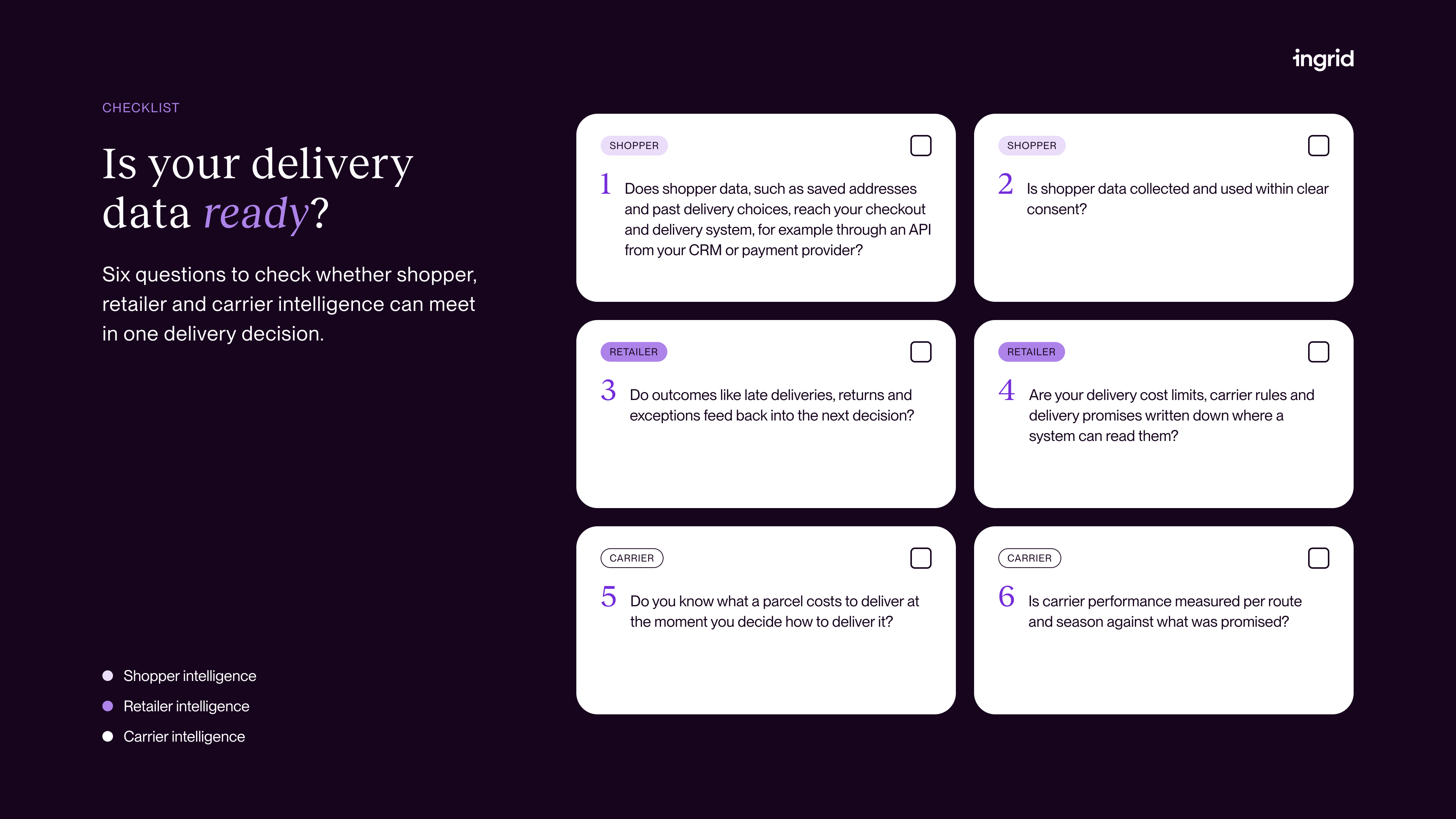
These questions cover the data itself, two for each kind of intelligence.
- Does shopper data, such as saved addresses and past delivery choices, reach your checkout and delivery system, for example through an API from your CRM or payment provider?
- Is shopper data collected and used within clear consent?
- Do outcomes like late deliveries, returns and exceptions feed back into the next decision?
- Are your delivery cost limits, carrier rules and delivery promises written down where a system can read them?
- Do you know what a parcel costs to deliver at the moment you decide how to deliver it?
- Is carrier performance measured per route and season against what was promised?
A "no" on any of these points to where the data isn't ready yet. That's a common starting point. At our October 2026 webinar, we asked attendees what an AI assistant would say today if a shopper asked when their products would arrive and what delivery costs.
About 1 in 5 (22%) expected the right answer with accurate dates and prices, and 39% expected something roughly right. Another 4% expected a wrong answer, 9% said AI wouldn't find the information at all and 26% had never checked.
Where do retailers stand today, and where does delivery go from here? Read Delivery in Agentic Commerce: 2027-2030
FAQs
What makes data AI-ready?
Data is AI-ready when it represents the decision it supports and is available at the moment that decision is made. For delivery, that means shopper, retailer, and carrier data connected in one system and current at checkout. Outcomes then feed back into it, so each decision improves on the last.
What is promise accuracy in delivery?
Promise accuracy measures how often a parcel arrives within the window promised at checkout. Tracked per order, carrier, lane and season, it shows which promises hold and which don't. It also gives a delivery system the evidence it needs to set promises that shoppers and AI agents can rely on.
What is the difference between shopper data and customer data in delivery?
Customer data usually lives in CRM and loyalty systems and describes a shopper's relationship with a brand. Shopper data in delivery is narrower: the addresses, delivery choices, timing and returns that show how someone prefers to receive orders. It's most useful when it reaches the checkout decision.
How is shopper data used in delivery decisions?
Shopper data shapes which delivery options and pickup points appear first, and the promise attached to them. It's used only within the consent it was collected under. That way, retailers can explain to their legal teams and their shoppers what's collected and why delivery decisions look the way they do.

FAQs
What does Ingrid Platform do?
Ingrid is the leading delivery intelligence platform that helps retailers turn delivery from a cost into a commercial advantage. Its modular platform connects retailers, carriers and shoppers across the whole shopping journey — discovery, checkout, tracking, transport, in-store and returns — so every delivery decision drives conversion, margin and loyalty on top of fulfillment and logistics.
How is Ingrid different from other delivery and shipping tools?
Most tools own a single touchpoint: logistics-led platforms stop at booking and labels, and post-purchase tools only start after the sale. Ingrid connects carrier choice to conversion and margin, with built-in A/B testing to prove what works. It gives retailers flexibility, choice and control instead of a fixed, one-size-fits-all setup.
Who is Ingrid for?
Ingrid is built for mid-market and enterprise e-commerce and omnichannel retailers shipping across multiple carriers, markets or delivery methods. Typically heads of e-commerce, logistics and operations leaders who want to turn delivery into a measurable revenue and margin lever. Retailers like Paul Smith, NA-KD, Apoteket, Nordic Nest and Mint Velvet use it to raise AOV, lift conversion, cut delivery-related support, implement direct exchanges, and increase delivery profitability.
Why does delivery intelligence matter?
Product and price used to decide the sale; now delivery does, too. Shoppers increasingly choose by delivery availability — same-day, next-day, pickup or in-store — while AI shopping agents rank retailers on delivery signals rather than branding. Ingrid helps retailers adapt with personalized delivery experience from checkout to returns. Back-end delivery intelligence contains cost and increases revenue, so delivery becomes a competitive advantage.
Related blog posts
AI-ready delivery data: shopper, retailer and carrier intelligence explained
What AI-ready delivery data is, and six questions to check where yours stands.

Shopify agentic commerce: Claude agents and delivery
We tested a Claude commerce agent on Shopify. Here’s what it saw about delivery.

Post-purchase journeys: turn delivery events into personalized messages
How delivery events can power personalized post-purchase journey that sell.