

Delivery in Agentic Commerce: 2027-2030
Retailers need to present delivery information that's clear, reliable and machine-readable from the first touchpoint.

AI agents compare retailers before a shopper sees your site, and they read your delivery data the same way they read your price. Retail's agent-readiness work has gone into product data, and the delivery setup underneath it has had far less attention. This report covers what changes when a machine reads your delivery offer, where European retailers stand today, and what agent-ready delivery looks like in practice.
Agent-readiness includes delivery operations
Most agent-readiness guidance in retail right now centers on product data: structured attributes, clean taxonomy, richer descriptions, feeds a model can parse without guessing. It’s a sound strategy, because a product an agent can't read is a product an agent won't recommend.
Delivery data sits one layer down, and it's had less attention so far. That data includes everything you state about getting the order to the shopper: which options are available to their address, whether the delivery method to the delivery point of their choice is available, what each one costs, when the parcel arrives, and how often that date holds.
When an AI agent compares two retailers for a shopper, it reads the delivery promise alongside the price. It reads it early, often before the shopper has even seen your site, and reads it as data. That's a harder test than a line of customer reassurance under the add to cart button, since a machine can't be reassured and can only compare the data you present. "Fast, reliable delivery" gives it nothing to compare.
That makes delivery the natural next step in agent-readiness. Agentic commerce has already entered the mainstream: across Europe, 61% of shoppers use AI for product discovery and comparison (McKinsey, 2026). Most delivery setups were built when the only reader was a person. Agent-ready delivery means delivery data a machine can read, compare and act on.

Why delivery needs to be redesigned
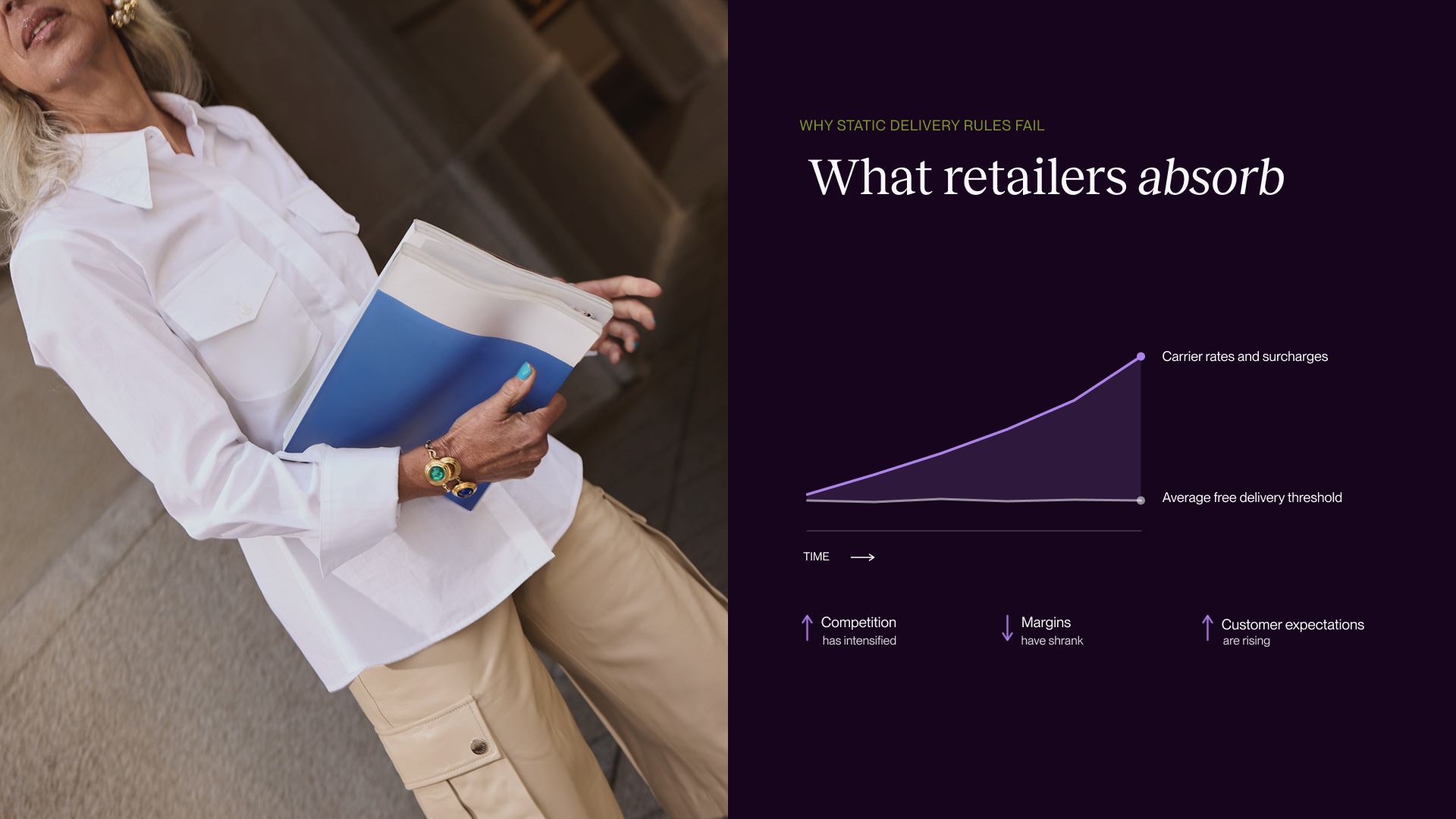
E-commerce and omnichannel retail delivery is being redesigned because the conditions it used to be configured for no longer hold. Carrier costs and shopper expectations have both moved a long way, and the rules governing delivery in most businesses haven't moved with them.
Static delivery rules don’t work
For a long time delivery came last in the sequence of retail operations. You developed and listed the products, set the prices, launched marketing campaigns, and then configured delivery to fulfill what had already been sold. That made sense while delivery was a cost to manage. It worked behind the scenes, and when it failed it would be something to fix rather than a strategy to reconsider.
Then several things shifted at once. Carrier rates and surcharges kept rising, while the free delivery threshold on most sites was set years ago and hasn't been revisited since. A single promised delivery date across a whole catalog forces a choice between promising short to protect conversion and promising long to protect trust.
Adding a carrier or opening a new market still takes months in most delivery setups, so complexity grows faster than the team managing it. On top of that, every order adds more customer support volume through WISMO questions, exceptions, returns, exchanges and the occasional parcel that simply doesn't arrive.
How delivery affects conversion
Delivery shapes conversion at the level of individual settings, like ordering your delivery options and introducing pre-selected ones, for example. Data from Ingrid shows that 68% of orders go out on whatever option you pre-selected, so the default is doing most of the deciding.
Given a real choice, 53% of shoppers would wait an extra day for the carrier they prefer. Another 56% would choose another brand and product if AI cannot clearly state delivery info, and 55% name inaccurate delivery dates as their single biggest frustration.
Delivery offer’s impact reaches past conversion. It shapes margins and whether a shopper comes back, through choices nobody flags at the time: a free delivery threshold set once and left alone, or one conservative delivery date applied across every delivery option.
Both might have been reasonable calls when they were made, but neither was set to withstand the test of thousands of checkout visits paid by thousands of shoppers, resulting in thousands of orders, returns, exchanges and relationships built or faded.
Why delivery automation isn’t enough
Most delivery today runs on automation: a rule that executes the same step every time, whatever the order looks like. Orders over €50 ship free; orders to this postcode get three to five days. The rule fires correctly every time, and it fires identically for a first-time shopper buying one low-margin item and a repeat customer with a full cart.
That was the right build for the tools available, and it works for humans making shopping decisions, more or less. Shoppers fill in the gaps and they know three to five days probably means Thursday, and they might forgive a vague delivery promise from a retailer they trust. AI agents don't fill in gaps at all. They compare what you've stated against what the competitor beside you has stated, and vague delivery information loses.
How AI agents read delivery
Agentic commerce means shopping where an AI tool does part of the work on the shopper's behalf, from researching the options to placing the order. It’s arriving in waves. The first wave is AI-mediated discovery and evaluation, and it's already the mainstream. Shoppers describe what they want, after which AI agents narrow the field and create a shortlist. Delivery sits inside that comparison, which is why this wave matters the most right now.
In the emerging second wave, AI tools are moving onto retailers' own sites and into the journey itself, and McKinsey puts usage at around 15% of shoppers. An agent working inside your checkout reads your delivery options directly, so this is the one to watch. Agents buying on their own is the third wave, and it's still small, between 1% to 3%, the one you can plan around soon.
How delivery decides the sale
Checkout has been the wrong place to introduce delivery for a while now, and plenty of retailers have already started presenting it earlier in the shopping journey. Delivery costs in the product feed, delivery options and estimated dates on the product page, a progress bar in the cart showing how far it is from free delivery. These surfaces put delivery information in front of shoppers while they're still browsing and coming to a buying decision.
Agentic commerce adds a layer of delivery data a person never sees. An AI agent builds its shortlist before anyone visits your site, working from whatever it can reach: your product feed, comparison surfaces, and APIs it can query directly. A shopper who can't find a delivery date will click through to checkout to see it. An AI agent won't. Introducing delivery information earlier was already worth doing for shoppers, and it's the same move that now makes you readable to agents.
What an AI agent needs to read
Moving delivery information isn't enough on its own, because the substance has to change, too. Retail teams write delivery copy to reassure a person: fast, reliable, free over €50, delivered in three to five days, sometimes seasonal heads-up about possible delays. An agent can't do anything with it, since none of those are values it can set beside your competitor.
Here’s an example. A shopper reads: free delivery over €50, arrives in three to five days. An agent needs something closer to: standard delivery, €4.90, arriving Thursday, September 24; pickup point, free, arriving Wednesday, September 23; home delivery before noon, €9.90, arriving Thursday, September 24. Same offer, stated as values that can sit next to a competitor's.
Most of that already exists somewhere in your business. Your carrier contracts hold the services and the rates, your warehouse knows its cutoff times, and your order history knows what actually happens. Now, it’s mostly about consolidation: getting this information into one place, then exposing it where an agent can reach it.
An agent reads those values in order, and each step can end the comparison before the next one starts. Can you deliver to this shopper at all? That's a yes or no, and nothing else gets read until it's yes. Then the available choices: home delivery, a pickup point, a parcel locker, in-store pickup, and the speed tiers under each. Then what each costs and when it arrives. Finally, your on-time record against that date.

What agentic operations mean for delivery
Agentic operations mean software that decides what to do on each order rather than executing the same rule across all of them. The shopper-facing version of this are the AI agents comparing retailers on someone's behalf. The operational version is the same kind of software working inside your retail business that helps you, say, choose the carrier, set the delivery promise and handle a possible exception when a parcel misses its window.
From executing rules to making decisions
Retail tech software has moved along a common arc. First it analyzed, then it recommended, then it started deciding and, in places, it now acts. Most commercial functions are somewhere in the middle of that arc. Pricing has had algorithmic support for years, and merchandising has AI recommendation engines. Most commercial functions have moved some distance along that path. Delivery touches every order, and it has moved the least.
Take one order. Under a rule, a €60 basket going to Malmö gets free standard delivery and a three-to-five-day window, whatever else is true about it. Under a decision, the same order gets looked at individually: this shopper has chosen a pickup point twice before, your usual carrier is running two days late into that postcode this week, and it’s a low-margin cart value. So, the software offers the pickup point first, at a small discount, with a precise delivery date.
Delivery ownership comes before autonomy
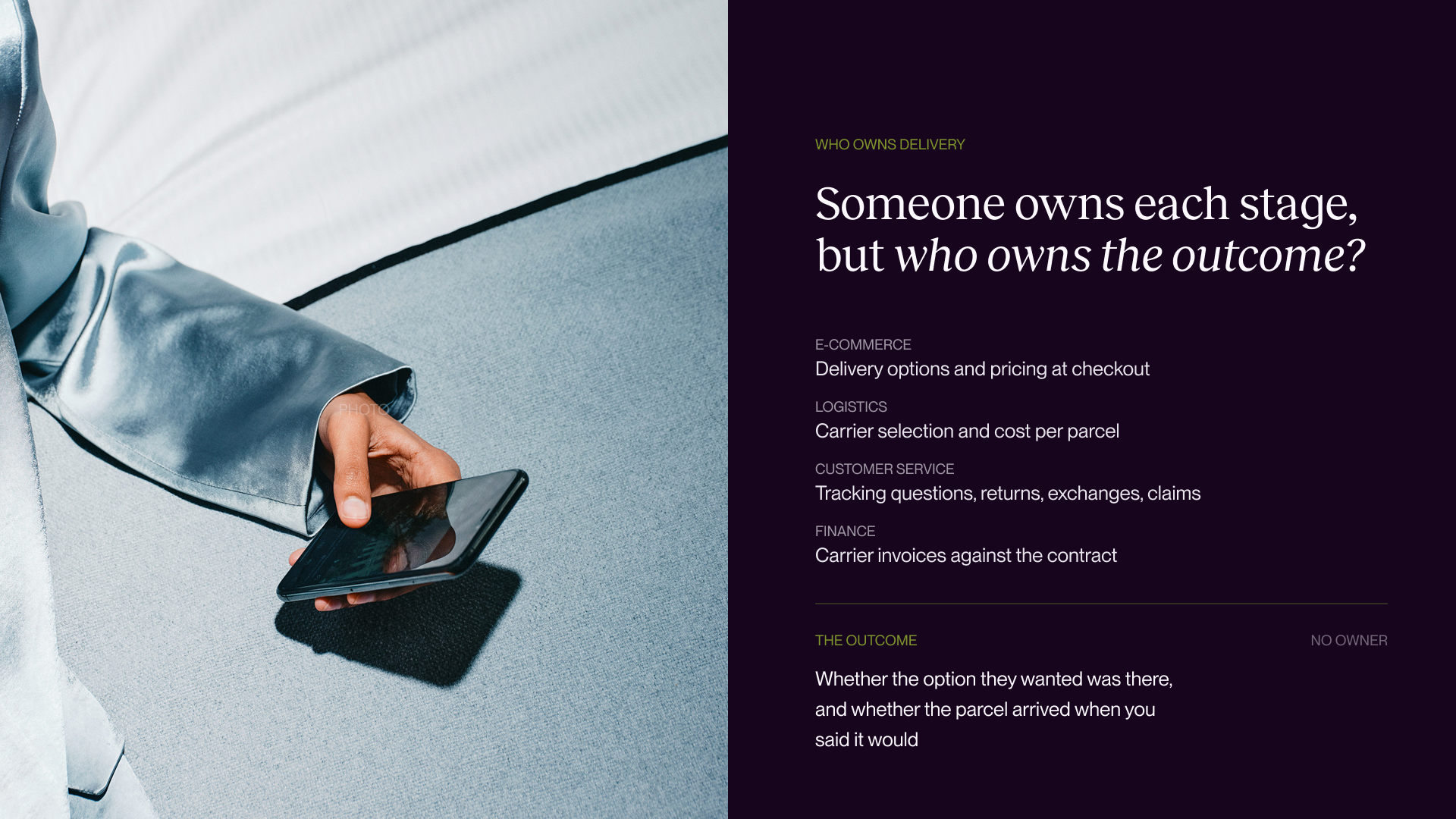
Delivery is split by stage, and each stage belongs to a different retail team. E-commerce owns the options and the pricing at checkout, because those move conversion. Logistics owns carrier selection and the cost per parcel. Customer service owns the tracking questions and the returns. Finance sees carrier invoices, if anyone checks them against the contract at all.
Each team optimizes its own stage honestly and well. What nobody owns is the outcome, which is the only part the shopper experiences: whether the option they wanted was there, and whether the parcel arrived when you said it would.
McKinsey and EuroCommerce put the prize from end-to-end AI transformation across European retail at €240 to €320 billion over five years. Very little of that investment has reached delivery, partly because there's no single person whose budget it is.
Someone has to own the outcome across all four functions, because autonomy applied to split delivery operations just automates the split. The organizational answer and the technical one point the same way: one owner, and one system that can see the whole order.
From manual rules to agentic delivery operations
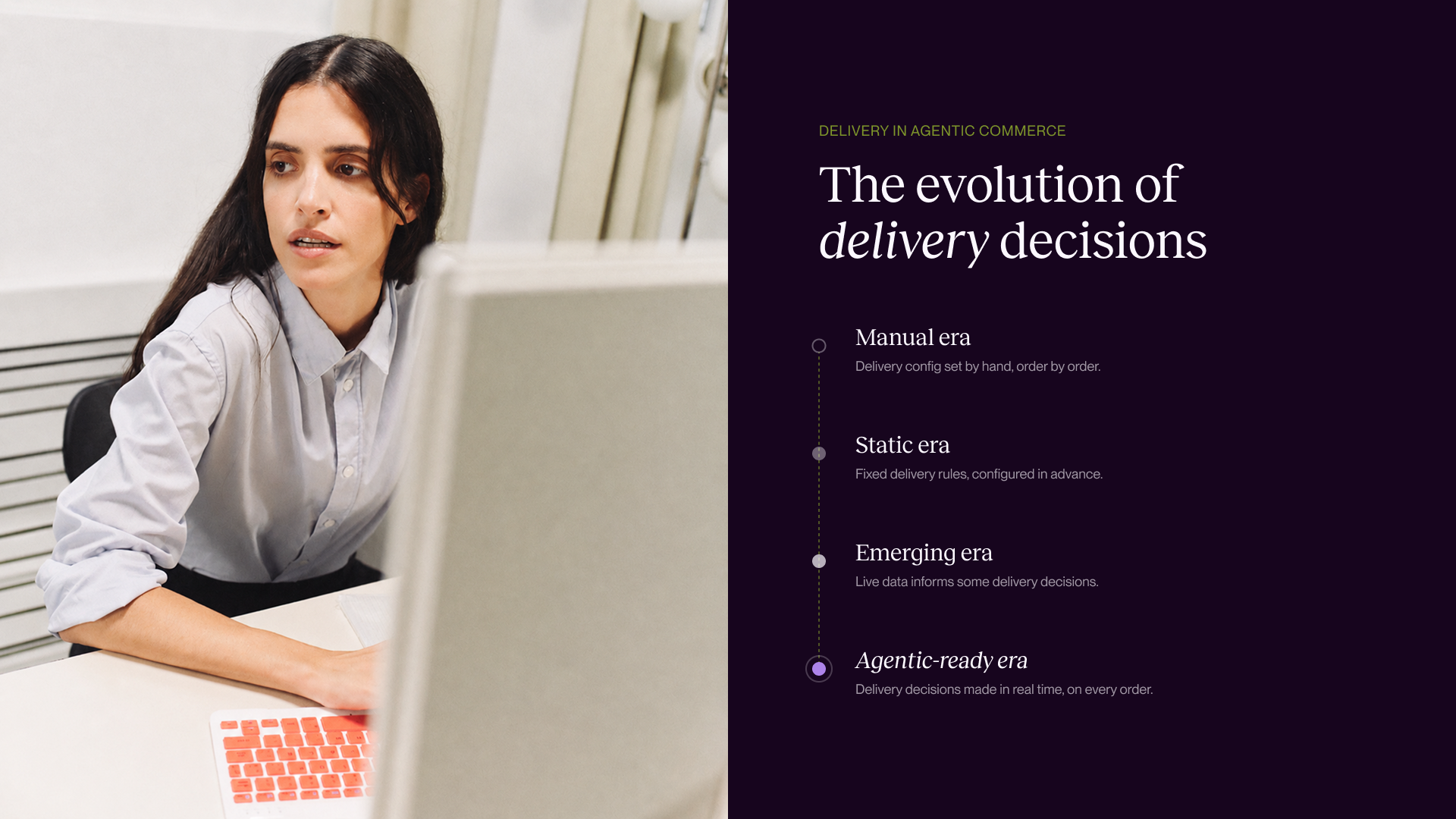
Delivery operations land in one of four eras, the first being the manual era. Delivery operations ran on people. Carrier rates lived in spreadsheets, delivery options were hard-coded into the checkout, and changing anything meant a developer ticket or a phone call. It worked at low volume but stopped working in a multi-carrier, multi-market, multi-brand setting.
In the static era, the rules are written down and they run fairly reliably. Every shopper sees the same options, the free delivery threshold stays the same based on guesswork, and the promised date comes from a fixed window, sometimes with a buffer, rather than from what's actually happening in the operation. That’s where most European retailers are today, depending on the market.
Emerging operations have started making delivery decisions from live data. Delivery dates come from real warehouse cutoffs and real carrier performance instead of a standard three-to-five-day window. Delivery options get A/B tested against conversion rather than assumed or decided for the shopper. Fragmented tech stack systems and delivery functions have started to share data and communicate.
Enter agentic-ready operations. They hold delivery data in one place, expose it where machines can read it, and let the system choose per order inside limits the retailer sets. What happened in the last order informs the next one. Very few retail companies are in the fourth stage today, and the practical gain comes from moving one stage rather than planning for the last one.
What agent-ready delivery looks like
Agent-ready delivery means your delivery data lives in one place, reads correctly to both people and machines, and drives decisions made per order inside the limits your team sets. Getting there takes a change underneath the tools rather than another tool.
What has to change underneath
Most delivery stacks were assembled one problem at a time. A checkout widget for delivery options, a carrier management system for labels, a tracking page for the post-purchase experience, a spreadsheet for invoice checks. Each one works on its own, and none of them sees the whole order, so every decision gets made without the context the others hold.
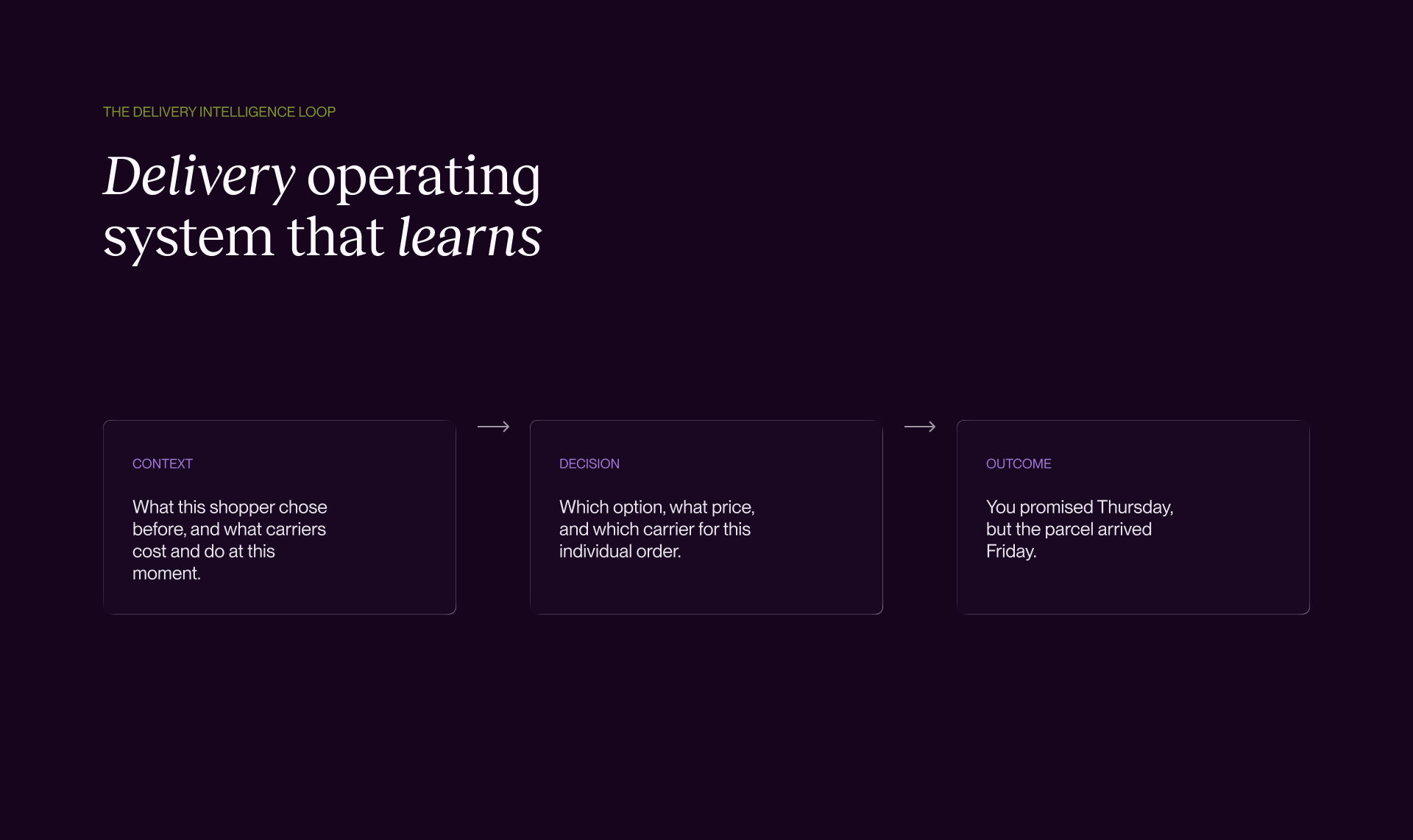
Three things have to connect underneath. First, the context behind every decision: what this shopper has chosen before, what your own orders and outcomes show, and what carriers actually cost and do in that postcode in a given week.
Second, something that turns that context into a decision and then carries it out: which options to show and at what price, which carrier gets the parcel, and what happens when a cutoff is missed or a shipment stalls.
Third, the surfaces where delivery gets read: checkout and tracking for shoppers, dashboards for your team, and wherever agents come looking. Surfaces are the part most delivery stacks don’t handle successfully. Delivery capability usually arrives as one bundled integration built around a checkout page, so anything that isn't a shopper in a browser has to work around it.
The agent-ready shape is API-first. Delivery gets split into separate APIs, each answering one question and each callable on its own: what can we offer this shopper and when, who is this shopper and where are they, where is the order now, how does it get booked and moved, how does it get returned.
An agent asks and gets a real answer back. So do your own systems and those of your partners, in values rather than page copy. Checkout isn't the only entry point for delivery logic anymore, and the page the shopper sees runs on the same APIs as everything else.
The delivery intelligence loop
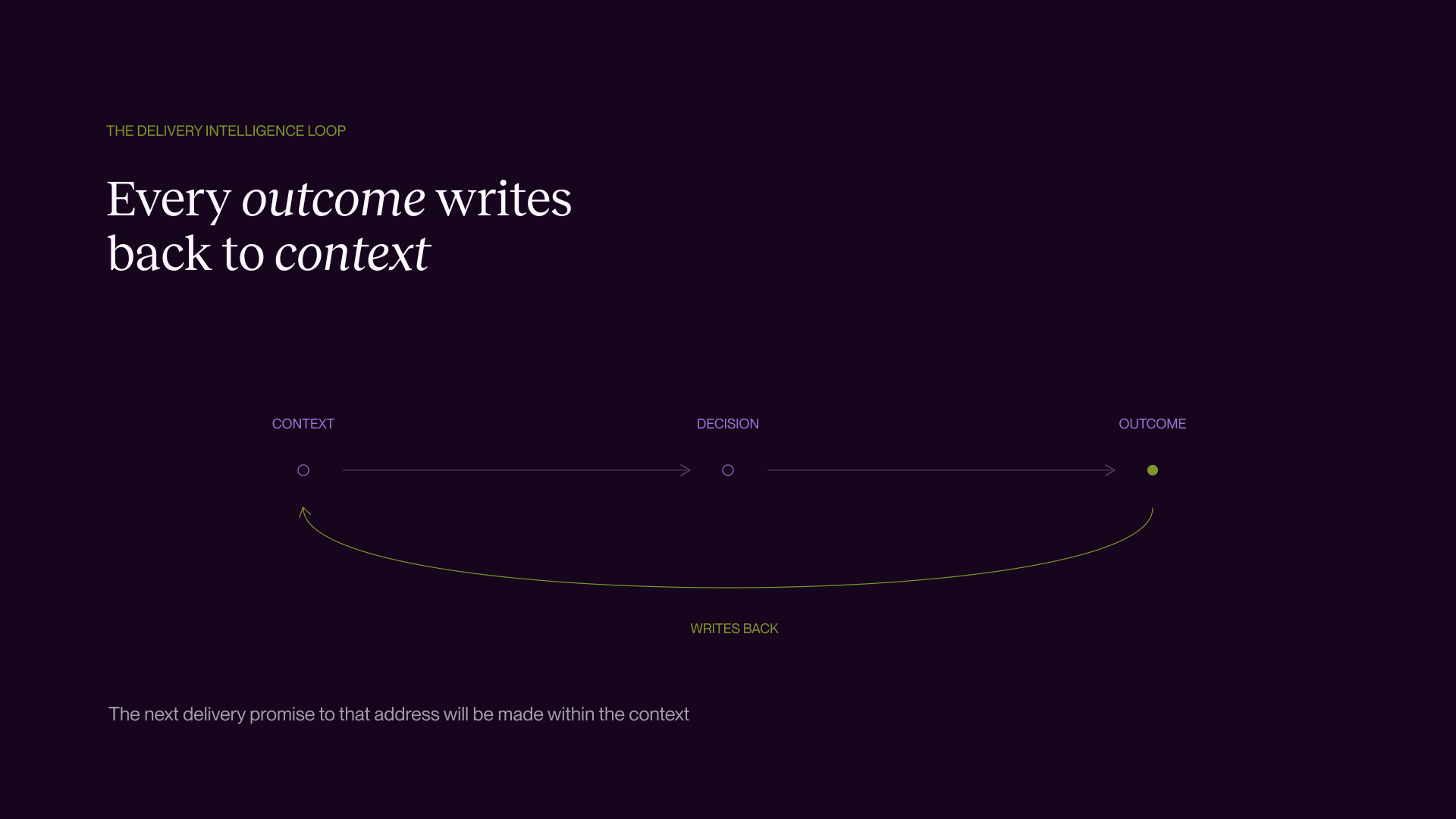
Context, decisions and surfaces compound. Every delivery decision reads the context, and every outcome adds to it. You promise Thursday, the parcel arrives Friday, and that becomes something the system knows about that carrier, that postcode and that week of the year. The next promise to that address is made with it.
Run that for a year and the context stops being a description of how you set things up and becomes a record of what really happens. Åhléns cut late deliveries by 12% after replacing fixed delivery windows with precise, accurate dates predicted from its own operation.
That's the difference between a system that learns and a rule that repeats. Put together, they can act as an operating system for delivery: one place where the context lives, one layer that decides, and the surfaces that expose both.
One layer for people and machines
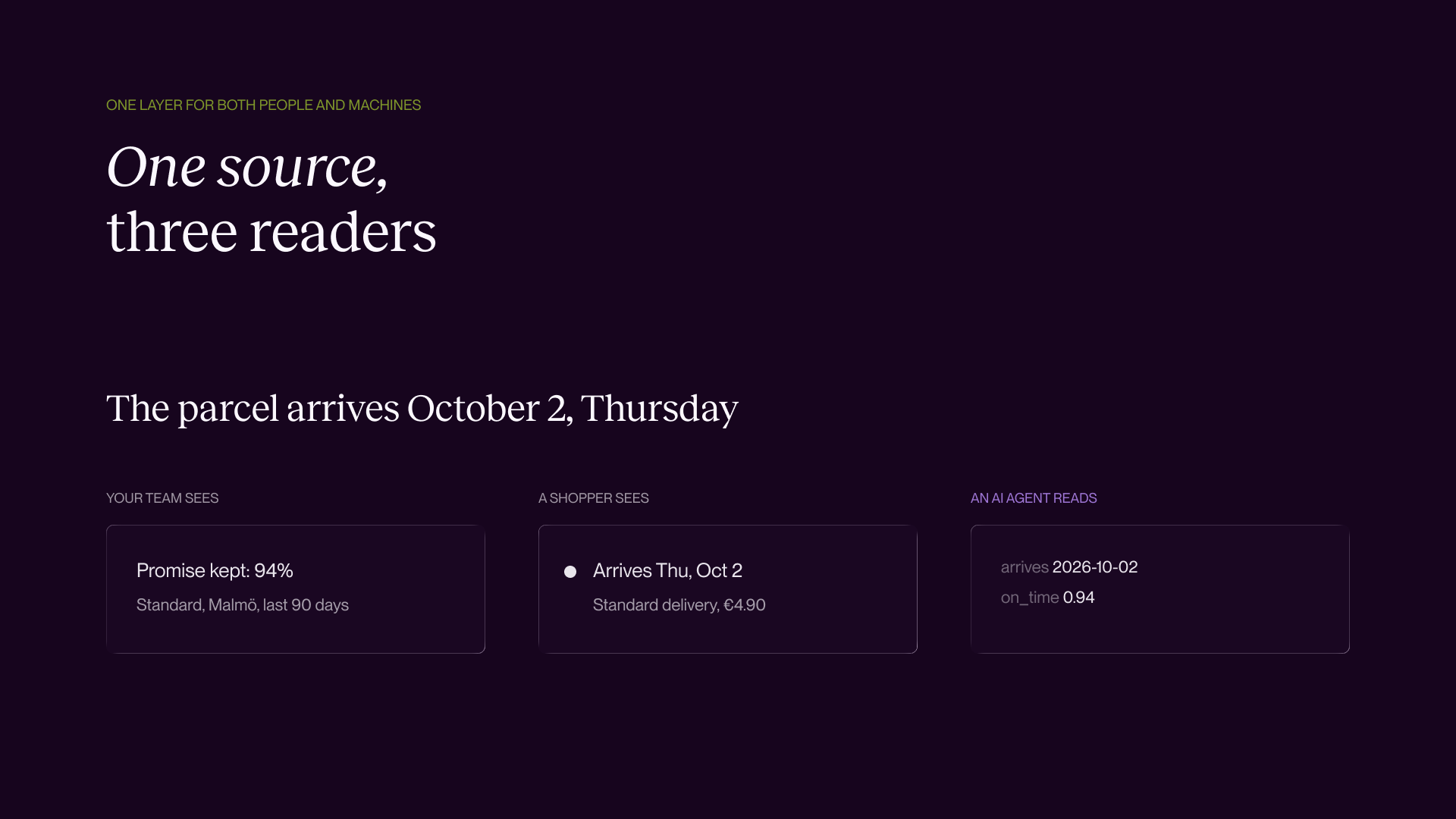
The same facts have to serve three audiences that read very differently. Your team needs to understand and configure the delivery operations. Shoppers need to choose a delivery option, follow a parcel on its track and, possibly, start a return. AI agents need those same facts in a form they can query.
When all three come from one source, the date an agent reads is the date the shopper sees and the date your brand’s delivery performance gets measured on. When they come from three systems, they disagree, and that disagreement is what a shopper experiences as a broken promise, retail teams as a fragmented delivery strategy and AI agents as a lack of readable data.
Autonomy inside limits you set
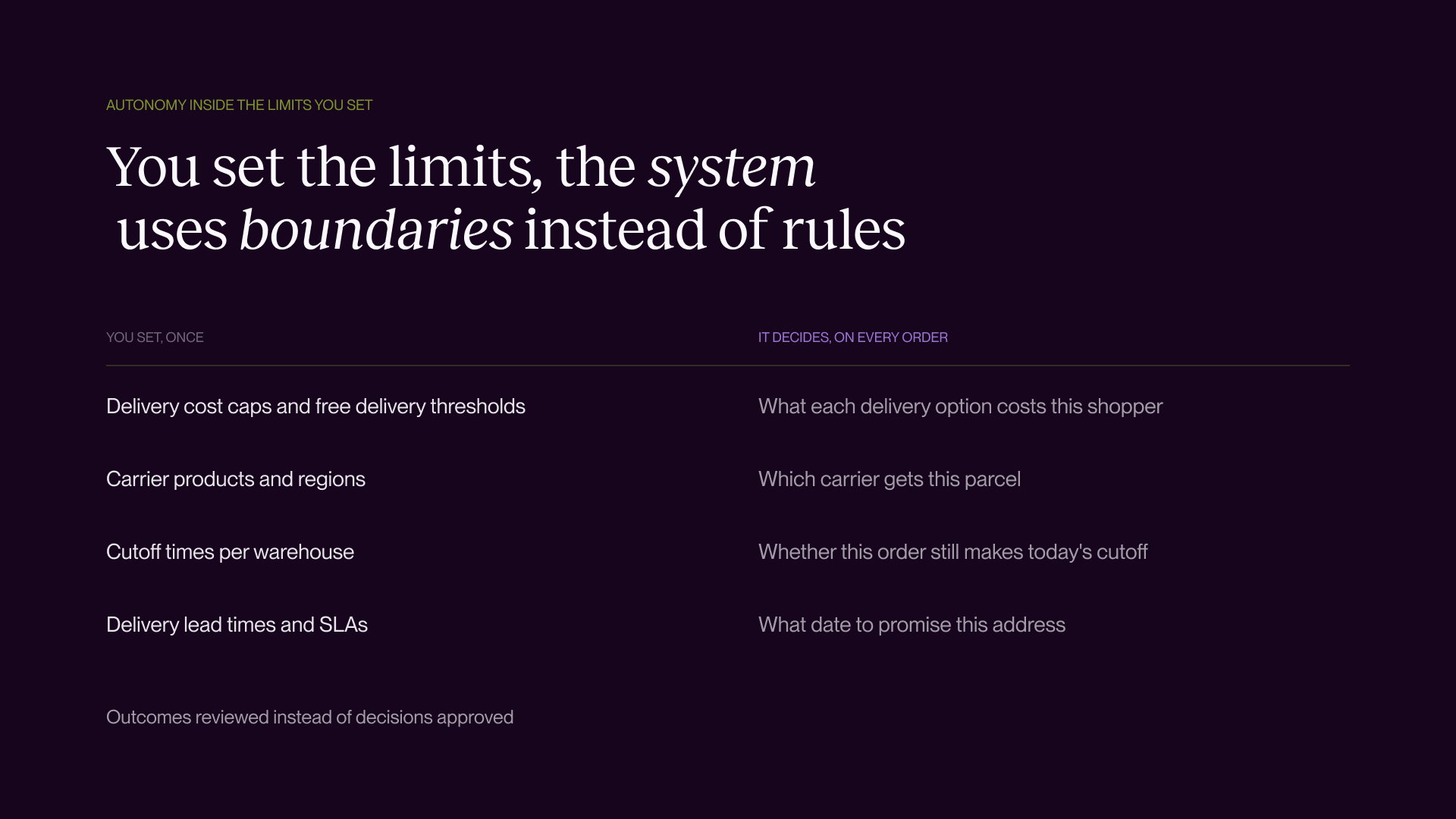
The system decides inside limits you set in advance: the floor on margin, the rules about which carriers can be used where, and the promises your brand won't break. The operating system decides inside those limits, on every order, and logs what it decided and why.
You're setting boundaries instead of writing rules, and reviewing outcomes instead of approving decisions. That's how most teams in the industry already manage a recommendation engine.
None of this arrives at once. Today, the useful version is intelligence that improves the decisions you already make. Next, specialized agents coordinate decisions across the stages that currently belong to different teams. Later, the operation adapts as conditions change without waiting for someone to notice.
Cellbes did this with delivery pricing. Instead of one free delivery threshold applied to every order, each order’s delivery got priced on its own, inside a minimum it still had to earn. Delivery revenue rose 23%, because the price could move per order, and delivery net profit rose 10%, because the limit stopped the price moving too far.
Where delivery goes next in 2027-2030
Piotr Zaleski, co-founder and CPTO at Ingrid, sets out three predictions for the next few years, and the shift underneath that makes them possible.
AI agents will be retail's decision-makers
As discussed in this article, an AI agent doesn't experience your brand the way a person does, and it won't give you the benefit of the doubt. It reads the product, price, delivery and returns data it can find, judges whether the promise looks credible and decides whether to shortlist you or leave you out.
Already by 2027, whether an agent can understand and act on your complete offer becomes a retail readiness question rather than a delivery technology question.
The delivery promise becomes personal
Most retailers show every shopper the same options and the same return terms. That was a configuration choice made once, because running the calculation per shopper wasn't possible. It is now, using what this shopper values, what they're buying, and what each option costs you and earns you.
The same applies past checkout. Return windows, fees and exchange offers can adapt to the shopper, the product and the risk on that order, provided the terms stay transparent and explainable.
Within the next couple of years, showing every shopper the same delivery options and return terms will look as dated as showing every shopper the same homepage.
Padded delivery windows stop working
Delivery estimates that say three-five business days protect the retailer more than the shopper. It's a buffer, but agents don’t read it the way shoppers do. They compare the promise against what actually arrives, which makes padding visible, and the retailer with the safest window stops being the one that wins.
Delivery windows get precise, evidence-based and continuously revised. Accuracy becomes a trust signal, and vague windows get penalized by shoppers and agents alike.
The second prediction is about personalization and relevance: the right promise for this shopper and this order. The third is about precision and credibility: whether you can keep that promise.
Behind all three: software that asks
Traditional software waits for you to encode the answer as a rule. Agentic software can notice what it doesn't know and ask for it. Is this order optimized for margin, conversion or loyalty? When can I upgrade the service? Which decisions need your approval?
You stay in the loop, and the nature of the loop changes. You set strategy and guardrails, resolve ambiguous cases and remain accountable. The system carries that intent into thousands of decisions and comes back to you when the evidence or the authority runs out. That's what makes the predictions possible without someone configuring every scenario.
What to consider now
None of this needs an immediate transformation project, because the first moves are small, and one of them takes as little as half an hour.
1. Start with what an agent can see today
Open a shopping assistant and ask it where to buy something you sell. Then ask when the parcel would arrive. Whatever comes back is roughly what an agent works with when it puts you next to the retailer beside you.
Teams tend to find one of three things. It quotes a delivery line from a feed that hasn't been touched in two years. Alternatively, it quotes nothing, or it quotes a competitor. This doesn’t take much time but tells you enough.
2. Get the delivery data into one place
The information an agent needs already exists in your business. Carrier contracts hold the services and the rates, your warehouse knows its cutoff times, and your order history knows what actually happened against what you promised.
That data spans multiple e-commerce and logistics systems that don't talk to each other. Every next step hinges on consolidating your delivery tech stack: a delivery decision made per order needs an all-encompassing view of that order, and so does an API an agent can query.
3. Decide the limits before the autonomy
Before anything decides on your behalf, write down what it can't do. Think about the lowest delivery margin you would deliver at, which carrier products are allowed in which regions, or the delivery dates you won't commit to, even when the numbers say you'd make it. Teams that skip this end up approving decisions one at a time, which is the work retail organizations would love to get off their desks. The limits are what let you stop approving delivery decisions and focus instead on delivery outcomes.
4. Give the delivery outcome an owner
Four teams touch delivery, and each optimizes its own stage well. The part nobody holds is the outcome, which is the only part the shopper experiences: whether the option they wanted was there, and whether the parcel arrived when you said it would. That doesn't call for a new department, just a name against a number, and a number that runs across all four stages rather than sitting inside one of them.
This holds whichever way AI goes
None of this is settled. It’s the early stage of agentic commerce, and the standards for how agents reach retail data are still being written. Even retailers who look ready today are working from the same incomplete picture as everyone else. That's the case for getting your delivery data into one place before anything else. This strategic move holds no matter which way agentic retail standards land.
About Ingrid
Delivery is the last untapped commercial lever in retail. Yet many retailers still run it as a patchwork of systems and static rules stitched together for a different era. Ingrid Agentic DeliveryOS is the operating system for agentic-ready retail delivery. It brings shopper, retailer and carrier intelligence together so every decision is made with full context: which options each shopper sees, what's promised, how it's priced, and how orders are tracked, returned and exchanged. More than 250 retailers, including Paul Smith, Nelly.com, Nordic Nest, Åhléns, Gant, ME+EM and NA-KD, use Ingrid across 170+ markets and 350+ carrier integrations.
Want to explore what DeliveryOS means for your business? Book a demo →
FAQ
Can AI agents access delivery data directly?
They can when it's exposed through an API. Agents build their shortlists before a shopper reaches the site, working from the product feed, comparison surfaces and whatever they can query. Delivery data that exists only inside a checkout page is data an agent has to work around.
What does API-first delivery mean?
API-first delivery means each part of the delivery setup can be queried on its own, instead of being reachable only through a checkout page. An agent, a retailer's own systems or a partner's can ask what options are available, what they cost, when the parcel arrives and where the order is now, and get values back rather than page copy.
What is agent-ready delivery?
Agent-ready delivery means delivery data a machine can read, compare and act on. That covers which options are available to a given address, what each one costs, when the parcel arrives and how often that date holds. The practical test is whether an AI agent can set your delivery offer beside another retailer's without a person interpreting it first.
What delivery data do AI agents read?
An agent reads delivery values in order, and each step can end the comparison before the next one starts. First, whether you can deliver to this address at all. Then the available choices, such as home delivery, a pickup point, a parcel locker or in-store pickup. Then what each one costs and when it arrives. Last, your on-time record against that date.
Can AI agents read delivery options at checkout?
Not during the comparison. An agent building a shortlist works off-site, from product feeds and APIs, and never reaches a checkout page. Agents working inside a retailer's own site can read it, but by then the retailer has already been shortlisted or passed over.
How much does delivery affect conversion?
Delivery shapes conversion at the level of individual settings. Ingrid's data shows that 68% of orders go out on whatever option the retailer pre-selected, 53% of shoppers would wait an extra day to get their preferred carrier, and 55% name inaccurate delivery dates as their single biggest frustration.
What is the difference between delivery automation and delivery autonomy?
Automation runs the same rule every time, whatever the order looks like. Autonomy decides what the step should be for that particular order, inside limits the retailer sets in advance, then carries it out. Most delivery today is automation: orders over €50 ship free, orders to this postcode get three to five days.
Where do retailers start with agent-ready delivery?
With what an agent can see today. Ask a shopping assistant where to buy something you sell and when it would arrive, and whatever comes back is roughly what an agent works with. After that it's consolidation, because the data an agent needs already sits across carrier contracts, warehouse cutoff times and order history rather than in one place.


Related blog posts

Agentic DeliveryOS: Delivery ready for AI agents
The operating system for agentic-ready retail delivery that brings shopper, retailer and carrier intelligence together so every decision is made with full context.

A 20% better delivery experience is worth 5-10% more sales
Delivery drives 29-42% of satisfaction with a brand. What's it worth in sales?

Delivery, the most overlooked growth lever in e-commerce
Why delivery decides trust, conversion and repeat purchase, especially in agentic shopping.