

Delivery, the most overlooked growth lever in e-commerce

Anastasiia Starchenko

The FODcast conversation with André Sikborn Erixon, VP of Growth at Ingrid, on why delivery decides trust, conversion and repeat purchase, and why that matters more as AI enters the buying journey. Useful for Heads of E-commerce, COOs, and CTOs at mid-to-large European retailers, and the CMOs and CFOs they build the case with.
Delivery is a customer-experience and margin decision that runs across the whole journey, not a back-office logistics cost. Retailers who match priced delivery choice to shopper preference convert more, retain more, and earn shipping revenue, and delivery accuracy is fast becoming the qualifier for being recommended by AI shopping agents.
Delivery has quietly become one of the most powerful and most misunderstood parts of modern commerce. Something that was viewed before as simply moving a parcel from A to B, today it shapes whether a shopper trusts a retailer, whether they convert, and whether they come back.
That was the starting point when The FODcast host James sat down with André Sikborn Erixon, VP of Growth at Ingrid. André has spent nine years at H&M Group and the last seven at Ingrid, working between the product and the retailers who use it.
His argument is straightforward, albeit uncomfortable for most retail teams: delivery is still filed under logistics and treated as a cost, when it’s really a customer decision that runs through the entire journey and lands directly on the bottom line.
What is delivery experience in e-commerce?
Ask most teams to define delivery experience and they will describe the moment the parcel arrives. André defines it far more broadly.
"We define delivery experience as all the aspects of the customer journey where delivery matters."
That includes the decision of where and when to buy, the promise shown at checkout, the tracking updates along the way, and the returns process at the end. Delivery experience runs through the whole purchase, surfacing at every stage where a shopper thinks about how their order will arrive.
This is why it gets messy. When delivery touches every stage, it cannot be owned by one team at the very end. It also explains why a bad delivery is so easy to recognize. Everyone has had one. The tangible memory of a delivery going wrong is, in André's view, the clearest proof that this sits inside customer experience rather than beside it.
Why do retailers still treat delivery as logistics?
If delivery is a customer decision, why do so many retailers still manage it as a back-office cost? André's answer is organizational. Delivery lands with the logistics team, gets measured as a shipping cost, and the consequences surface somewhere else entirely. Usually in the customer support queue.
By his account, around half of all customer contacts are still delivery-related: where is my order (WISMO), why is it late, where do I return this. A support team can field those questions, but it cannot fix the root cause, because the tools to shape delivery sit upstream and out of reach.
The deeper problem is how retailers treat their carrier setup. Many act as though the carriers at their checkout were never really a choice.
"A lot of retailers treat it as affiliation by non-choice, as if it wasn't an active decision on their end."
The line André hears most is "our 3PL only supports these carriers, so what can we do?" Few teams would leave pricing or merchandising on autopilot in the same way, and delivery deserves the same active attention. The encouraging part is that the tools to give it that attention already exist.
Breaking out of that constraint is the subject of Ingrid's guide to choosing a multi-carrier delivery platform.
What do shoppers want from delivery beyond speed and price?
The default assumption in e-commerce is that shoppers want delivery fast and cheap, so retailers compete on those two variables and little else.
"They think that price and speed are the only two variables that matter."
The data from Ingrid Platform tells a different story. Between 20% and 30% of shoppers choose an option that is neither the fastest nor the cheapest, provided the retailer offers a real choice in the first place.
They are selecting for something else: a locker on the way home, a pickup point near the office, a lower-carbon option, or simply a day that suits them. The word André keeps returning to is context.
"It has to fit your life. And that's context. It's all about context."
His clearest example is a home renovation. If the work starts next Friday, same-day delivery of the materials isn’t a benefit. There’s nowhere to put them, and the shopper would rather they arrive the day before the carpenter does. ‘Fast’ is only valuable when the context calls for it. The same shopper who needs something urgently on Tuesday may want it held for the following week on Thursday.
Why shoppers choose lockers and pickup points
Context also explains the growth of lockers and pickup points, which are maturing quickly in the UK and are already well established in the Nordics. André notes a pattern that surprises many retailers: some younger shoppers, even in the UK, actively prefer out-of-home (OOH) delivery over having a parcel brought to their door. The reason doesn’t really matter. What matters is that the preference is visible in the data, and that a retailer offering only home delivery cannot serve it.
How many delivery options should a checkout offer?
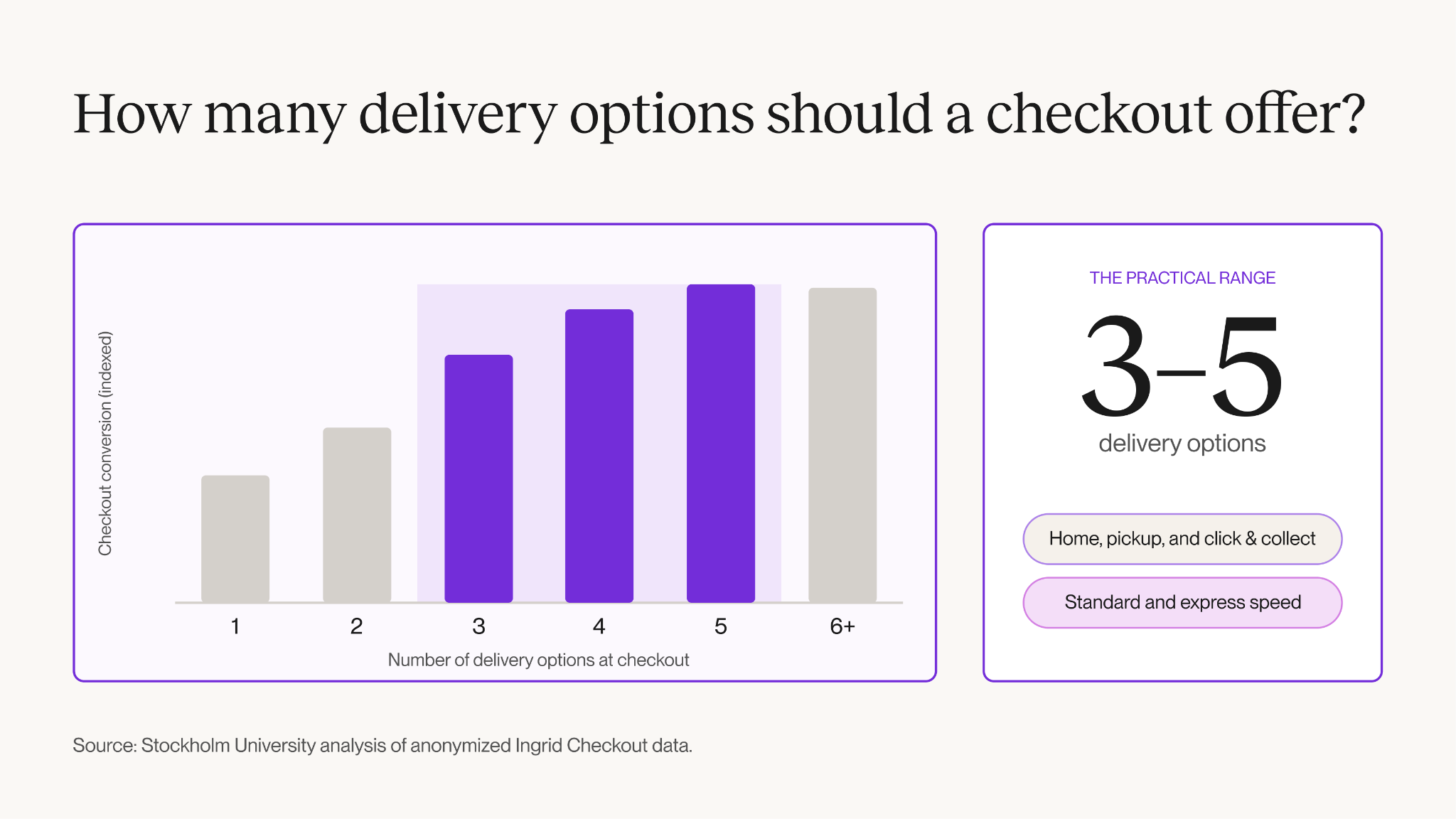
If shoppers want choice, is there such a thing as too much of it? In 2024, researchers at Stockholm University approached Ingrid to study exactly this, using an anonymized slice of the platform's checkout data.
The finding was specific. Conversion starts to climb once a checkout offers three delivery options, peaks somewhere between four and five, and shows no measurable improvement beyond five. Three to five options is the practical range, typically covering a mix of delivery modes like home, pickup, click and collect, as well as some variation in speed.
A follow-up finding was more surprising. At one of the largest bookshops in Sweden, returning shoppers changed their delivery option in 34% of cases: same shop, same checkout, often the same kind of purchase, and still a different choice.
Context was driving each choice. The same shopper's situation shifts from one order to the next, and their delivery selection shifts with it. It’s a strong argument for presenting a considered set of options every time rather than assuming a shopper's last choice is their permanent one.
Ingrid covers the mechanics of this in more detail in delivery options at checkout.
How omnichannel fulfillment makes delivery a competitive advantage
Offering the right options is only half the challenge. The retailer still has to fulfill them, and this is where omnichannel either creates value or quietly leaks it.
For years, ‘omnichannel’ mostly described an internal view of stock. André argues the real prize is using full stock visibility to fulfill orders from wherever the product actually sits. Once a retailer can see and ship from every location, availability rises sharply and so does the ability to convert.
Two capabilities matter here. The first is ship-from-store. Nudie Jeans has deployed it around the world for sustainability reasons — shipping to a shopper in Australia from a local store rather than routing a parcel back through a central warehouse in Sweden. The second is split deliveries, allocating a single order across several locations when no one site can fulfil it in full.
"That's where availability explodes and converting more customers becomes the obvious choice."
Paul Smith is André's reference case for split deliveries orchestrated across stores and warehouses. He is candid that none of this is effortless. It takes central order orchestration and, often, an investment in the underlying systems.
"What about making profit was ever easy? If it was easy, it was short-term."
How to turn delivery from a cost center into revenue
Follow the ownership of delivery cost inside a mid-sized retailer. The logistics team negotiates carrier contracts, because delivery is seen as a shipping cost. They hand the e-commerce team a short list of options that are cheaper but rarely better.
With only cheap or free options to show, the retailer ends up giving away shipping and, often, a poor delivery experience with it. André's reframe is to price the preference rather than discount it away.
"Offer choice, offer towards the preferences, and make people pay a little for it. All of a sudden you have shipping revenue."
The structure is simple. A standard, white-label option sits at the bottom — the shopper doesn’t choose how it arrives, the time window is looser, and the retailer optimizes it for cost. Express sits at the top, priced for the shopper who genuinely needs speed and will pay for it. There’s real elasticity between the two.
There’s room to charge for a preference, within reason. Shoppers already pay more for a product variant they prefer, and the same willingness carries over to how an order arrives. Made testable through A/B testing, delivery stops being a cost-only line the e-commerce team can only defend and becomes one they can actively grow.
"We call it delivery economics when we meet customers."
It’s also where the money is most visible. Any traffic a retailer buys converts at a certain margin, and that margin is currently shaped by delivery costs, failed deliveries and returns that get spread across every order. Improving it flows straight to the bottom line, often faster than buying more expensive acquisition traffic.
For the full data picture, Delivery Economics 2026 references the benchmarks and real-life retail wins, including OSPREY LONDON turning delivery into a profit driver.
How does delivery affect customer loyalty and repeat purchase?
James offered an analogy that André endorsed. A great holiday can be overshadowed by a delayed flight home, because we tend to remember an experience by how it ends. Delivery is that final stretch of a purchase. It shapes how shoppers remember the whole thing.
He prefers to reframe loyalty as repurchase, because it forces a sharper question. What experience did the shopper have? Will they come back? A shopper can admire a brand but refuse to buy from its site again because a previous delivery went badly.
It also rarely helps to blame the carrier, because the shopper doesn’t separate the two. The frustration attaches to the retailer, in a support ticket or a public review. A delivery fails, and no one comes out ahead. André’s principle for closing that gap is memorable and practical.
"No one’s winning. Is the courier winning? You're not winning. Your kid isn’t getting their present. The retailer is definitely not winning. If you're a retailer that has stores, always think how you'd handle it in the store and bring that to digital."
No shop assistant would hold a loyal customer's refund for two weeks or bounce a parcel back after a single failed attempt. The digital equivalents happen constantly.
The rule is simple: hold your online delivery experience to the same standard you set in-store. Outdoor retailer Ellis Brigham does this by carrying its in-store service standards into online delivery and returns.
How does agentic commerce change delivery?
The forward-looking part of the conversation is where delivery intelligence stops being a nice-to-have. As shopping moves towards AI agents acting for the shopper, the buying journey changes shape. The shopper sets the context and delegates the effort, and an agent does the searching and comparing.
André frames agentic commerce as a context layer sitting on top of AI. The shopper describes what they want, including when and where they need it, and the agent carries that context into the purchase.
For a retailer, that raises a demanding question: can you answer, accurately and in real time, whether a specific product can arrive by Friday to a specific address? Most retailers cannot answer that today. The ones who can will be recommended. The ones who cannot will not.
"If you're not accurate about time, you will score poorly in the interface."
That’s where Ingrid positions itself as the delivery intelligence layer for the retailer — the system that stores the full delivery configuration and can answer, for any product and destination, exactly when it can be delivered.
Ingrid is building towards this through protocols such as model context protocol (MCP) and the emerging Universal Commerce Protocol (UCP), so that a retailer's delivery promise is legible to the agents doing the shopping. André’s takeaway says that the capability has to be built retailer-side first, because everything else depends on accuracy at the source.
Ingrid has written more on delivery in the agentic era and on readying your delivery promise for AI agents via UCP.
What should retailers measure?
André was asked two direct questions to close. The first: if a retailer could change one thing about delivery, what should it be?
"Focus on accuracy in your checkout. And meet your customers' preferences. If you don't know them, research them. It's not that difficult. Look at Trustpilot, start there."
The second: the one metric to track. André names shipping margin.
"Look at your shipping margin. If you can't impact your shipping margin, you have an unscalable business model."
He also suggested something more ambitious. Delivery quality currently hides across several metrics — support tickets, net promoter score (NPS), lifetime value — because it influences all of them at once. He wants a single, obvious measure of the quality of a retailer's delivery, modeled on the way NPS captures sentiment, and a working name for it is the Net Delivery Score (NDS).
It doesn’t exist yet as an industry standard, but the logic behind it runs through the whole conversation. Delivery shapes conversion, margin and repeat purchase all at once, which is exactly why it deserves a measure of its own.
FAQs
How can retailers reduce delivery-related support contacts?
Fix accuracy at the source before adding support capacity. Most "where is my order" contacts trace back to a delivery promise that was vague or wrong at checkout, so the highest-leverage move is showing an accurate, product- and destination-specific delivery date, backed by reliable tracking and self-serve options to redirect or reschedule a parcel. Delivery-related questions make up around half of all customer contacts, so tightening the promise removes cost rather than adding headcount. IDEAL OF SWEDEN saw this first-hand: after adding Ingrid Tracking, delivery-related contacts fell from 37% to 4% of its support volume. To illustrate the opportunity at scale, Ingrid estimates an €80M retailer model: around 1M orders a year, with WISMO contacts costing about €6 each. It values deflecting 40% of delivery-status tickets at roughly €192k a year in freed support capacity.
How do you set an accurate delivery promise at checkout?
Base the promise on the retailer's real delivery configuration for that product and destination, not a fixed site-wide estimate. That means accounting for which location will fulfill the order, the carrier's lead time to the shopper's address, and daily cut-off times, then showing a specific date. Accuracy is what protects conversion at checkout, and it is increasingly what lets an AI shopping agent trust and recommend the retailer. AI-powered delivery intelligence in Ingrid Predictive Delivery Times calculates each promise from real carrier performance and adjusts it automatically as conditions change.
How should retailers price delivery options?
Price to preference rather than defaulting to free shipping. A practical ladder runs from a lower-priority standard option optimized for cost, up to express for shoppers who need speed and will pay for it, with pickup and click and collect in between. Keep the range to three to five options and A/B test both the mix and the price points, since 20% to 30% of shoppers choose something other than the cheapest or fastest when given a real choice. AI-powered delivery intelligence in Ingrid Profit-Optimized Delivery prices options against real delivery cost and balances margin with conversion order by order. It earned a 23% shipping revenue increase at Cellbes and a 12% shipping profitability uplift at Åhléns.
How can retailers cut delivery costs without hurting conversion?
Control cost at the source, then price to protect conversion. Filtering out cost-inefficient options is the quiet win. Using Ingrid Checkout rules to steer shipments away from expensive parcel-locker sizes and penalty fees, Nelly.com saved around 1.6M SEK a year without changing what shoppers saw. On the revenue side, A/B testing the free-shipping threshold let NA-KD grow shipping revenue by 82% without damaging conversion. Apoteket lifted shipping revenue by 75% by charging for low-value orders while keeping free delivery for profitable baskets, with only a 1% dip in conversion.
When should a retailer use ship-from-store?
Use it when stock is spread across locations and availability or speed is capping conversion. Fulfilling from the nearest store or dark store shortens the distance to the shopper, raises the share of orders you can accept, and supports faster or lower-carbon delivery. Nudie Jeans runs this globally for sustainability, and Paul Smith drove a 10% weekly revenue increase by fulfilling online orders in-store, with around 20% of its online orders now shipped from stores. It pays off once central order orchestration and full stock visibility are in place, so orders can be split and routed to the best location.
How do retailers get recommended by AI shopping agents?
Be able to answer, accurately and in real time, whether a specific product can reach a specific address by a specific date. Agents compare retailers and favor a precise promise ("1 to 2 days to this address") over a vague one ("3 to 5 days"), so retailers that expose an accurate delivery promise get surfaced more often. This means connecting the full delivery configuration to a delivery intelligence layer and to agent protocols such as MCP and the commerce-specific UC by Shopify and Google.
About Ingrid
Ingrid is the delivery intelligence platform that helps retailers design, A/B test and execute delivery strategy across the entire customer journey, from checkout to tracking, returns to exchanges. With 350+ carrier integrations and 250+ leading retailers on board, including Paul Smith, ME+EM, Nordic Nest and NA-KD, Ingrid powers delivery across 170+ markets. Founded in Stockholm in 2015.
Listen to the full conversation with André Sikborn Erixon on The FODcast.
About The FODcast
The FODcast, short for the Future of Digital Commerce, is a podcast from Simply Commerce, a UK specialist recruitment firm that places talent across digital commerce, spanning tech, product, digital marketing, sales, and leadership. Hosted by Tim Roedel and James Hodges, each episode brings you in-depth discussions, expert interviews and real-world case studies that provide valuable perspectives on where digital commerce is headed.
Recent guests include leaders from Akeneo and Grebban, with topics ranging from AI-driven product discovery and headless commerce to the total cost of e-commerce growth, and now delivery. You can listen on Spotify, Apple Podcasts, and YouTube.

FAQs
What does Ingrid Platform do?
Ingrid is the leading delivery intelligence platform that helps retailers turn delivery from a cost into a commercial advantage. Its modular platform connects retailers, carriers and shoppers across the whole shopping journey — discovery, checkout, tracking, transport, in-store and returns — so every delivery decision drives conversion, margin and loyalty on top of fulfillment and logistics.
How is Ingrid different from other delivery and shipping tools?
Most tools own a single touchpoint: logistics-led platforms stop at booking and labels, and post-purchase tools only start after the sale. Ingrid connects carrier choice to conversion and margin, with built-in A/B testing to prove what works. It gives retailers flexibility, choice and control instead of a fixed, one-size-fits-all setup.
Who is Ingrid for?
Ingrid is built for mid-market and enterprise e-commerce and omnichannel retailers shipping across multiple carriers, markets or delivery methods. Typically heads of e-commerce, logistics and operations leaders who want to turn delivery into a measurable revenue and margin lever. Retailers like Paul Smith, NA-KD, Apoteket, Nordic Nest and Mint Velvet use it to raise AOV, lift conversion, cut delivery-related support, implement direct exchanges, and increase delivery profitability.
Why does delivery intelligence matter?
Product and price used to decide the sale; now delivery does, too. Shoppers increasingly choose by delivery availability — same-day, next-day, pickup or in-store — while AI shopping agents rank retailers on delivery signals rather than branding. Ingrid helps retailers adapt with personalized delivery experience from checkout to returns. Back-end delivery intelligence contains cost and increases revenue, so delivery becomes a competitive advantage.
Related blog posts

What does agentic commerce infrastructure mean for delivery?
How an API-first delivery setup lets AI agents read a retailer's delivery offer on behalf of shoppers.

Agentic DeliveryOS: delivery ready for AI agents
The operating system for agentic-ready retail delivery that brings shopper, retailer and carrier intelligence together so every decision is made with full context.

A 20% better delivery experience is worth 5-10% more sales
Delivery drives 29-42% of satisfaction with a brand. What's it worth in sales?