

How to choose a multi-carrier delivery platform: a buyer's guide for enterprise e-commerce

Anastasiia Starchenko

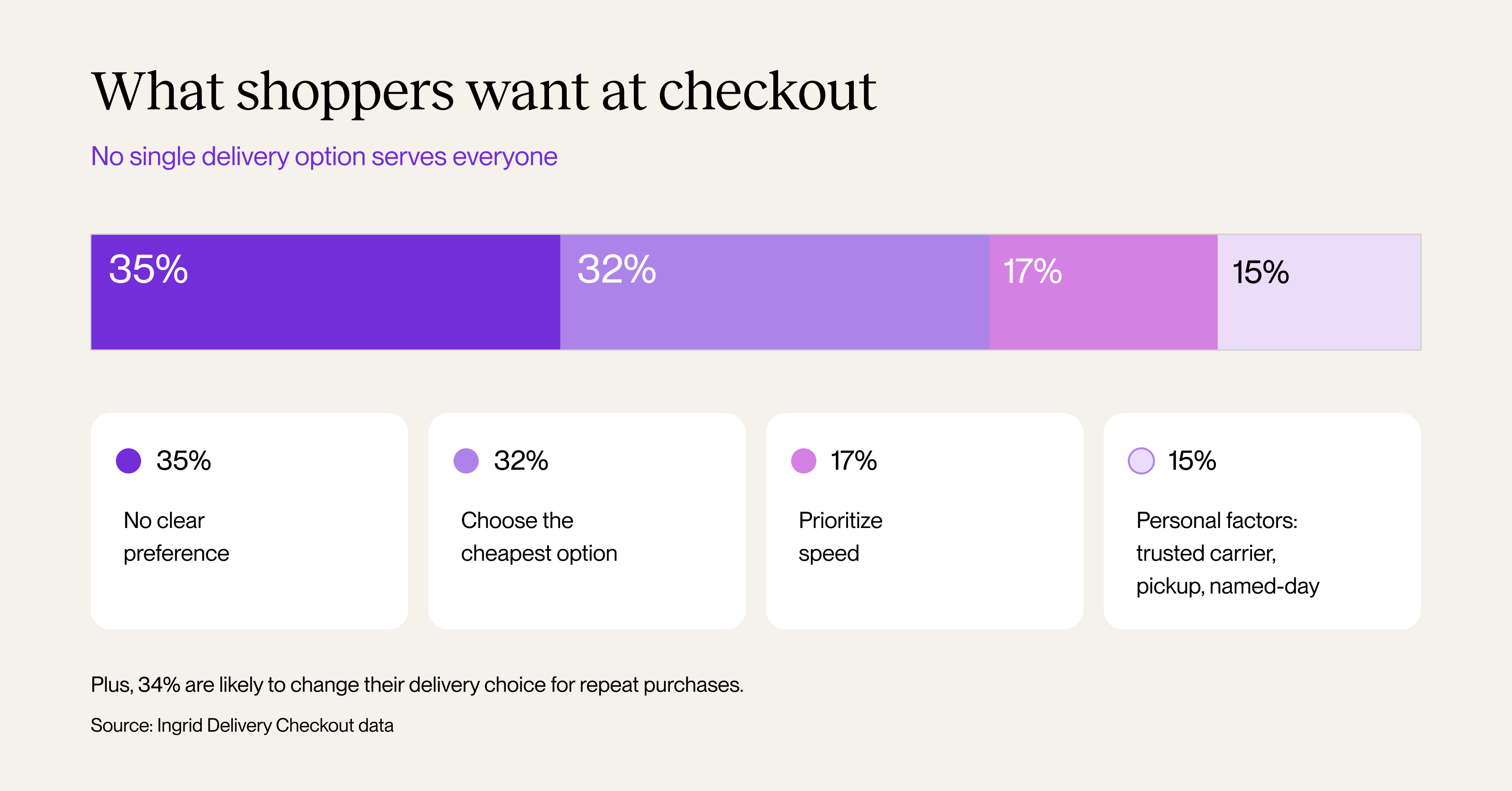
Shoppers don't all want the same thing at checkout. Across Ingrid Delivery Intelligence Platform, 32% choose the cheapest delivery option, 17% prioritize speed, 35% have no clear preference, and the rest decide on personal factors.
A default single-carrier setup serves one of those groups and leaves margin and conversion on the table. Meanwhile, a multi-carrier delivery platform lets you match the right carrier and method to each order, which lifts conversion ~27% on average and has helped retailers grow shipping revenue 12–82%.
When you compare platforms, score them on five other things besides carrier count: carrier orchestration, checkout impact, delivery accuracy, analytics, and cost control. Platforms that can shape the sale at checkout are the ones that turn delivery into a commercial advantage, and the ones AI shopping agents will reward.
Who this article is for
Mid-market and enterprise e-commerce and omnichannel retailers evaluating or rethinking their delivery setup — heads of e-commerce, logistics and operations leaders, and the teams that own checkout and margin. It's most useful if you ship across multiple markets, run meaningful peak volumes, are mid-replatforming, or suspect your delivery line is costing more than it should. If you're a small retailer shipping stable volumes in a single market, a single carrier may still serve you well — this guide is about what changes at scale.
A multi-carrier delivery platform lets a retailer offer, rank, and orchestrate several carriers across the customer journey — from the delivery options a shopper sees at checkout to tracking, returns, and exchanges. The platform you choose should be judged on the metrics that matter to the business: checkout conversion, delivery accuracy, and shipping margin. Label-printing speed barely registers next to those.
This guide is written for mid-market and enterprise e-commerce and omnichannel retailers comparing platforms. It explains how a multi-carrier strategy outperforms a default single-carrier setup, gives you five criteria to evaluate vendors against, and shows where the leading platforms, including Ingrid, fit. Use it to shortlist, to brief a commerce agency your team works with, or to pressure-test a setup you already have.
What is a multi-carrier delivery platform?
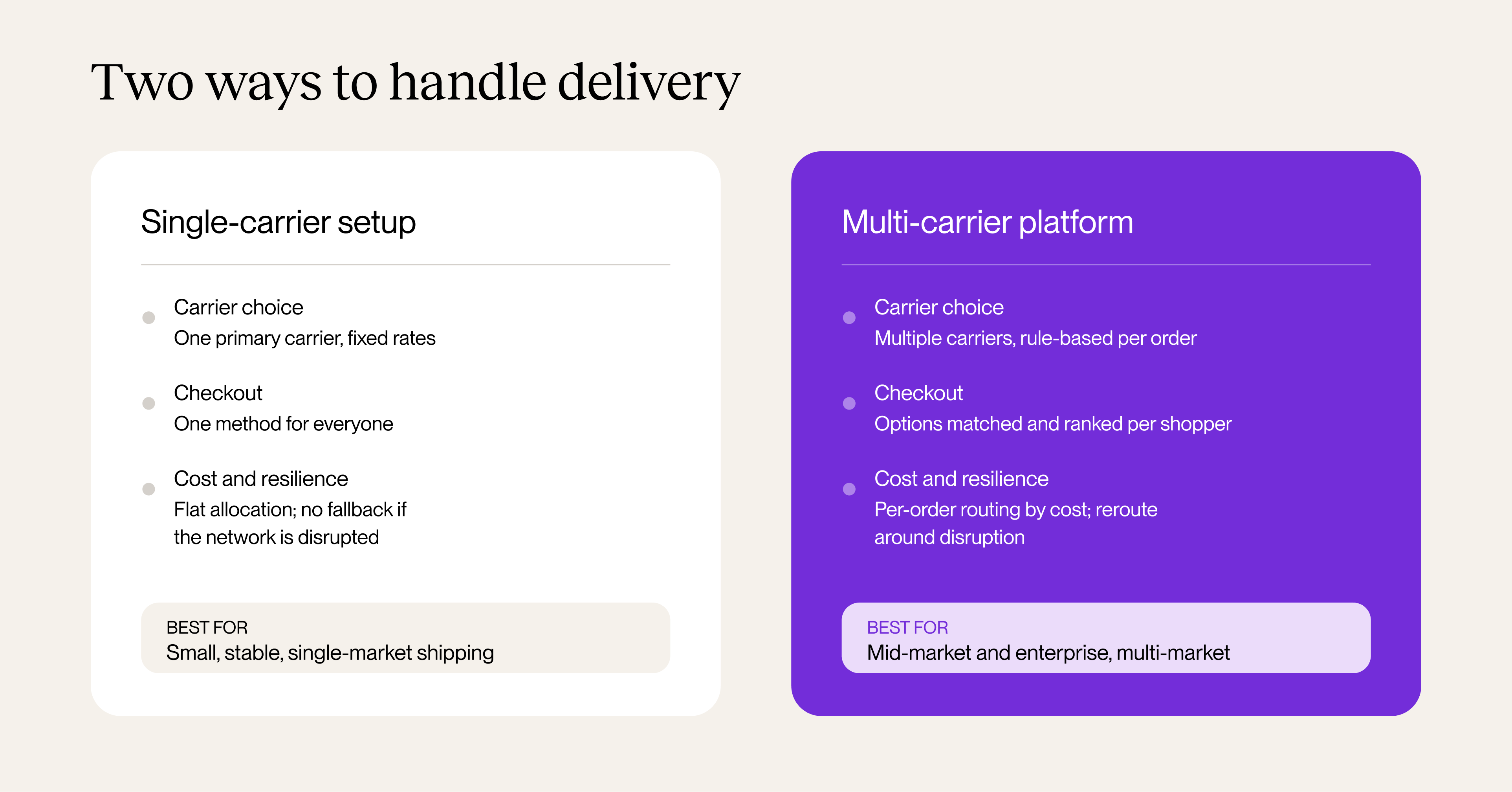
A multi-carrier delivery platform is software that connects a retailer to multiple shipping carriers and decides which carrier and method to use for each order, based on cost, speed, destination, and shopper preference. Unlike a single-carrier setup, it lets you present a choice of delivery options at checkout, route each order to the most suitable carrier, and manage tracking and returns across all of them from one place.
Single-carrier setup
- Carrier choice: one primary carrier, fixed rates
- Checkout options: one delivery method for everyone
- Cost control: flat allocation, same fee regardless of route
- Resilience: dependent on one network, no fallback if it's disrupted
- Best for: very small, stable, single-market shipping
Multi-carrier delivery platform
- Carrier choice: multiple carriers, selected per order by rule
- Checkout options: options matched and ranked per shopper
- Cost control: per-order routing by cost and performance
- Resilience: diversified, ability to reroute around carrier disruption
- Best for: mid-market and enterprise, multi-market, peak volume
A single carrier can work for a small retailer with stable volumes and one market. For everyone shipping across multiple services, countries, or peak periods, a multi-carrier platform is the standard, as well as, increasingly, the baseline that AI shopping agents expect to find.
Shipping software or delivery intelligence platform?
Here the category splits, and the distinction matters when you choose. Most "multi-carrier shipping software" is built for the back office: rate-shopping, label generation, customs documents, and tracking. It treats delivery as a fulfillment task to execute efficiently after the sale.
A delivery intelligence platform extends that logic to the parts of the journey that actually move revenue, such as the checkout, where delivery options influence whether a shopper buys, and the post-purchase experience, where accuracy and communication shape whether they come back.
It connects carrier choice to conversion and margin on top of the warehouse. That's the lens this guide uses, because for a mid-market or enterprise retailer, the commercial upside lives at checkout, not at the label printer.
Why a multi-carrier strategy beats a default carrier setup
Because shoppers don't all want the same thing at checkout, and a single default carrier can only serve 1-2 categories of delivery expectations. Data across Ingrid Delivery Checkout shows the split clearly: 32% of shoppers choose the cheapest delivery option, 17% prioritize speed, and 35% have no clear preference.
The remaining 15% decide on personal factors like a trusted carrier, pickup availability, named-day delivery, or a climate-smart option. Preferences aren't fixed, as 34% are likely to change their delivery choice for repeat purchases.
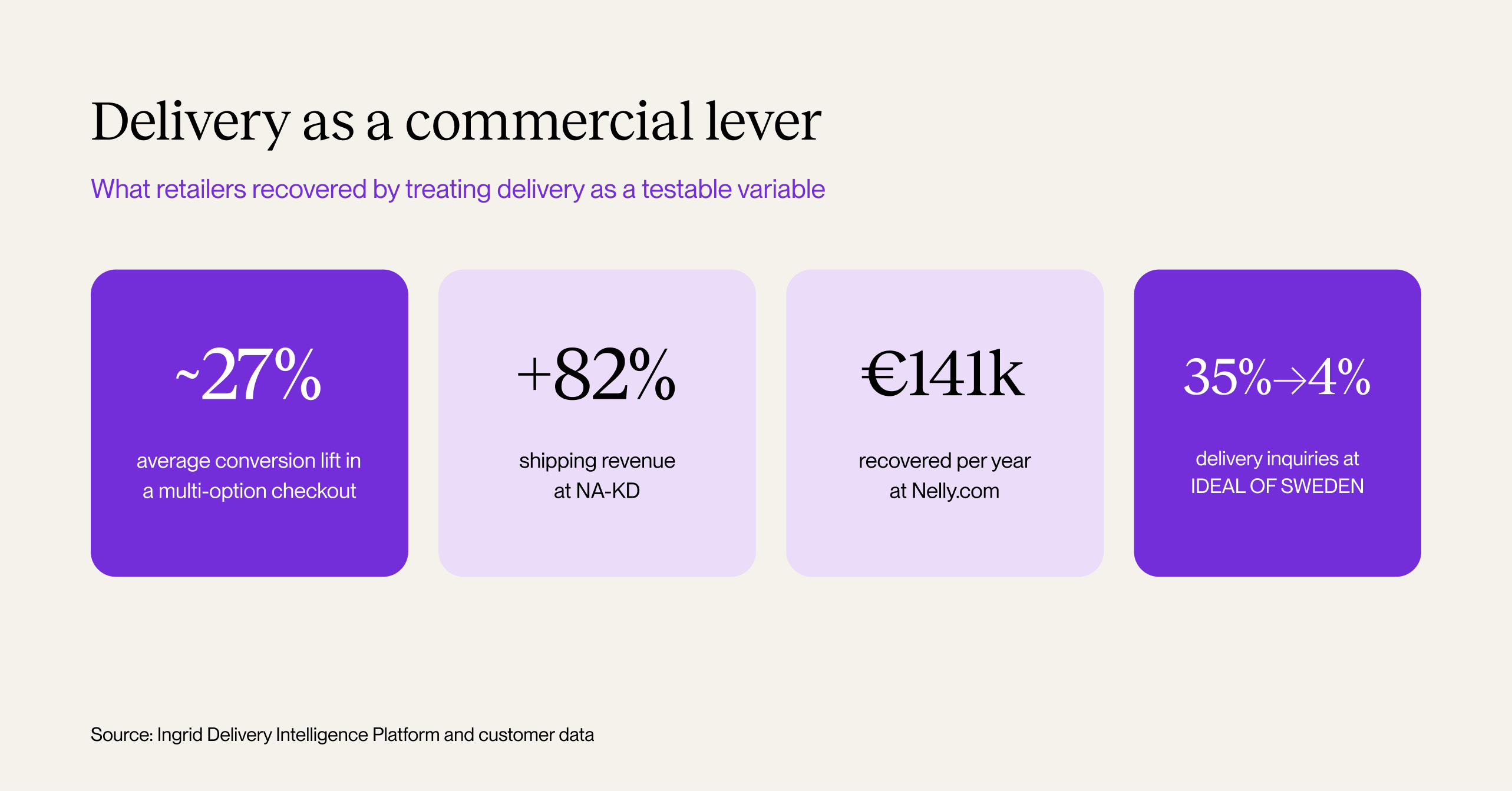
One delivery method built on a default carrier serves one of these groups, but a multi-carrier strategy lets you match the right carrier and method to each order. Presenting an intelligent set of delivery options at checkout lifts conversion by around 27% on average, as Ingrid Delivery Checkout data suggests, while protecting margin.
The margin hiding in carrier choice
When retailers actually introduce carrier choice and test it, the results tend to contradict the assumptions behind the old default or general industry standards. OSPREY LONDON, a premium UK bag and accessories brand, who added a more cost-efficient carrier alongside its long-standing premium option.
The assumption was that the cheaper carrier meant a lower level of service, so it was offered as the budget choice, not the headline one. Shoppers saw it differently: 90% of volume shifted to the lower-cost service, unprompted, and they reported feeling they were getting a better experience.
"I'm not relying on what I think anymore. I'm actually giving customers the choice, and they think they're getting a better service. We're saving a huge amount of delivery costs, too."
— Ben Jones, Head of E-commerce and Tech
The pattern repeats across retailers who move from a flat, default setup to cost-aligned, profit-ranked delivery options. Nelly.com analyzed 300,000+ invoiced shipments, set rules to avoid cost-inefficient parcel-locker sizes and dimensional penalties, and recovered €141,000 (£120,000) a year with no impact on delivery times.
NA-KD A/B tested free shipping thresholds across markets and grew shipping revenue 82% without damaging conversion. Apoteket, Sweden's largest pharmacy chain, adjusted delivery pricing by order value and grew shipping revenue 75% while holding conversion within 1%.
Cellbes grew shipping revenue 23% by ranking the delivery methods at checkout by margin rather than by habit via AI-powered, profit-optimized insights. The gain came without compromising conversion. Åhléns ran a similar profit-optimized ranking experiment and grew shipping profitability 12%.
"We saw the potential to improve shipping revenue without compromising conversion by ranking shipping methods together with Ingrid. More importantly, it's an opportunity to gain real insight into how our customers think and decide — insights that drive both customer value and profitability."
— Erik Claesson, Distribution and Logistic Manager at Cellbes
Taking delivery off the IT and agency queue
The margin and conversion gains depend on something more mundane but just as important — whether the people who own delivery can actually change it. In most setups, every carrier addition, pricing tweak, or checkout test is a ticket for IT or the agency, which means the commercial team waits weeks to act on what it already knows. A platform that puts that control in the hands of the team running delivery turns a dependency into a capability.
"Before Ingrid we spent a lot of time managing carrier integrations and vendors, building the missing parts ourselves. Now we have all the tools needed to be self-reliant and quickly make the changes needed to meet customer expectations of a seamless shopping experience. On the internal side, we can put our resources into more proactive and productive tasks."
— Hannah Bennett, Head of Digital, Paul Smith
That self-reliance is also what makes the testing in the previous section possible. When experiments are quick to set up and don't need a developer, optimization becomes a routine the commercial team runs, not a project it requests.
"Ingrid Delivery Checkout experiments are easy and straightforward to set up without too big of a hassle. The platform has a good management system with a lot of customization, if needed, and it's simple to navigate, even for less experienced software users."
— Adrian Lexell, Solution Architect, SkalHuset
Where this is heading is even more self-directed. Ingrid is currently developing and testing a number of ideas with a small group of customers, including a unified delivery operating system for configuring checkout, carriers, options, and pricing in one place, an address-validation API to cut failed deliveries at checkout, and conversational AI for updating delivery configuration by prompt rather than manual setup. It points to where agentic retail and delivery intelligence are going — even less dependency on developers, even faster iteration for the team that owns delivery.
The market is already moving
Sweden offers a preview of where other markets are heading. Multi-carrier is the norm: 77% of Swedish retailers use competing carriers for different delivery types, shoppers are used to choosing between methods at checkout, and out-of-home (OOH) options like lockers are widely adopted.
By contrast, an early-2026 benchmark found 71% of major Dutch retailers still operate with a single carrier at checkout, and many UK retailers are in the same position. The gap between a default setup and a multi-carrier one is exactly the margin and conversion these markets are leaving on the table.
How to compare multi-carrier delivery platforms: 5 criteria
The right way to compare platforms is to evaluate them against the outcomes delivery actually drives: carrier orchestration, checkout conversion, delivery accuracy, analytics, and cost control. Score each vendor on all five rather than on carrier count alone — breadth of carriers is table stakes; what you do with them is the differentiator.
1. Carrier orchestration and integration
Ask: How many carriers and markets are supported? How fast can you add a new carrier when you expand?
Look beyond the headline carrier count to onboarding speed, rule-based routing, OOH and pickup coverage, and cross-border support. The value isn't the size of the network but how quickly and intelligently you can route across it. For a retailer expanding into new markets, time to onboard a carrier is a direct growth constraint.
It's also worth checking how the platform fits the way you actually implement. If a commerce agency builds and maintains your storefront, their familiarity with the platform — and whether it's config-driven rather than a custom build — often determines how fast you go live and how easily you iterate afterward. The best fit is a platform your team or your agency can configure and run without a standing development project behind every change.
2. Checkout impact in conversion
Ask: Can the platform present and rank delivery options at checkout and let you A/B test them?
This is where carrier choice converts, and where most "shipping software" stops short. The decision to buy happens at checkout, and if a shopper doesn't see a delivery option that fits — the right speed, price, or pickup point — they are more likely to abandon the cart. In the UK, 37% have left and bought from a different retailer specifically because of delivery.
Platforms that only operate in the back office never touch the purchase decision moment; they process the order after the shopper has already decided. The ability to present a tailored set of delivery options at checkout, rank them by margin, and A/B test the order and pricing transforms delivery from a cost into a conversion factor.
Intelligent checkout options lift conversion ~27% on average, and the way options are ranked determines which carrier fulfills the order and whether you make or lose margin on it. If a platform can't influence what the shopper sees at checkout, it can't influence whether they buy.
3. Delivery promise accuracy
Ask: Are delivery promises calculated per order from real fulfillment data, or are they static padded windows?
Across markets, shoppers value reliability over speed: 92% of Dutch shoppers rate reliability as the single most important delivery attribute, and 54% of UK shoppers say they wouldn't return to a retailer after a broken delivery promise.
A strong platform generates specific, per-order delivery dates from real fulfillment data, such as "arrives Thursday" rather than "3–5 business days", and gives you branded, retailer-owned tracking instead of handing the post-purchase experience to a carrier. Accuracy builds trust; trust drives repeat purchase.
4. Analytics and experimentation
Ask: Can you see whether delivery makes or loses money — per order — and test changes safely?
Shipping revenue contribution rarely appears as its own line in commercial reporting, which means most teams can't tell whether delivery subsidizes the business or drains it. The platform should surface that, report carrier performance, and include built-in A/B testing so you can change thresholds, pricing, and option ordering based on evidence rather than conventional wisdom. The retailers recovering 12–82% in shipping revenue all share one thing — they are able to measure, test, and act on the delivery data.
5. Cost control and margin
Ask: Can pricing reflect the real economics of each shipment, instead of one flat fee?
A flat delivery fee quietly loses money on expensive routes and overcharges on cheap ones. Cost-aligned pricing — rate-shopping, surcharge and dimensional-penalty prevention, and testable free-shipping thresholds — keeps you competitive where costs are low and protects margin where they're high.
At scale, the cost adds up. Say, a retailer shipping 2,000 orders a day on a flat fee can absorb roughly €290,000 a year in delivery costs it never recovers from shoppers. That’s a margin that falls straight to the bottom line once pricing is aligned to actual cost.
It’s also the criterion that makes delivery legible to the people who sign off the budget. In most businesses, shipping revenue contribution never appears as its own line, so the CFO sees delivery as an unexplained cost rather than a managed one.
A delivery platform that ties carrier choice, pricing and conversion to a number you can report turns "delivery costs went up again" into a unit-economics conversation leadership can actually act on and a business case the Champion can take to the board.

Multi-carrier delivery platforms compared (2026)
The table below maps the main platforms in this space against the five criteria, framed as buyer questions rather than feature lists. Verify each vendor's current capabilities against their own materials during your evaluation; positioning shifts.
Ingrid
Ingrid is an end-to-end delivery intelligence platform that spans across checkout and tracking all the way to returns and exchanges.
- Carrier network: 350+ carrier integrations;
- Checkout conversion: flexible, curated delivery options, built-in delivery checkout A/B testing, average conversion growth up to 27% with a multi-option delivery checkout offering;
- Delivery accuracy: AI-driven, predictive delivery times per order, calculated from real performance data, as well as branded, retailer-owned tracking; at IDEAL OF SWEDEN, delivery-related inquiries dropped from 35% to 4%;
- Analytics: insights dashboards measuring commercial levers like conversion and shipping revenue contribution, as well as delivery promise and handling-time tracking; curated data that integrates with retailer’s own BI tool;
- Cost control: free shipping threshold testing, shipment cost-aligned delivery pricing instead of a flat fee, surcharge and dimensional-penalty prevention, profit-optimized ranking of delivery options at checkout, great for enterprise commerce at scale; 1.6M SEK (~€141k) in cost savings at Nelly.com, up to 82% shipping revenue increase at NA-KD, and 12% shipping profitability growth at Åhléns.
nShift
nShift is an end-to-end delivery and experience management platform that covers checkout, shipping, tracking, returns, and emissions.
- Carrier network: 1,000+ carriers providers;
- Checkout conversion: delivery options, built-in A/B testing, a 20% conversion increase at Flying Tiger Copenhagen after adding pickup points;
- Delivery accuracy: AI-predicted estimated delivery dates, trained on the carrier network data, plus carrier-API ETAs and branded, retailer-owned tracking;
- Analytics: a unified data layer that ingests and normalizes carrier, checkout, ERP and WMS data, which feed BI dashboards and predictive alerts; operations- and cost-led rather than checkout-revenue-led;
- Cost control: rule-based least-cost routing that auto-selects the carrier and service per order by stock keeping unit (SKU), value, weight, delivery promise or carbon emission, plus a shipping-price configurator, including free-shipping levels, and cost tracking across every shipment.
Scurri
Scurri is a delivery management software that connects all aspects of the order, shipping, and delivery process through one central platform.
- Carrier network: 1,500+ carrier services;
- Checkout conversion: delivery options and estimated delivery dates; in one A/B test at LeMieux, customers not shown delivery dates had 10.3% higher checkout abandonment;
- Delivery accuracy: estimated delivery dates at checkout where available — carrier-data based, rule-driven — as well as branded tracking;
- Analytics: operational reporting dashboards like exceptions, transit times, tracking, volume by carrier and service; carrier-performance focused;
- Cost control: real-time rate comparison across carriers with rule-based routing, plus operational reports (transit times, exceptions) that surface cost-inefficient lanes. Solid operational reporting but lighter than competitors.
Sendcloud
Sendcloud is Europe’s leading shipping platform for e-commerce with the courier choice and automations retailers need to scale and deliver great customer experiences.
- Carrier network: 170+ carrier integrations;
- Checkout conversion: conversion-focused checkout product with flexible delivery options; benchmark research cites a 2–4 percentage-point lift in conversion rate when moving from single- to multi-carrier setup;
- Delivery accuracy: branded tracking with built-in upsell and customer feedback on carrier performance; estimated delivery dates based on carrier’s transit-time value, so based on rules, not AI-predicted;
- Analytics: shipping intelligence based on carrier performance insights to track performance, control costs, and predict risks;
- Cost control: retailers get three pricing routes they can mix: (a) pre-negotiated carrier rates, i.e., volume-pooled discounts available without your own contracts, strong for small-to-medium enterprise (SME), (b) upload own negotiated carrier contracts or (c) combine both and let the platform pick, plus rate comparison across 160+ carriers and 9,500+ shipping methods.
Metapack
Metapack is an enterprise multi-carrier delivery platform, now part of ShipStation Global (Auctane).
- Carrier network: 400+ carriers and 4,900+ delivery services, weighted toward enterprise and cross-border;
- Checkout and conversion: real-time, validated delivery checkout choices, checkout intelligence suggests fulfillment locations for each; checkout conversion framed as a benefit;
- Delivery accuracy: branded delivery tracking plus AI predictions for early identification of at-risk shipments; predictive analytics rather than a stated per-order EDD model at checkout;
- Analytics: real-time reporting, predictive analytics, and carrier-performance reporting across carriers, warehouse operations, and the end-customer experience; an AI layer ("Ask Metapack" natural-language queries, "Build with AI" report creation); operations/SLA-led rather than checkout-revenue-focused;
- Cost control: parcel-level shipping-cost visibility, rule-based carrier selection to cut shipping and customs costs, and consolidated cross-border clearance; finance-oriented spend control and margin protection.
Parcel Perform
Parcel Perform is an AI delivery experience software for e-commerce post-purchase experience.
- Carrier network: 1,100+ carriers
- Checkout conversion: delivery checkout with easy OOH pickup location search;
- Delivery accuracy: branded tracking page; AI-powered delivery updates that keep the EDD promise during delays; no-code campaign manager for tracking upsell; up to 45% fewer tracking-assistance calls at Nespresso; overall, a rich tracking feature set;
- Analytics: AI Decision Intelligence monitors delivery data, writes plain-language summaries, and surfaces issues with root-cause analysis; strong on logistics and operations, less on checkout revenue.
- Cost control focused on the logistics spend: automated shipping-cost audit that reconciles carrier invoices against rate cards and flags overcharges; AI-driven multi-factor rate shopping by cost, speed, reliability, and carbon emissions; a PUDO API that auto-routes to lower-cost pickup points with up to ~40¢ savings per shipment at Flaconi.
Every platform here can connect multiple carriers. The real differences show up in criteria 2 through 5 — whether the platform can shape the sale at checkout, promise accurately, prove its commercial impact, and align cost to price. That's where a delivery intelligence platform separates from shipping software.
Who needs a multi-carrier delivery platform?
Mid-market and enterprise retailers who ship across multiple markets, run meaningful peak volumes and/or sell omnichannel — these get the most from a multi-carrier platform. The signals that you've outgrown a single-carrier setup are likely cross-border orders, a replatforming cycle underway and, most importantly, a delivery line on the P&L that no one has tested in years.
A very small retailer with stable volumes in one market can still run effectively on a single carrier. Anyone with scale, complexity, or growth ambitions — and any retailer preparing for AI-assisted shopping — the flexibility, resilience, and margin control of a multi-carrier platform quickly outweigh the simplicity of a default setup.
Multi-carrier delivery and the shift to AI-assisted shopping
There's a forward-looking reason to get this right now, as AI agents are starting to compare retailers and evaluate delivery the way no human shopper does.
55% of UK shoppers have already used AI — a chatbot, search assistant, or shopping agent — to find or buy products, rising to over 75% among Gen Z and Millennials. Google and Shopify's Universal Commerce Protocol and OpenAI's Agentic Commerce Protocol are live, letting agents browse, compare, and check out.
AI agents don't respond to brand storytelling. They evaluate structured, machine-readable signals, and delivery is one of the most concrete. Ask an agent to "find running shoes under €120, delivered by Friday," and the retailer that returns a specific, data-backed promise like "arrives Thursday by 6pm" wins over the one that says "3–5 business days."
Among UK shoppers using AI to shop, 66% are more likely to buy when the agent shows flexible delivery options, and more than half would abandon the purchase entirely if delivery information isn't clear.
The capabilities that improve delivery economics today — accurate per-order promises, cost-aligned pricing, connected data across checkout, tracking, and returns — are the exact signals AI agents will use to rank retailers tomorrow. A multi-carrier delivery platform that already produces them is how you stay discoverable as shopping shifts to agents. Ingrid explores this in depth in Delivery Economics 2026.
FAQs
What is a multi-carrier delivery platform?
A multi-carrier delivery platform is software that connects a retailer to multiple carriers and selects the best one for each order based on cost, speed, destination, and shopper preference. It lets you present a choice of delivery options at checkout, route orders intelligently, and manage tracking and returns across all carriers from one system.
What's the difference between multi-carrier shipping software and a delivery intelligence platform?
Multi-carrier shipping software focuses on back-office execution — rate-shopping, labels, customs, and tracking. A delivery intelligence platform extends that to the commercial parts of the journey: it shapes the delivery options shoppers see at checkout, generates accurate per-order delivery promises, and connects carrier choice to conversion and margin. The first optimizes fulfillment; the second optimizes revenue.
How do you compare multi-carrier delivery platforms?
Score each platform against five criteria: carrier orchestration and integration, checkout impact (conversion), delivery accuracy (promise and tracking), analytics and experimentation, and cost control. Carrier count alone is a weak basis for comparison — what separates platforms is whether they can influence the sale at checkout and prove their commercial impact.
How does a multi-carrier strategy reduce shipping costs?
By routing each order to the most cost-effective carrier for that destination and service level, rather than defaulting every shipment to one carrier. Retailers also recover margin by preventing dimensional and surcharge penalties and by aligning delivery pricing to real cost. One brand recovered €141,000 a year this way; another shifted 90% of volume to a lower-cost carrier simply by offering the choice.
Can a multi-carrier platform improve checkout conversion?
Yes. Shoppers have different delivery priorities — 32% choose the cheapest option, 17% prioritize speed, 35% have no clear preference, and the rest decide on personal factors. Presenting an intelligent, ranked set of options at checkout serves all of them and lifts conversion by around 27% on average, according to Ingrid Platform data.
Which multi-carrier delivery platforms do leading retailers use?
Leading retailers use a range of platforms depending on their needs. Ingrid, for example, powers delivery for brands including Paul Smith, ME+EM, NA-KD, GANT, and TOTEME across 170+ markets. Other established platforms in the space include nShift, Scurri, Sendcloud, and Parcel Perform. The right choice depends on how much you need delivery to influence checkout conversion and margin, not just execute shipments.
Is a multi-carrier delivery platform worth it for enterprise and omnichannel retailers?
For most, yes. Enterprise and omnichannel retailers ship across multiple markets, handle peak volume, and run ship-from-store and click-and-collect workflows that a single carrier can't serve well. The conversion, margin, and resilience gains of a multi-carrier platform typically outweigh the simplicity of a default setup at that scale.
Does a multi-carrier platform support international and cross-border delivery?
Yes. Multi-carrier platforms support international shipping through customs documentation, multi-currency handling, and carrier networks with regional and global coverage, so you can offer consistent options and tracking across borders. Onboarding speed for new carriers and markets is a key thing to evaluate if you're expanding.
How does a multi-carrier delivery platform support AI-assisted shopping?
AI shopping agents rank retailers on structured delivery signals — accurate promises, transparent pricing, and carrier reliability — rather than on branding. A multi-carrier delivery platform that produces accurate per-order delivery dates and consistent pricing makes a retailer discoverable and recommendable to agents, where a static, single-carrier setup with vague delivery windows risks being passed over.
Choosing well
A multi-carrier delivery platform is no longer a back-office upgrade — it's a commercial decision that touches conversion, margin, and customer trust on every order. Compare platforms on what delivery actually drives: their ability to orchestrate carriers, shape the sale at checkout, promise accurately, prove their impact, and align cost to price. The retailers who treat delivery as a lever rather than a line item are the ones recovering double-digit shipping revenue today — and building the infrastructure AI agents will reward tomorrow.
Want to see how Ingrid turns multi-carrier delivery into a conversion and margin advantage? Book a demo or read Delivery Economics 2026 →

FAQs
What does Ingrid Platform do?
Ingrid is the leading delivery intelligence platform that helps retailers turn delivery from a cost into a commercial advantage. Its modular platform connects retailers, carriers and shoppers across the whole shopping journey — discovery, checkout, tracking, transport, in-store and returns — so every delivery decision drives conversion, margin and loyalty on top of fulfillment and logistics.
How is Ingrid different from other delivery and shipping tools?
Most tools own a single touchpoint: logistics-led platforms stop at booking and labels, and post-purchase tools only start after the sale. Ingrid connects carrier choice to conversion and margin, with built-in A/B testing to prove what works. It gives retailers flexibility, choice and control instead of a fixed, one-size-fits-all setup.
Who is Ingrid for?
Ingrid is built for mid-market and enterprise e-commerce and omnichannel retailers shipping across multiple carriers, markets or delivery methods. Typically heads of e-commerce, logistics and operations leaders who want to turn delivery into a measurable revenue and margin lever. Retailers like Paul Smith, NA-KD, Apoteket, Nordic Nest and Mint Velvet use it to raise AOV, lift conversion, cut delivery-related support, implement direct exchanges, and increase delivery profitability.
Why does delivery intelligence matter?
Product and price used to decide the sale; now delivery does, too. Shoppers increasingly choose by delivery availability — same-day, next-day, pickup or in-store — while AI shopping agents rank retailers on delivery signals rather than branding. Ingrid helps retailers adapt with personalized delivery experience from checkout to returns. Back-end delivery intelligence contains cost and increases revenue, so delivery becomes a competitive advantage.
Related blog posts

A 20% better delivery experience is worth 5-10% more sales
Delivery drives 29-42% of satisfaction with a brand. What's it worth in sales?

Delivery, the most overlooked growth lever in e-commerce
Why delivery decides trust, conversion and repeat purchase, especially in agentic shopping.
How to choose a multi-carrier delivery platform: a buyer's guide for enterprise e-commerce
Carrier orchestration, checkout impact, delivery accuracy, analytics, and cost control.
