

Peak Season Stress Test 2026
Black Friday and Cyber Monday don’t create new problems in a retailer's delivery setup, only reveal the ones that were already there, at a volume that’s eventually hard to ignore.

Black Friday and Cyber Monday don't create new delivery problems, but rather reveal already existing weaknesses, once order volume hits 3-5 times normal.
This report uses the Black Week data from 2025, plus results from retailers including NA-KD, Nelly, Apoteket and OSPREY LONDON, among others, to break down six recurring failure points in checkout, carrier capacity and returns.
It also covers why delivery promise accuracy, not speed, wins the order, including AI shopping agents now comparing retailers directly.
Black Friday and Cyber Monday (BFCM) don’t create new problems in a retailer's delivery setup. They reveal the ones that were already there, at a volume that’s eventually hard to ignore. Every year, checkout logic, carrier capacity, tracking, returns and the tech stack behind them get tested at three to five times normal load, over a handful of days, with no room to patch anything mid-flight.
Most guidance written about Black Friday and Cyber Monday treats this as a survival exercise: how to get through the week without breaking anything. That framing misses the more useful question. What breaks, or nearly breaks, essentially reveals where a retailer's delivery strategy, tech stack and margin discipline stand, tested by real order volume instead of a roadmap slide.
This piece is built around three ideas our team keeps coming back to in conversations with mid-market and enterprise retailers: what the stress test reveals, what delivery costs and generates in margin terms, and why delivery promise accuracy is becoming the thing that wins the order, including in the eyes of AI shopping agents now doing some of the shopping themselves. Each section pairs what a retailer can act on before November with what is worth planning for going into 2027.
"It's not enough to survive peak season as a retail brand. You shouldn't be thinking, how do we get through this? You should be thinking: if something fails, what does that say about your setup, your strategy, or your tech stack?
— Merijn van Zuidam, Enablement Lead, Ingrid
1. The peak season stress test
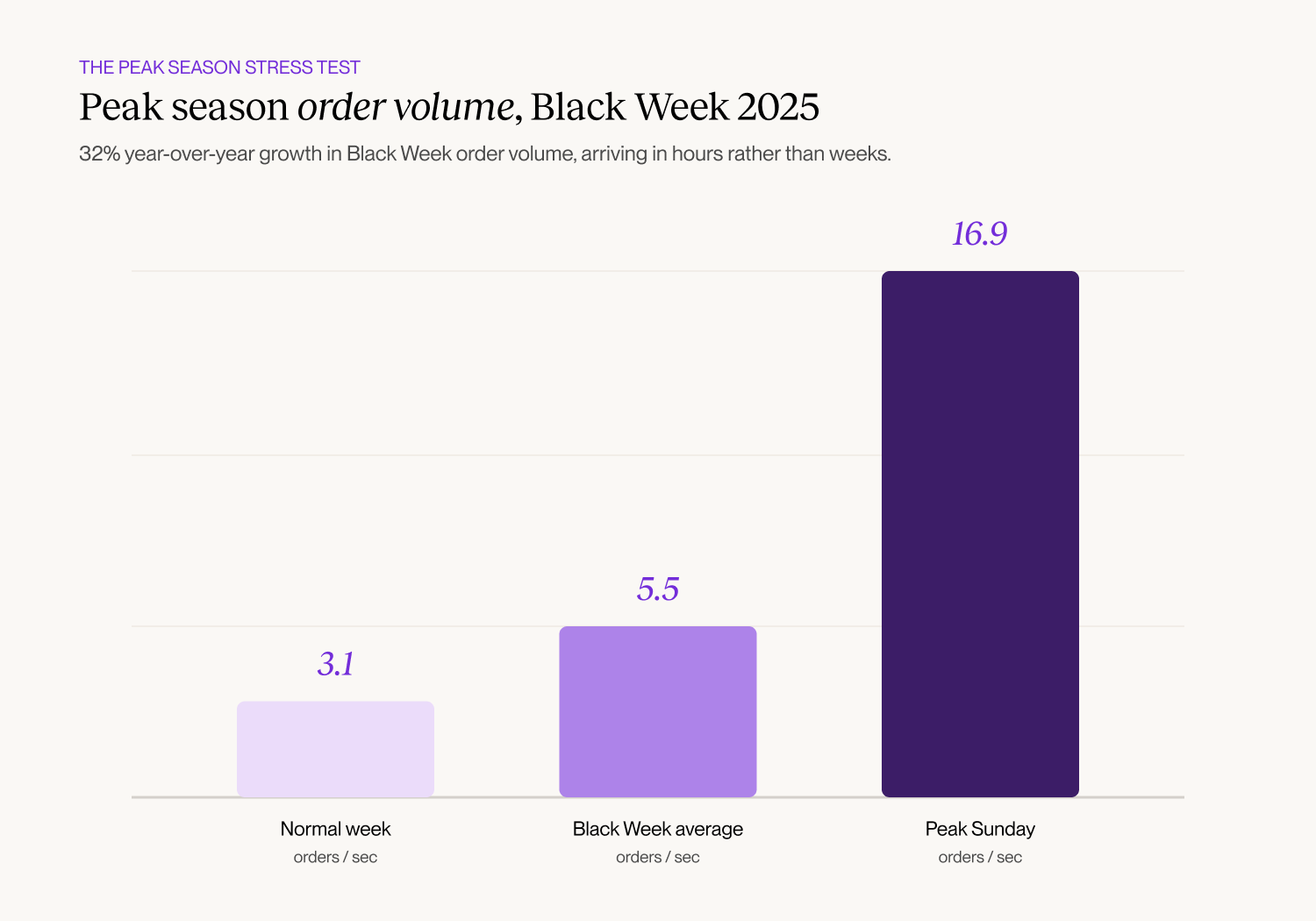
During Black Week 2025, order volume processed by Ingrid grew 32% year over year (YoY), with average throughput jumping from 3.1 orders per second in a regular week to 5.5 orders per second across Black Week, peaking at 16.9 orders per second on the Sunday before Cyber Monday.
Retail sector performance split sharply: Sports and Outdoor grew 13.1% year over year, while Fashion, Home and Electronics, and Pharmacy and Health posted more modest gains. None of that volume announces itself gradually. It arrives in hours instead of weeks and finds whatever in the setup could have already been fragile.
Checkout logic is often the first place it shows. A shopper qualifies for free shipping before a discount is applied, drops below the threshold once the sale price kicks in, and abandons at the last step. Few brands have isolated whether the delivery cost and not the product price was the actual conversion block, since that kind of test rarely happens outside peak, when the stakes of getting it wrong are highest.
Carrier capacity is the second. E-commerce brands running a single carrier, or a checkout that only ever surfaces the carrier that suits the warehouse rather than the one a shopper would choose, has no cushion once that carrier's network tightens under load. Delays start piling up and surfacing in customer service tickets, at exactly the point where support teams have the least spare capacity to absorb them.
Tracking is the third. A delay notice on a homepage rarely reaches a shopper who has already checked out. The gap opens precisely where a shopper is actually waiting, the post-purchase experience: order confirmation, tracking, inbox. Generic tracking notifications and tracking portals from carriers leave shoppers confused or unsatisfied: all they might be seeing are their parcels bouncing from one sorting center to another.
Fragmented stock is the fourth. Inventory sitting in physical stores while an online product page shows "out of stock" is not a stock problem so much as a systems one: the store has exactly what the warehouse ran out of, and without a way to route around that, the sale is lost regardless of how much inventory exists somewhere in the business.
Returns are the fifth, and the slowest to show up. Over 20% of peak season orders are returned, and the ones that ship in the first two weeks of a Black Week promotion, then come back too late to resell before Christmas, turn January into the most expensive month of the year. Refunds go out, and restocked inventory has nowhere to go.
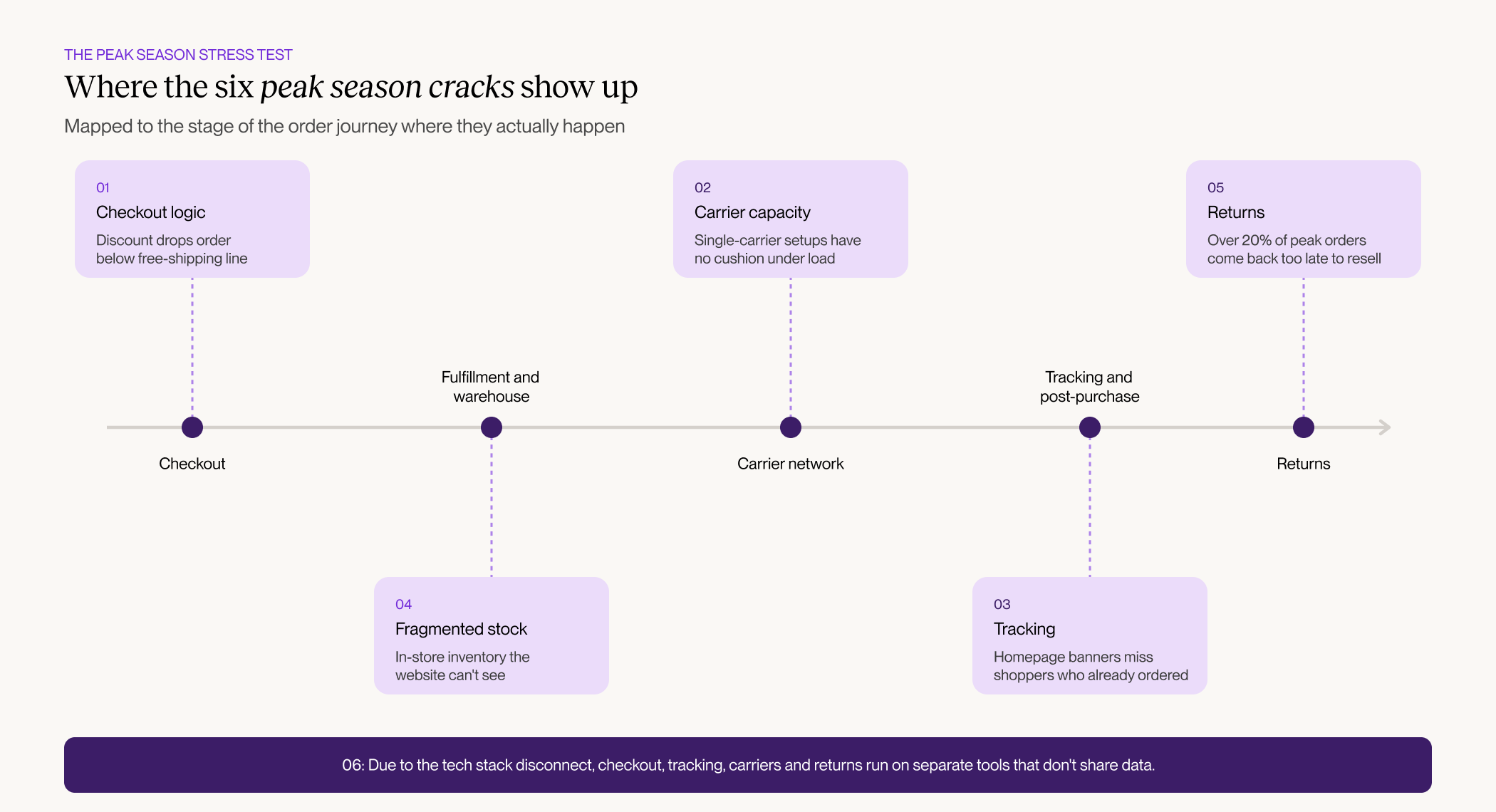
The sixth sits underneath all the others, and that’s the disconnected tech stack. Checkout in one platform, tracking in another, carrier management spread across 5-15 carriers, each with its own API, rate card and invoice format. Returns live somewhere else entirely, and none of the tools communicate with each other or share data.
It’s a ‘frankenstack’: not a decision anyone made on purpose, but the result of adding one tool at a time as the business grew. These six challenges are about which parts of a delivery setup were never load-tested until the busiest week of the year.
For an enterprise retailer, none of this stays operational for long: a gap that costs a fraction of a percent in conversion, or a return rate that eats into margin, surfaces first on an e-commerce dashboard and then, a few weeks later, in a board conversation about why Q4 came in under plan.
The six issues above are what that unanswered cost question actually looks like day to day. The strain is there year-round, absorbed into normal operations, but peak season is where it becomes too large to explain away.
Worth doing before Black Friday
A release freeze is one lever several experienced e-commerce operators point to consistently: treating the weeks from late October through the end of November as off-limits for anything touching checkout, tracking or delivery performance, with anything sitting in the backlog addressed earlier in the year. It sounds obvious, but not every team may actually enforce it as a hard rule.
Carrier diversification is another. A retailer running 2-3 carriers, including at least one backup option outside the primary relationship, has somewhere to route orders once the main carrier's network tightens. A single-carrier setup does not, and the cost of that shows up first in customer service load, then in brand reputation. If packages are delayed enough to overwhelm a support team, a retailer faces both a shipping problem and brand loyalty losses.
Moving delay communication to the point of transaction is a smaller change with an outsized effect. A homepage banner does not reach someone who has already ordered. Proactive messaging at checkout, order confirmation and in tracking updates, telling a shopper up front that a sale item may take a little longer, tends to outperform passive site-wide warnings, largely because a shopper who got a good deal is usually willing to wait, as long as they are told before they start wondering.
Ship-from-store is worth considering wherever physical inventory already exists. Paul Smith had stock sitting across 36 stores while online shoppers were seeing "out of stock" notices, right as peak season demand hit hardest. Connecting store inventory to online demand led to a 28% Black Friday revenue growth and 95% sell-through rate during the Autumn-Winter peak season.
Worth considering into 2027
The deeper fix behind any of the above is whether the underlying tech stack can support these calls quickly, with shared data, instead of routing every decision through whichever team happens to own that particular tool. A peak season problem that repeats two years running is a reasonable signal to evaluate whether the current e-commerce or delivery stack is still the right fit, rather than patching around it again. Platforms built for mass load exist for a reason, and peak season weaknesses are one of the clearest, least abstract moments to make that case internally.
2. Delivery as a commercial strategy
Nobody owns delivery margin line
Product margin has an owner. Delivery margin, in most retail organizations, does not. It gets absorbed into logistics cost or folded into marketing budget, treated as an operational expense rather than a lever anyone is actively managing, let alone testing.
That gap is expensive precisely because peak season multiplies it. Flat delivery fees and free shipping threshold inertia compound once order volume triples or more: the same untested assumption that costs a little in a normal month costs considerably more during Black Week. The retailers who are the most exposed are often those who never separated delivery revenue from the rest of the P&L in the first place.
Now, discounting and free shipping aren’t quite a strategy. The instinct when checkout conversion dips tends to repeat itself every year: cut the price further, or drop the free shipping threshold, without first testing whether delivery cost, not the product price, was the actual block.
Offering free shipping across the board without a free delivery threshold or a plan behind it tends to be straightforwardly bad for margin. Retailers who have never A/B tested removing or raising the threshold are often not constrained by data telling them not to, they are constrained by never having tested it at all.
Worth doing before Black Friday
Testing delivery pricing changes now, rather than during Black Week, is the highest-leverage single move available here. Threshold and shipping cost experiments run on normal volume in the months before peak season, then extrapolated for a three to five times volume multiple, produce a far more reliable read than anything tested live during Black Week, when there is no room to course-correct if it goes wrong. NA-KD ran exactly this kind of structured A/B test on its free shipping threshold ahead of peak season and grew shipping revenue 82%, without the conversion damage the team had assumed would follow raising it.
Assigning delivery to a commercial owner and a revenue target before November, rather than a cost budget after the fact, is a second lever worth considering. As long as the delivery margin sits inside logistics cost or gets absorbed by marketing spend, nobody is incentivized to test it, and the leak compounds every peak season instead of shrinking.
A third is making carrier choice a checkout decision rather than a warehouse one. A common pattern is surfacing only the carrier most convenient for fulfillment, rather than the one a shopper would actually pick given the choice. That is a logistics decision wearing a checkout's clothes, and it costs conversion precisely when order volumes, and the stakes of a lost sale, are highest.
Worth considering into 2027
Introducing membership and loyalty models that bundle delivery, returns and exchange perks. Select offers tend to work well for retailers with a broad, high-frequency catalog, less so for niche or infrequent-purchase categories. In the UK, according to a 2026 shopper survey, 11% say they have joined a membership program purely for delivery benefits, and 53.8% cite free delivery as a loyalty perk as the most important convenience improvement. More broadly though, the goal for 2027 planning is building delivery margin measurement into the same planning cycle as product margin and marketing spend.
3. The delivery promise stress test
Speed alone stopped being the differentiator
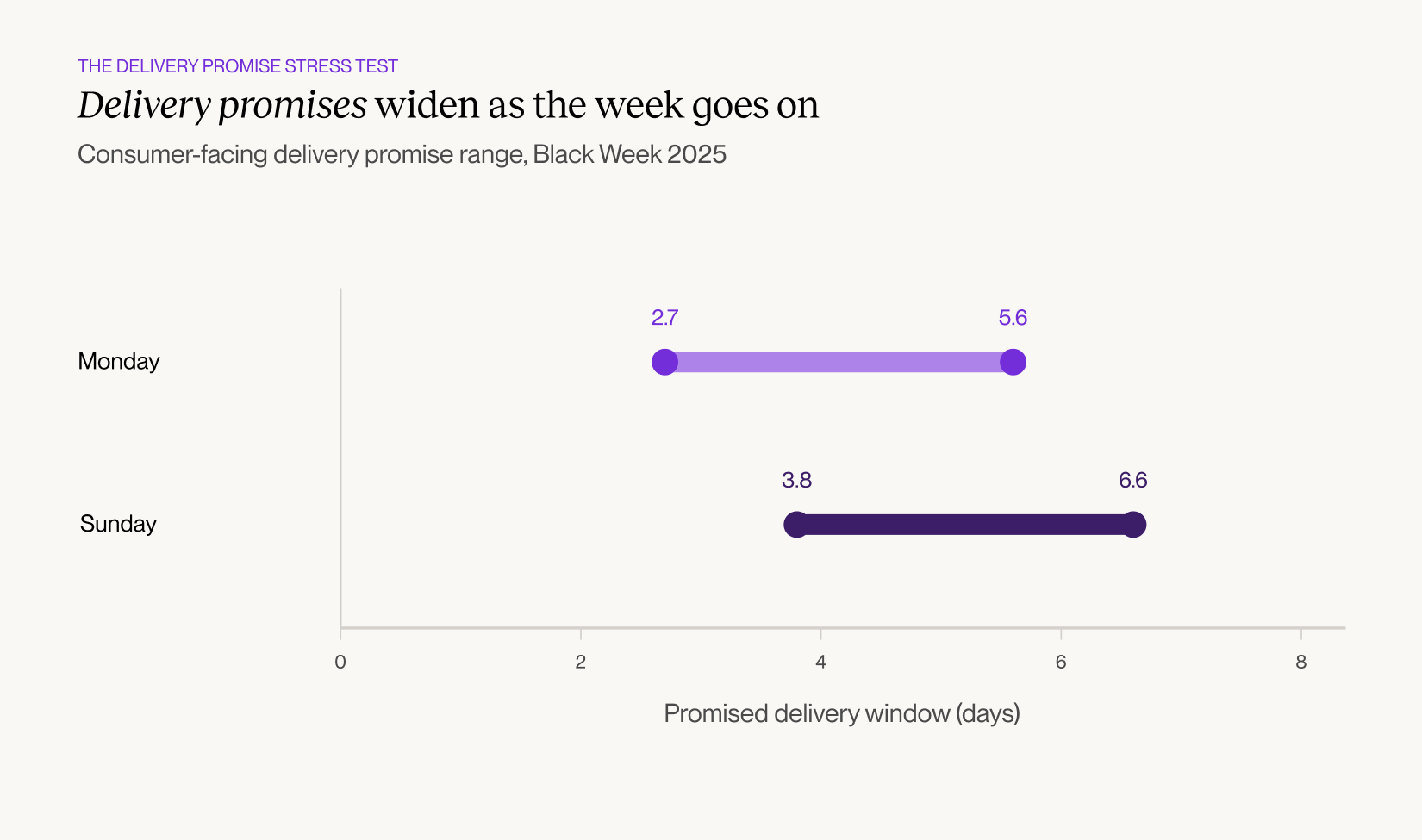
For years, the assumption was that delivery competition came down to speed: whoever promised the fastest date won the order. That’s no longer the whole picture. Average consumer-facing delivery promises during Black Week 2025 stretched from 2.7 to 5.6 days on the Monday to 3.8 to 6.6 days by the following Sunday, lengthening as volume and the weekend approached, a pattern that mirrored 2024 as well.
Nowadays, shoppers are less likely to walk away over the speed of delivery. Late deliveries are the more telling number: 31% of orders arrived late during Black Week 2023 against a regular-week baseline, improving somewhat by 2024 but still well above normal. What actually costs a retailer trust isn’t a promise of five days instead of two, but a promise that turns out to be wrong.
“Accuracy outweighs speed by 100%. Because we offer a premium product, people usually take a long time deciding but expect their orders to be delivered no later than promised."
— Dominik Högger, European Retail Manager, Red Wing Shoes
One short-term strategic fix would be to widen the brand’s typical delivery windows by an extra day during peak sales. Since 65% of delays happen in transit, this protects against carrier congestion without breaking trust. It's better to underpromise and overdeliver than the other way around.
Another would be to add a free fallback delivery option. Retailers can offer a wider-window option that books any currently available carrier at better rates, while keeping paid options for express or time-slot delivery, so they can fulfill orders even when top-of-mind carriers hit capacity.
The delivery promise gap matters even more now because shoppers are not the only ones evaluating it. Specific, accurate delivery dates decide how AI shopping agents assess and surface retailers, in much the same way a vague "3 to 5 business days" used to cost conversion with human shoppers.
It’s not a future scenario. Retailers researching considered purchases are already automating parts of that comparison today. One data point worth sitting with: in May 2026, at a commerce industry event with roughly 400 retail attendees on the topic of agentic shopping, only a handful said they were actively working on anything related to it. Interest is high, but execution isn’t there yet, which leaves the gap between "aware of this" and "measuring this" wide open for whoever closes it first.
Worth doing before Black Friday
Building in a mechanism to adjust the promise in real time, not only at checkout, is one of the more effective low-cost changes available. If warehouse throughput slows during peak load, adding a working day to the promised delivery window in the backend, so checkout reflects it immediately, protects trust more than an unchanged promise that turns into a broken one. This is achievable on most existing tech stacks without new software; the underlying principle matters more than any specific tool used to apply it.
Segmenting delay communication by product type, rather than relying on blanket messaging, is a second option worth testing. Shoppers ordering sale or clearance stock can be told upfront that fulfillment may take a little longer, while regular-stock communications stay clean. Proactive, specific messaging at the point of transaction tends to outperform a generic site-wide banner, largely because it reaches a shopper exactly when they are deciding whether to trust the purchase.
Starting to measure agentic referral traffic now, even informally, is worth the modest effort it takes. Whatever share of traffic is already arriving via AI assistants and shopping agents this year becomes the baseline for judging next year's progress. Retailers who wait until this channel is unmistakably large will be measuring from zero at a moment when competitors already have a year of data behind them.
Worth considering into 2027
Accurate, real-time delivery promises are difficult to sustain without checkout, tracking, carrier and returns data actually talking to each other. Carrier performance data should sharpen the promise a shopper sees at checkout, and tracking events should trigger proactive communication before anyone has to ask where an order is. Returns data belongs in that same picture too, feeding back into delivery economics instead of sitting in a system nobody reconciles.
That’s the long-term argument for consolidating a fragmented delivery stack: not simply fewer vendor contracts, but a single connected layer where every touchpoint's data sharpens the next decision. Retailers heading into 2027 without that connective layer are likely to find delivery promise accuracy, and by extension AI agent visibility, increasingly hard to compete on, no matter how good any individual tool in the stack is on its own.
Black Friday delivery revenue insights 2025
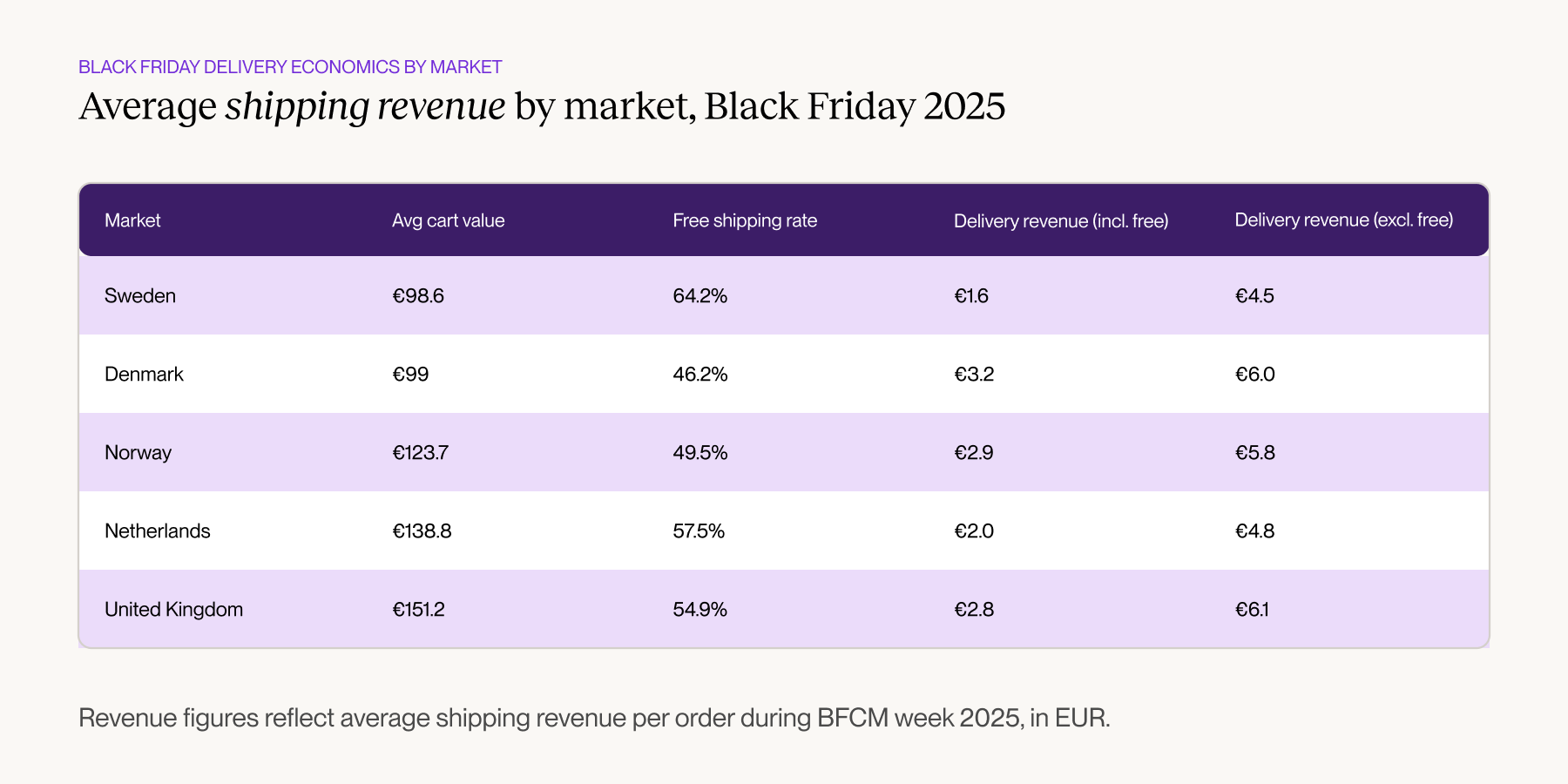
Free shipping strategy varied sharply by market during Black Friday 2025: Sweden gave it away most often, Denmark the least. In 2025, Sweden led with 64% free shipping despite having the lowest average cart value, with the Netherlands close behind at 58%.
Norway and the UK showed higher cart values but lower free shipping rates at 55% and 50% respectively. Denmark had the lowest free shipping rate at 46%. Shipping revenue including orders with free delivery fell between €1.6-€3.2. When customers did pay for shipping, adjusted shipping revenue stayed relatively consistent across markets between €4.5-€6.1.
Average delivery revenue in Sweden
Sweden showed the lowest average cart value at €98.6 yet offered the highest free shipping rate at 64.2%. Average shipping revenue including free orders was €1.6, the lowest across the five markets mentioned, while adjusted shipping revenue excluding free shipping stood at €4.5. This aggressive free shipping strategy significantly impacts overall shipping revenue capture despite consistent rates when customers do pay for delivery.
Average delivery revenue in Denmark
Denmark recorded an average cart value of €99 with the lowest free shipping rate at 46.2% across all five markets. Average shipping revenue including free orders was €3.2 — the highest among the five market spotlights — while adjusted shipping revenue excluding free shipping reached €6.0. The conservative free shipping approach combined with low cart values suggests a strategy focused on protecting shipping margins rather than subsidizing delivery costs.
Average delivery revenue in Norway
Norway demonstrated an average cart value of €123.7 with 49.5% of orders receiving free shipping. Average shipping revenue including free orders reached €2.9, while adjusted shipping revenue excluding free shipping stood at €5.8. The balanced approach shows moderate free shipping adoption alongside relatively strong shipping revenue when fees are applied, suggesting strategic threshold management.
Average delivery revenue in the Netherlands
The Netherlands recorded an average cart value of €138.8, with 57.5% of orders qualifying for free shipping— the second-highest free shipping rate after Sweden. Average shipping revenue including free orders was €2.0, the lowest across all markets, while adjusted shipping revenue excluding free shipping stood at €4.8. This indicates a generous free shipping strategy that impacts overall revenue capture despite healthy cart values.
Average delivery revenue in the United Kingdom
The UK showed the highest average cart value at €151.2 during the BFCM week 2025, with 54.9% of orders receiving free shipping. Average shipping revenue including free orders stood at €2.8, while adjusted shipping revenue excluding free shipping reached €6.1. The relatively high cart value paired with moderate free shipping rates suggests retailers can command premium basket sizes while maintaining shipping revenue.
Peak season turns up the volume, literally
None of the six cracks in section one, the untested margin line in section two, or the promise-accuracy gap in section three are new problems. They were already present in most delivery setups well before Black Friday week arrives. Peak season simply removes the ability to ignore them for one more year. Enterprise retailers, who run enough volume that a fraction of a percent shows up as a meaningful number, tend to feel that pressure first.
The retailers already treating delivery this way are testing pricing decisions before committing to them, connecting the stock and systems they already have instead of buying more, and starting to measure the parts of the customer journey, agentic referral traffic among them, that will matter more next year than they do today. They treat delivery decisions, especially over Black Friday and Christmas, as something worth testing rather than something to survive.
Nelly recovered about €145K a year simply by re-examining invoiced delivery data instead of accepting penalty fees as a cost of doing business. NA-KD grew delivery revenue 82% by testing free delivery thresholds instead of assuming a higher one would hurt conversion.
Apoteket grew delivery revenue 75% by rebuilding delivery pricing around order profitability instead of a blanket free-shipping policy. Cellbes added 23% in delivery revenue and Åhléns 12% in delivery revenue by re-ranking checkout delivery options instead of leaving them on autopilot.
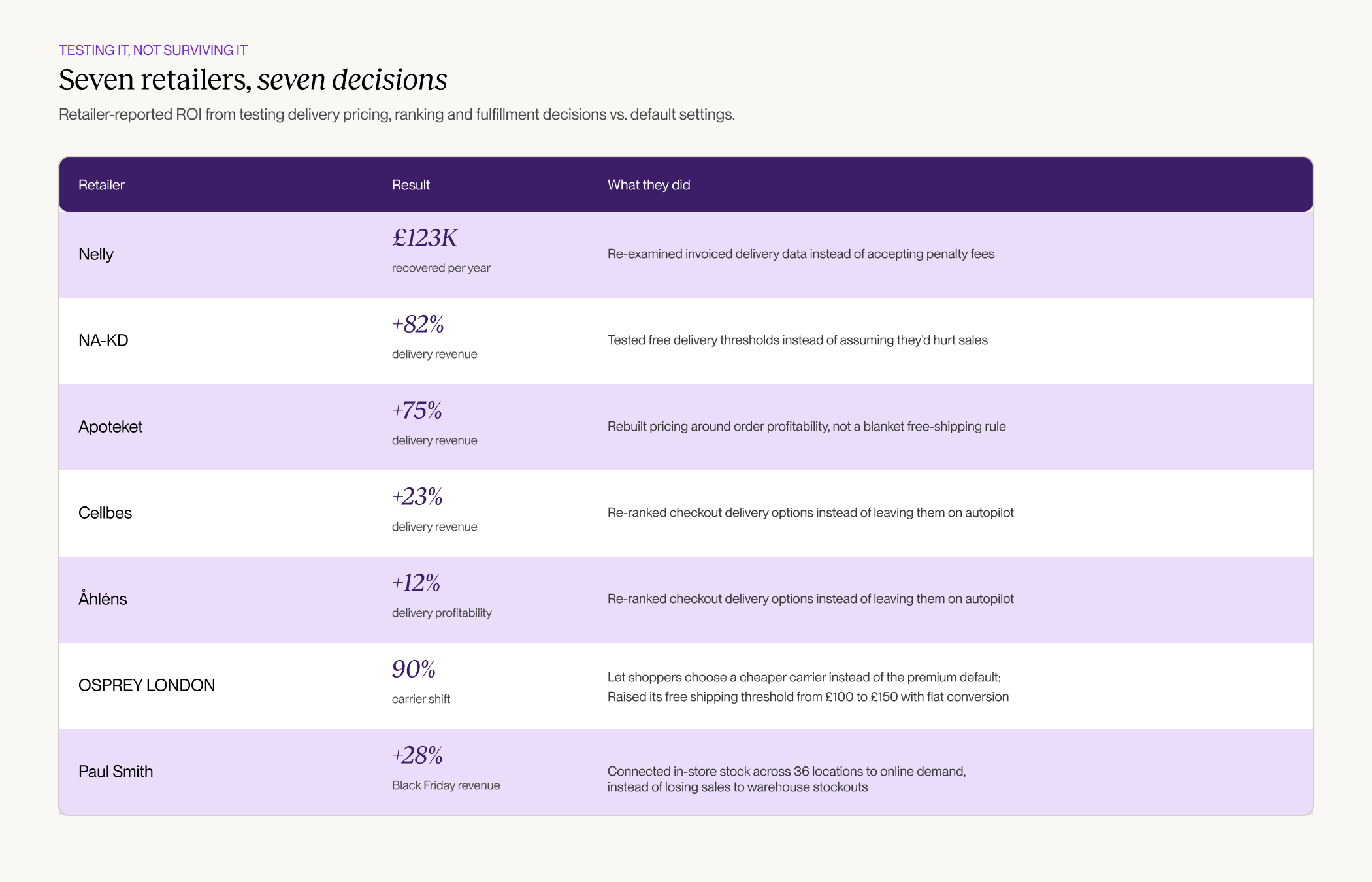
OSPREY LONDON saw 90% of UK volume shift to a cheaper carrier once shoppers were given a choice at checkout, challenging the assumption that customers preferred the premium option it had always defaulted to. Raising its free shipping threshold from £100 to £150 left conversion unchanged, challenging the assumption, drawn from customer surveys ranking free delivery a top priority, that a higher threshold would cost sales.
None of this requires equal effort, or an equal team, from every retailer. A lean mid-market operation without a dedicated ops function will get more out of picking one lever than attempting all ten above. The release freeze and the shift to proactive delivery promise communication cost time and discipline rather than budget or new software, which makes either a more realistic starting point for a smaller team than a full carrier renegotiation or a platform evaluation.
FAQ
How do you reduce delivery costs during Black Friday?
Test pricing changes on normal-volume months before peak, then extrapolate for a three-to-five-times volume multiple, rather than testing live during Black Week when there's no room to correct the course. NA-KD ran this kind of test on its free shipping threshold and grew shipping revenue 82% without the conversion drop the team expected.
What's a good free shipping threshold for Black Friday?
There's no universal number, and that's the actual finding: retailers who've never A/B tested raising or removing their threshold are working from assumptions rather than data. Using delivery data analytics, Apoteket rebuilt its pricing around order profitability instead of a blanket free-shipping policy and grew shipping revenue 75% while holding conversion within a 1% margin.
How do you reduce cart abandonment caused by delivery costs?
One overlooked cause: a shopper qualifies for free shipping, a discount drops the order below the threshold, and they abandon cart at the last step, so it’s worth checking whether delivery cost, not product price, is the actual conversion block. Retailers with existing analytics can segment cart abandonment by proximity to the free shipping threshold. Those who don’t have that visibility can start with a temporary threshold change and compare conversion before and after, which isn't a true test, but establishes the same finding without new tooling.
What is ship-from-store and does it help during peak season?
It connects inventory sitting in physical stores to online demand, so a warehouse stockout doesn't have to mean a lost online sale. Paul Smith adopted it after stock sat across 36 stores while online shoppers saw "out of stock" during peak demand, and saw 28% Black Friday revenue growth with a 95% sell-through rate that season.
How do you prepare for Black Friday shipping delays?
Diversify carriers before peak, not during it. A retailer running 3-5 carriers, including a backup outside the primary relationship, has somewhere to route orders once the main carrier's network tightens; a single-carrier setup doesn't, and the cost shows up first in customer service load, then in brand reputation. 55% of shoppers cite inaccurate delivery time as their top post-order frustration
When should you stop making changes to your e-commerce site before Black Friday?
Several experienced e-commerce operators treat late October through the end of November as off-limits for anything touching checkout, tracking or delivery performance, and address backlog items earlier in the year instead. It sounds obvious, but not every team enforces it as a hard rule.
Does delivery speed or delivery accuracy matter more to shoppers?
Accuracy, not speed. Average delivery promises during Black Week 2025 stretched to 5.6-6.6 days, longer than what used to count as fast, yet late deliveries are what actually costs retailers trust. 70% of shoppers say they would question their loyalty to a brand if it did not live up to its delivery promise, and 54% claim they would not buy from a brand again after a delivery promise failure.
How do AI shopping agents evaluate delivery options?
Specific, accurate delivery dates are what AI shopping agents use to compare and surface retailers, the same way a vague "3 to 5 business days" used to cost conversion with human shoppers. Adoption is early: at a May 2026 industry event with roughly 400 retail attendees on agentic shopping, only a handful said they were actively working on it.
Who should own the delivery margin in a retail organization?
In most organizations, nobody does. It gets absorbed into logistics cost or folded into marketing budget rather than managed as its own line, which is expensive precisely because peak season multiplies whatever assumption was never tested.


Related blog posts

A 20% better delivery experience is worth 5-10% more sales
Delivery drives 29-42% of satisfaction with a brand. What's it worth in sales?

Delivery, the most overlooked growth lever in e-commerce
Why delivery decides trust, conversion and repeat purchase, especially in agentic shopping.

How to choose a multi-carrier delivery platform: a buyer's guide for enterprise e-commerce
Carrier orchestration, checkout impact, delivery accuracy, analytics, and cost control.
