

Shopify agentic commerce: Claude agents and delivery

Anastasiia Starchenko

Claude commerce agents can shop a Shopify store and complete orders, and for stores running Ingrid, every order still ends with Ingrid’s full delivery offer at checkout. In the chat, a generic agent only sees basic delivery methods and fixed rates set up in Shopify, while live delivery options, carriers, dates and pickup points stay at checkout. To bring that information into the conversation, retailers need a delivery-aware agent connected to their delivery data, for example through Ingrid’s API.
What are Claude commerce agents, and what changes for Shopify retailers?
Claude commerce agents are AI shopping assistants built from a blueprint Anthropic published in September 2026. In the same announcement, Shopify told retailers that they can connect an agent built this way to their stores with little effort.
Read together, the two posts sound like one launch. They aren't. Shopify's Cart MCP and Checkout MCP, the tools that let an agent build a cart and turn it into a checkout, have been available for a while. What's new is a ready-made starting point that helps developers build an agent on top of them in hours, or minutes even, instead of weeks.
The two tools split the work. Cart MCP handles most of the agentic shopping journey: the agent uses it to build and adjust the cart while it talks with the shopper. Checkout MCP comes in only at the very last step, when the cart becomes a checkout and the shopper takes over to pay.
That's useful for engineering teams. For retailers, the split between cart and checkout raises a more interesting question. Most of the conversation happens in the cart, while delivery options appear at checkout. So what happens to delivery when a shopper stops browsing a page and starts asking an assistant instead? Our team built a test store to find out.
How does a Claude agent check out on a Shopify store?
A Claude agent checks out on Shopify in five steps, using Shopify tools built on the Universal Commerce Protocol (UCP), an open standard for how AI agents and online stores talk to each other. We covered it in detail in our UCP explainer. Here, it's enough to know that UCP splits a purchase into separate steps, and Shopify offers a tool for each one.
- Shop Sign-in lets the shopper log in, so the agent can personalize what it suggests.
- Shopify Catalog lets the agent search products and compare them.
- Cart MCP builds the cart. Most of the conversation happens here: adding items, changing sizes, checking estimated totals.
- Checkout MCP turns the cart into a checkout once the shopper is ready to buy. It's rate-limited more strictly than Cart MCP, so it's meant for the final step and not for back-and-forth chat.
- By default, the agent hands the shopper a link to the retailer's own checkout page, where payment happens. That's good news for anyone worried about agents and payment data: the agent never sees a card number, and the shopper pays on the same checkout page they'd use on the website. Shopify lets agents it verifies at higher trust levels complete checkouts directly.
Can an AI shopping agent see delivery options on Shopify?
Not by default and not in full. Our team built a shopping assistant on the blueprint and connected it to a Shopify test store running Ingrid. As an assistant, it worked well. It found products, explained them and built the cart in a few messages. Checkout and delivery were a different story.
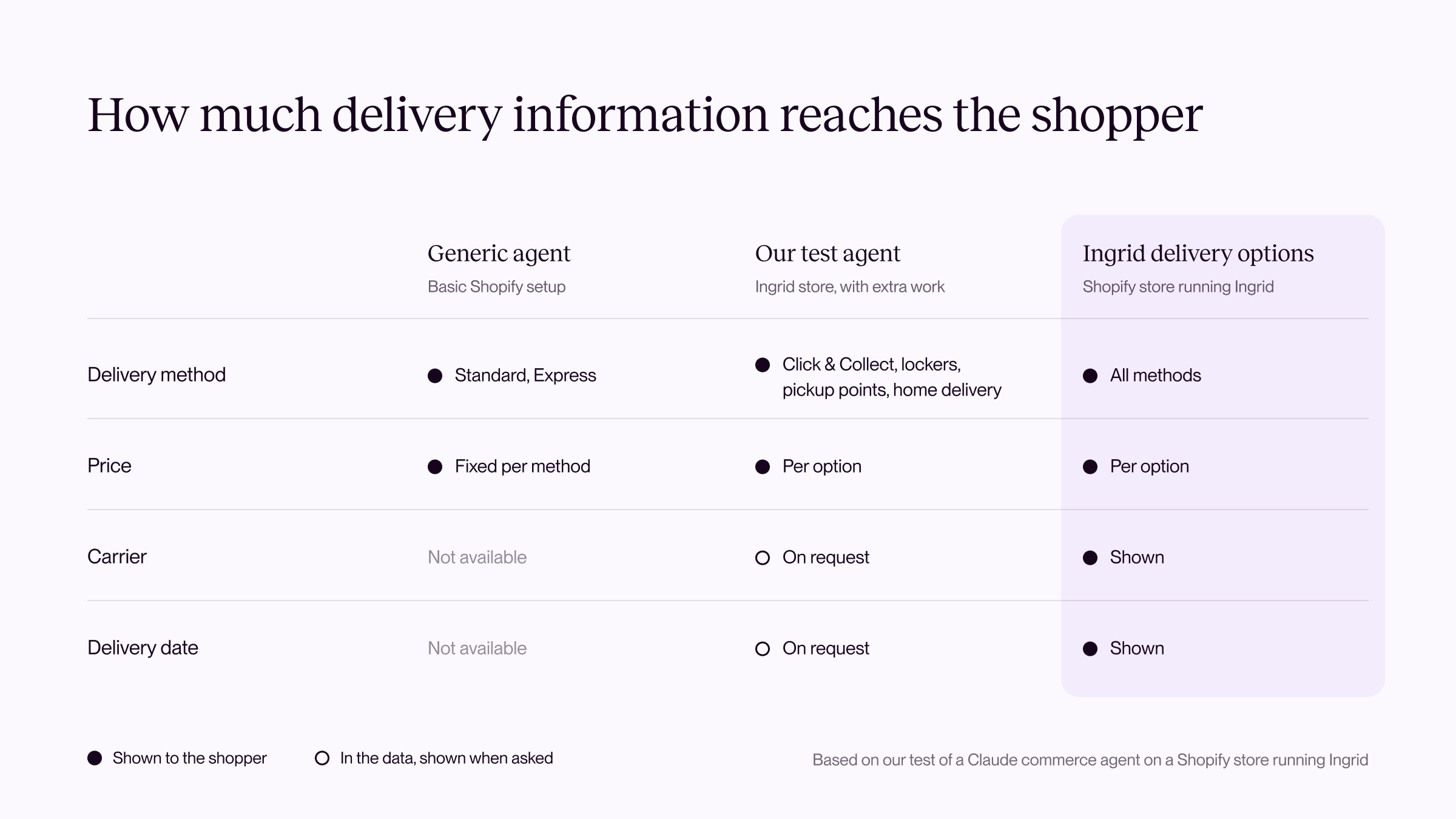
By default, a generic agent sees the delivery information set up directly in Shopify, such as delivery methods and their rates, because it's stored in the store's settings. Ingrid's delivery information works differently: delivery options, prices, carriers and dates are calculated for each order, based on what's in the cart and where it's going, and Shopify requests them when the checkout is created.
For retailers already using Ingrid on Shopify, that means an order placed through any agent still ends with Ingrid's full delivery offer at checkout, with no extra setup. It also means a generic agent only meets that information once the shopper reaches checkout.
With some extra work on our side, the agent could bring Ingrid's options into the chat. When our test shopper asked "what are my delivery options?,” it listed the available methods, such as Click & Collect, parcel lockers, pickup points and standard delivery, each with its price.
The agent stopped there, even though it had more to share. Delivery dates and carriers were already in the data it received, but it only mentioned them when the shopper asked or when it was instructed to. The checkout page showed the same options with the full delivery promise, such as Click & Collect available within 4 hours or parcel locker delivery in 1–2 business days, with the carrier for each. Whether that promise also reaches the shopper in the chat comes down to how the agent is built and instructed.
How can retailers make Ingrid delivery options agent-ready on Shopify?
By building an agent that's connected to them. Any agent can complete a purchase on a Shopify store running Ingrid, but only an agent connected to the retailer's delivery data can talk about delivery before checkout.
That leaves retailers with a choice, whether or not they've noticed it yet. For the purposes of this explainer, let’s use two conceptual labels: a generic agent and a delivery-aware agent. These aren't official terms from Anthropic or Shopify.
Generic agent
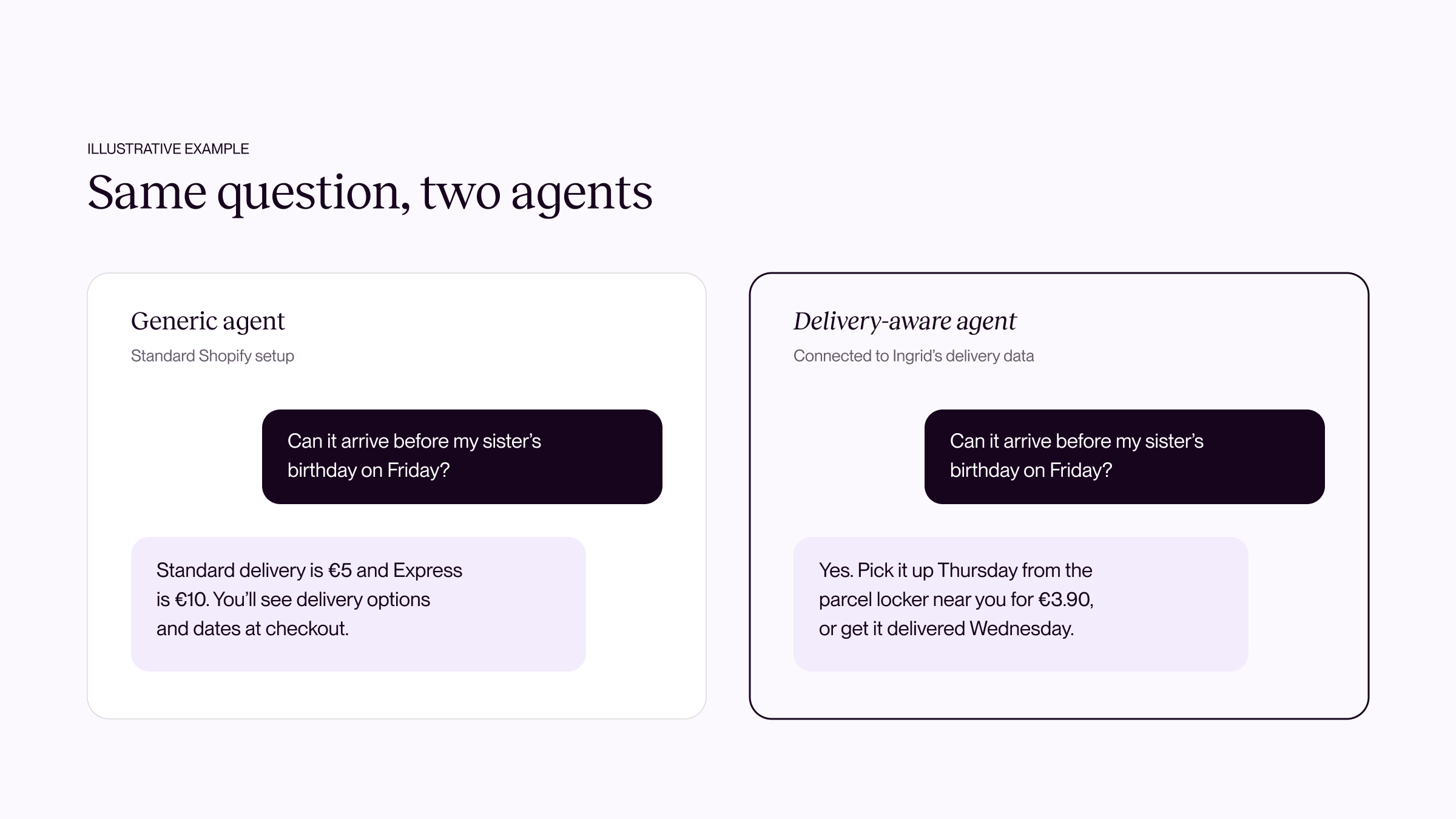
A generic agent connects to a Shopify store and works fine at a technical level. If the store uses simple delivery rates set up in Shopify, such as "Standard, €5" and "Express, €10", the agent can read them and share them in the chat.
The live delivery information Ingrid brings, such as nearby pickup points, delivery estimates and carrier options calculated for each order, stays out of the conversation. The shopper sees it only at checkout, so the delivery choice happens after the conversation is over.
Delivery-aware agent
A delivery-aware agent is built for one retailer and connected to its delivery data, for example, through Ingrid's API. That opens the conversation to questions a generic agent can't answer, such as "Does it ship to my usual pickup point?" or "Can it arrive before my sister's birthday on Friday?" With Ingrid's delivery data behind it, the agent could answer with real options, times and places before the shopper reaches checkout.
This is where Ingrid's delivery personalization fits the conversation. Predictive delivery times tell the shopper when an order is likely to arrive, and options pre-selected with the retailer's margin in mind put the best-fitting choice first.
Specific promises also matter beyond one retailer's chat: they're among the signals AI agents use to rank retailers on delivery and returns. For mid-market and enterprise retailers already running Ingrid, the delivery side is in place. What's left is building a delivery-aware Claude commerce agent that brings it into the chat.
Who builds a delivery-aware agent?
The retailer, either its own engineering team or a commerce agency working for it. Neither Shopify nor Ingrid builds the agent. Each company supplies a different part:
- Anthropic provides the blueprint, which is the agent's starting code and design.
- Shopify provides the commerce tools the agent uses, from product search to checkout. By default, payment stays on Shopify's checkout page.
- Ingrid provides the delivery information shown at Shopify's checkout, from options and prices to carriers and delivery dates, through a back-end connection between the two systems. For stores using Ingrid, Shopify asks Ingrid for this information whenever a checkout is created, so it works whether a person or an agent built the cart.
- For a delivery-aware agent, the retailer's developers also connect the agent to the retailer's delivery data, for example through Ingrid's API, so the agent can use it during the chat. Ingrid supplies the data, and the retailer builds the agent.
In practice, this means a decision worth making early. If an AI shopping agent is part of your plans, decide whether delivery belongs in the conversation, and if it does, include delivery data in the agent's scope from the start.
For retailers already running Ingrid on Shopify, the delivery data is in place, and the work is in the agent. For retailers evaluating a new delivery platform, it's worth checking whether delivery options, prices, carriers and dates are calculated for each order and available through an API before checkout, and whether the same data also serves tracking and returns.
Consistent delivery intelligence from checkout to returns
Retailers keep delivery consistent by running every surface on the same delivery intelligence: shopper, retailer and carrier data that shapes everything from the options and promise at checkout to tracking and returns. The website, the checkout page and now the AI agent conversation all ask the same question: what can this shopper get, at what cost and how reliably? Answering it the same way everywhere depends on a few things working together.
The first is data quality: a delivery promise is only as good as the address, carrier and performance data behind it, and stale data fails the same way on a product page as it does in a chat.
The second is the operation behind the promise. Tracking, carrier performance and returns all sit behind the one line an agent gives a shopper. When the operation doesn't back that line up, the shopper blames the channel that made the promise.
The third is a promise that adapts to the shopper. The right option, cost and delivery time depend on who's buying, what's in the order and which market they're in. Ingrid's API-first infrastructure serves that promise to any surface that asks for it, whether it's a checkout page or an agent built for one retailer.
As shopping keeps moving to new surfaces, solving delivery once, in one system, will matter more than rebuilding it for every new channel. That's the idea behind Ingrid's Agentic DeliveryOS, the agentic operating system that runs delivery end to end, built on shopper, retailer and carrier intelligence. Whether a shopper buys on a product page, at checkout or through an AI agent, the delivery promise comes from the same place.
To go deeper, read what agentic commerce infrastructure means for delivery or our report on delivery in agentic commerce.
FAQs
Can a Claude commerce agent show delivery options on a Shopify store?
Yes, with limits. By default, an agent built on Anthropic's blueprint sees the delivery methods and rates stored in Shopify's settings. Delivery options calculated for each order, such as Ingrid's, appear at Shopify checkout and reach the chat only if the agent is built to request them.
Does a Claude commerce agent work with Ingrid on Shopify?
Yes. For stores using Ingrid, Shopify requests delivery options from Ingrid whenever a checkout is created, so an order started by any agent ends with Ingrid's delivery options at checkout. Showing those options in the chat itself takes an agent connected to the retailer's delivery data, for example through Ingrid's API.
What's the difference between Shopify Cart MCP and Checkout MCP?
Cart MCP lets an agent build and adjust a cart during the conversation, and it handles most of the shopping journey. Checkout MCP turns the finished cart into a checkout at the last step and is rate-limited more strictly, so it isn't meant for back-and-forth chat.
What should retailers look for in a delivery platform for agentic commerce?
Delivery options, prices, carriers and delivery dates that are calculated for each order and available through an API before checkout. The same data also needs to serve tracking and returns, so the promise an agent makes matches what happens after the order.

FAQs
What does Ingrid Platform do?
Ingrid is the leading delivery intelligence platform that helps retailers turn delivery from a cost into a commercial advantage. Its modular platform connects retailers, carriers and shoppers across the whole shopping journey — discovery, checkout, tracking, transport, in-store and returns — so every delivery decision drives conversion, margin and loyalty on top of fulfillment and logistics.
How is Ingrid different from other delivery and shipping tools?
Most tools own a single touchpoint: logistics-led platforms stop at booking and labels, and post-purchase tools only start after the sale. Ingrid connects carrier choice to conversion and margin, with built-in A/B testing to prove what works. It gives retailers flexibility, choice and control instead of a fixed, one-size-fits-all setup.
Who is Ingrid for?
Ingrid is built for mid-market and enterprise e-commerce and omnichannel retailers shipping across multiple carriers, markets or delivery methods. Typically heads of e-commerce, logistics and operations leaders who want to turn delivery into a measurable revenue and margin lever. Retailers like Paul Smith, NA-KD, Apoteket, Nordic Nest and Mint Velvet use it to raise AOV, lift conversion, cut delivery-related support, implement direct exchanges, and increase delivery profitability.
Why does delivery intelligence matter?
Product and price used to decide the sale; now delivery does, too. Shoppers increasingly choose by delivery availability — same-day, next-day, pickup or in-store — while AI shopping agents rank retailers on delivery signals rather than branding. Ingrid helps retailers adapt with personalized delivery experience from checkout to returns. Back-end delivery intelligence contains cost and increases revenue, so delivery becomes a competitive advantage.
Related blog posts
Shopify agentic commerce: Claude agents and delivery
We tested a Claude commerce agent on Shopify. Here’s what it saw about delivery.

Post-purchase journeys: turn delivery events into personalized messages
How delivery events can power personalized post-purchase journey that sell.

What does agentic commerce infrastructure mean for delivery?
How an API-first delivery setup lets AI agents read a retailer's delivery offer on behalf of shoppers.