

How to get accurate delivery costs into your product feeds across every market, channel, and SKU

Anastasiia Starchenko

Who this guide is for
E-commerce and performance marketing decision-makers at multi-market retailers who already run product feeds across search and social, and are scoping how to make delivery cost accurate at catalog scale — by hand, with a feed tool, or platform-native. If you're earlier than that and still standardizing feed basics, start with the fundamentals in Google Merchant Center's feed specification and come back to this for the delivery-cost layer.
You already run product feeds across Google Shopping, Meta, TikTok Shop, Pinterest, wherever your shoppers discover and buy. You've optimized titles, split out campaigns, tuned bids, and cleaned up your images. So why does product feed optimization still feel like it's leaving money on the table? Look at the field almost nobody touches: delivery cost.
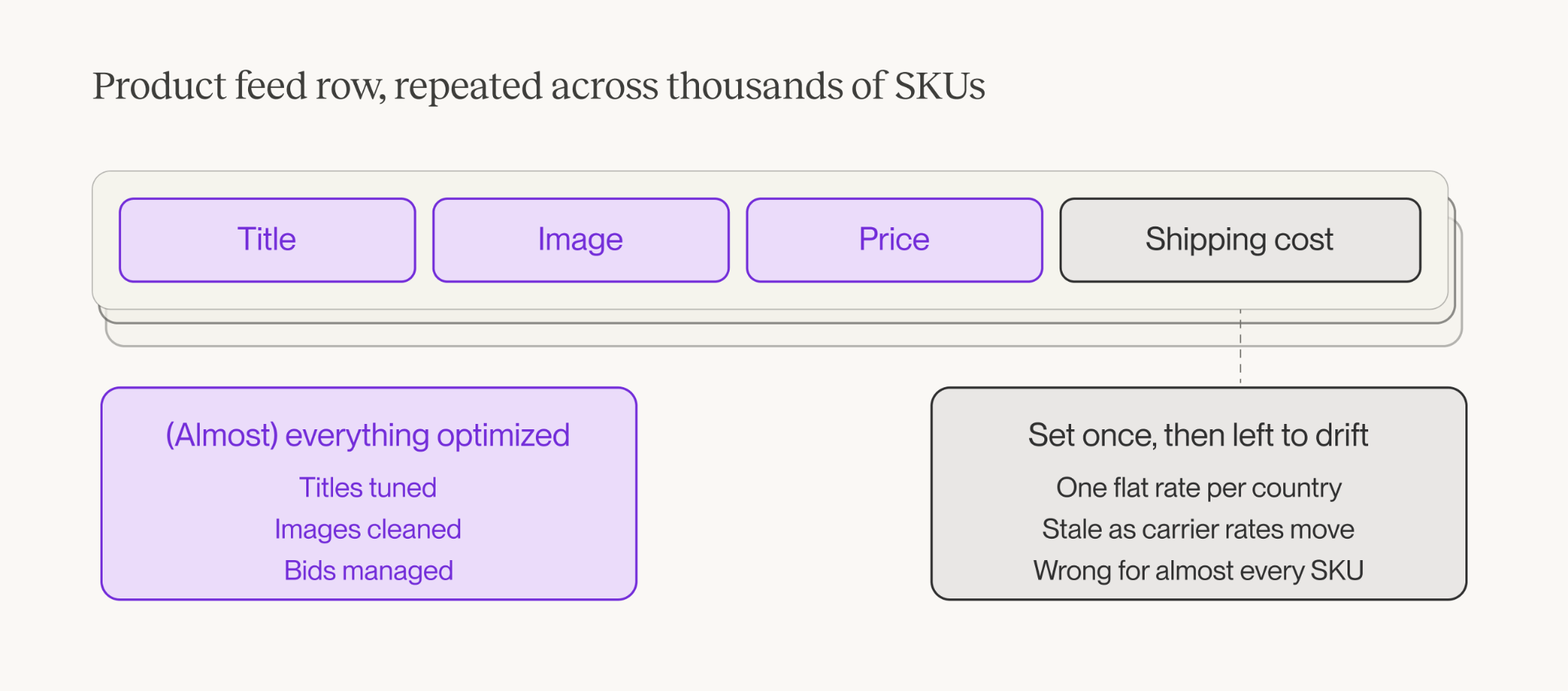
For most retailers, shipping is the most neglected attribute in the feed. It's set once, usually as a flat number per country, and then left to drift. But across thousands of stock keeping unites (SKUs) and dozens of markets, a wrong or generic delivery pricing is expensive in ways that don't clearly show up as a delivery-related cost.
It inflates your cost per acquisition instead, triggers Merchant Center disapproval and quietly suppresses conversion when the price a shopper sees in an ad doesn't match the price at checkout. This guide is about fixing that. Not setting up a feed from scratch, but optimizing the one part of it that complex catalogs consistently get wrong, on search and social alike.
Why delivery cost is the most neglected field in your feed
Feed optimization advice almost always stops at the obvious attributes: title, description, product type, image, price. Shipping gets a single setting and a shrug, because delivery cost is the attribute least suited to being set once.
While delivery pricing changes are deliberate and visible, delivery cost changes are ongoing and invisible. Carrier rates move, surcharges appear, a heavy item ships differently than a small one, and the same product costs a different amount to deliver in Stockholm than in Madrid. A flat rate can't represent any of that, so retailers do one of three things, all of which cost them:
- They overstate shipping to stay safe, and lose the price comparison in the ad.
- They understate it and impact margin on every order while risking a mismatch with checkout.
- They average it across the catalog, which is wrong for almost every individual product.
This is identical whether the destination is Google Shopping, Bing, Meta, TikTok Shop, or Pinterest. The feed is the feed. A delivery cost that's wrong in your Google Merchant Center feed is wrong in your Meta catalog too — you've just multiplied the problem by the number of channels you sell on.
How search and social platforms actually use shipping data
It's worth being precise about where shipping data lives, because that's where the trouble starts.
On Google, you can declare shipping in two places: account-level shipping settings in Merchant Center, or the shipping attribute on each product in the feed. Account-level settings are simple — a handful of rules covering a country or a price band. They work beautifully for a small catalog with predictable shipping.
They fall apart the moment your real delivery cost depends on the individual product (its weight, its dimensions, its origin) and the specific market. At that point, the feed-level shipping attribute is the only place granular enough to tell the truth, as it overrides the account-level defaults per product, and it has to be populated, per SKU, per market, and kept current.
Social platforms work the same way conceptually. Meta, TikTok Shop, and Pinterest all consume a product catalog, and shipping is an attribute within it. The mechanics differ, but the failure mode is the same: a per-platform feed, maintained separately, with shipping costs that don't match each other or checkout. The result for a complex retailer is a fragmented setup — one feed per platform, each with its own shipping logic, none of them quite right, and all of them drifting apart over time.
Where it breaks at scale: the Nordic Nest reality
Nordic Nest Group is a useful example of how hard this gets, because they operate at exactly the scale where simple approaches collapse. They run four brands across roughly 70 markets, with a catalog that runs from small home accessories to bulky furniture — products whose delivery economics are wildly different from one another. Put their constraints next to the failure modes above and the picture is clear.
Thousands of SKUs
Over 90,000 SKUs with different weights and dimensions, no single shipping rate fits a catalog that spans coasters to sofas.
Cross-border e-commerce
Around 70 markets, each with its own carriers and regional services, with delivery costs different in every country, and often within them.
Multiple marketing platforms
Separate data feeds per platform, where Google Shopping, Bing, and Facebook Ads each pulling their own version of the truth, with all the drift that invites.
Dynamic delivery pricing
Rates and conditions change constantly. A feed that's accurate on Monday is stale by Friday, and stale shipping data on Google Shopping risks delisting.
Peak season sales
Black Friday alone pushed their in-house systems toward millions of price updates, more than the setup was built to handle.
Underneath all of it sits the pain our most complex retailers describe most often: every change runs through IT or an agency. There's no way to test, adjust, or correct delivery cost independently, which means the data that drives a meaningful share of paid performance is the data the team has the least control over.

Accurate, dynamic, per-market shipping across all feeds
The target state for product feed optimization, where delivery cost is concerned, has four properties. Get those four right and shipping stops being a liability in the feed. It becomes accurate enough to compete on.
Per-SKU and per-market
The shipping value reflects the actual product and the actual destination, not a catalog average or a flat local rate.
Dynamic delivery cost updates
It updates automatically as carrier rates and conditions change, daily if needed, and holds up under peak load rather than breaking when it matters most.
Consistent across channels
The same delivery cost flows to Google Shopping, Bing, Meta, TikTok Shop, and Pinterest, so a shopper sees the same number wherever they find the product.
Consistent with checkout
This is the one most setups miss. The delivery cost in the ad should match the delivery cost at checkout , both because Google's policies require consistency to avoid disapprovals, and because a mismatch is exactly the kind of small betrayal that kills conversion and trust.
How to fix delivery cost in your feeds: three approaches
There's more than one way to get there. Here's an honest read on each.
Manual rules and spreadsheets, per platform
This is where most retailers start, and it's fine until it isn't. It collapses at catalog scale: the combinatorial math of SKUs × markets × carriers × channels is more than a team can maintain by hand, and every peak season makes it worse. You spend the optimization effort on data entry instead of strategy.
Generalist feed-management tools
Platforms like DataFeedWatch, Channable, Feedonomics, and GoDataFeed are genuinely good at the attributes they were built for — titles, categories, images, and rule-based transformations distributed across channels. If your bottleneck is mapping and enriching catalog data at scale, they earn their place.
But they treat shipping as just another field to map. They don't calculate real delivery economics across markets and carriers, because that's not what they're for — they'll faithfully distribute whatever shipping number you give them, accurate or not. The delivery cost still has to come from somewhere true.
That's the gap a delivery specialist fills. Ingrid isn't a general feed tool competing on enrichment — it's the delivery intelligence layer that calculates the correct per-product, per-market shipping cost in the first place. It works as the source of delivery truth alongside a feed tool you already use, or as a direct route from delivery logic to your feeds on its own.
Specialist delivery intelligence layer with a unified feed
This is the Nordic Nest’s approach that fits a complex, multi-market catalog. Instead of maintaining shipping separately in every platform's feed, the delivery cost is calculated once, accurately, and distributed everywhere from a single source.
Here's how it works with Ingrid. Ingrid's Configuration API holds the delivery logic — carriers, markets, rules, real costs — and Ingrid Shipping Command Line Interface (CLI) calculates the delivery cost per product and per market, then pushes it into one unified data feed.
That feed flows out to Google Shopping, Bing, Meta, TikTok Shop, and Pinterest. Because it's the same delivery logic that powers Ingrid Delivery Checkout, the cost in the ad matches the cost the shopper sees at checkout — automatically, everywhere.
For Nordic Nest, that meant deploying the CLI as a container-based service integrated with their e-commerce platform, reading a single unified XML feed of product data, and distributing accurate shipping prices across every channel from one place, which has replaced the fragmented per-platform setup entirely.

Lower CPA, fewer disapprovals, faster expansion
The results are the argument. With Ingrid, Nordic Nest handles over 10 million delivery cost calculations across four brands on a single server, updating delivery prices daily across multiple platforms, even during peak shopping periods, with full compliance with Google Shopping's policies, and with the per-platform feed complexity eliminated.
"Ingrid's solution has been a significant step forward for us. Managing over 90,000 products across markets is challenging, especially with strict requirements like Google Shopping's. Ingrid has helped us handle price updates efficiently, easing system strain. What stands out most is how seamlessly it fits into our operations, letting us focus more on improving the customer experience."
— Thom Rosengren, Web Developer and Team Lead, Nordic Nest Group
Accurate delivery cost in the feed means a lower cost per acquisition (CPA), because you're not overstating shipping and losing the comparison, or understating it and losing margin. It means fewer disapprovals, because the feed stays compliant and current, and faster expansion into new markets and channels, because adding one is a configuration change rather than a development project. It’s a consistent promise from the first ad impression all the way to checkout, which is what actually converts.
For the person who owns this internally, it's also a shift in control. Delivery cost stops being the number you can't explain to finance and can't change without a queue, and becomes something you can test, adjust, and optimize like any other part of the feed.
See the full Nordic Nest story →
Why this matters even more now: agentic shopping
Google and Shopify's Universal Commerce Protocol (UCP) — launched in early 2026 as an open standard for agentic commerce — lets AI agents discover, recommend, and buy products across the whole shopping journey. The same shift is already reaching European retailers: agents like ChatGPT, Gemini, and Perplexity are comparing retailers on behalf of EU shoppers, and the protocols that power them (UCP, plus OpenAI's Agentic Commerce Protocol) are designed to work across markets, not just one.
What's striking for feed owners is where the data comes from. Google is adding new Merchant Center data attributes specifically to power discovery in this conversational, agentic era. In other words, the product feed is becoming the canonical source not just for ads and Shopping listings, but for what AI shopping agents read when they recommend products — and value signals like shipping cost and delivery promise feed directly into that evaluation.
The implication for delivery data is direct, and it's why delivery is becoming the discoverability layer in agentic commerce. When an agent matches a shopper's request — including specifics like when something needs to arrive and what it will cost to ship to their country — accurate, structured, per-market shipping data is what lets it represent your product correctly.
Vague or missing delivery information gives the agent less to work with, and less reason to surface you. For a multi-market European retailer, that's the whole game: an agent comparing you against competitors will favor the feed that states an accurate delivery cost and promise for each one. To put simply, the work that fixes your feeds for paid performance today is the same work that makes you discoverable to AI shopping agents tomorrow
Take control of delivery cost in your feeds
Accurate delivery cost, calculated once and consistent across every search and social feed, and matched to checkout. That's product feed optimization where it actually moves the numbers. Book a demo → and we'll show you how to manage delivery data across markets and channels without the per-platform complexity.
FAQ
How does the shipping attribute work versus account-level shipping settings?
Account-level settings in Google Merchant Center apply broad shipping rules — by country or price band — across your whole account. The feed-level shipping attribute sets shipping per individual product. For simple catalogs, account-level rules are enough. For complex, multi-market catalogs where real delivery cost depends on the specific product and destination, the feed-level attribute is the only place granular enough to be accurate.
Do social platform feeds (Meta, TikTok, Pinterest) handle shipping data differently from Google?
The mechanics differ, but the principle is the same: each consumes a product catalog in which shipping is an attribute. The common failure is maintaining a separate feed per platform with shipping costs that don't match each other — or checkout. A single source of delivery cost distributed to every channel keeps them consistent.
Why do my products get disapprovals for shipping on Google Shopping?
A frequent cause is a mismatch between the shipping cost shown in the feed and the cost a shopper sees at checkout. Google's policies require consistency, so stale or inaccurate feed shipping data can lead to disapprovals or delisting. Keeping feed shipping accurate and synced with checkout is the fix.
How do I handle shipping in the feed for multiple countries?
Each market typically needs its own delivery cost, reflecting local carriers and services. At scale this is impractical to maintain by hand — it's best handled by calculating delivery cost per product and per market from a single source, then distributing it to each market's feed automatically.
How do I keep shipping costs accurate across feeds as carrier rates change?
Automate it. Carrier rates and conditions change continually, so the delivery cost in your feeds should be recalculated and updated on a schedule (daily, if your catalog warrants it) rather than edited manually. This also protects you during peak periods, when manual processes tend to break.
Does shipping data affect how AI shopping agents recommend my products?
Increasingly, yes. With Google and Shopify's Universal Commerce Protocol and new Merchant Center attributes feeding AI shopping agents, the product feed is becoming the data source agents read to recommend and check out products. Accurate, structured, per-market shipping data gives an agent more to work with when matching a shopper's delivery needs.
About Ingrid
Ingrid is a delivery intelligence platform that helps retailers design, A/B test, and execute delivery strategy across the entire customer journey. From checkout to tracking, returns to exchanges, Ingrid orchestrates how delivery options are presented, priced, promised, and communicated, and turns assumptions into evidence. Trusted by over 250 leading retailers including Paul Smith, Nordic Nest, GANT, ME+EM, NA-KD, and Pink Gellac across more than 170 markets.

FAQs
What does Ingrid Platform do?
Ingrid is the leading delivery intelligence platform that helps retailers turn delivery from a cost into a commercial advantage. Its modular platform connects retailers, carriers and shoppers across the whole shopping journey — discovery, checkout, tracking, transport, in-store and returns — so every delivery decision drives conversion, margin and loyalty on top of fulfillment and logistics.
How is Ingrid different from other delivery and shipping tools?
Most tools own a single touchpoint: logistics-led platforms stop at booking and labels, and post-purchase tools only start after the sale. Ingrid connects carrier choice to conversion and margin, with built-in A/B testing to prove what works. It gives retailers flexibility, choice and control instead of a fixed, one-size-fits-all setup.
Who is Ingrid for?
Ingrid is built for mid-market and enterprise e-commerce and omnichannel retailers shipping across multiple carriers, markets or delivery methods. Typically heads of e-commerce, logistics and operations leaders who want to turn delivery into a measurable revenue and margin lever. Retailers like Paul Smith, NA-KD, Apoteket, Nordic Nest and Mint Velvet use it to raise AOV, lift conversion, cut delivery-related support, implement direct exchanges, and increase delivery profitability.
Why does delivery intelligence matter?
Product and price used to decide the sale; now delivery does, too. Shoppers increasingly choose by delivery availability — same-day, next-day, pickup or in-store — while AI shopping agents rank retailers on delivery signals rather than branding. Ingrid helps retailers adapt with personalized delivery experience from checkout to returns. Back-end delivery intelligence contains cost and increases revenue, so delivery becomes a competitive advantage.
Related blog posts

A 20% better delivery experience is worth 5-10% more sales
Delivery drives 29-42% of satisfaction with a brand. What's it worth in sales?

Delivery, the most overlooked growth lever in e-commerce
Why delivery decides trust, conversion and repeat purchase, especially in agentic shopping.

How to choose a multi-carrier delivery platform: a buyer's guide for enterprise e-commerce
Carrier orchestration, checkout impact, delivery accuracy, analytics, and cost control.
