

EU Right of Withdrawal: What retailers need to know in 2026

Anastasiia Starchenko

From June 19, 2026, every retailer selling online to EU shoppers needs a clearly labeled, easy-to-find digital function for exercising the right to cancel a purchase within 14 days of delivery. The right itself is not new — EU shoppers have had it since 2011 — but the customer experience of exercising it now becomes regulated.
The button itself is the small part. The harder work is deciding who owns it, keeping it distinct from commercial returns, capturing each request on a durable medium, and stopping the 14-day clock from extending to a 12-month one for every affected shopper.
Who this guide is for
E-commerce, CX, and operations leaders at EU and EU-facing retailers researching the rule and what counts as compliant. If you already know the rule and are scoping how to implement it, read the implementation guide instead.
On June 19, 2026, a small button becomes a legal requirement across the European Union. Every retailer that sells to EU shoppers will need to offer a clearly labeled, persistently accessible withdrawal button — a digital way for shoppers to exercise their 14-day right of withdrawal in two clicks, from the same online interface where they bought.
The right itself isn't new. EU shoppers have been able to cancel an online purchase within 14 days, no reason required, since the 2011 Consumer Rights Directive. What's changing under Directive (EU) 2023/2673 is the customer experience. Rather than a clause hidden in the terms and conditions, the right to withdraw takes the shape of a clear, easily accessible digital withdrawal function.
E-commerce, CX and operations teams are still researching the withdrawal requirement and exploring possible solutions. With this in mind, the following explainer shows what the rule actually requires, what doesn't qualify, how teams are approaching the build, and where the right of withdrawal actually starts.
EU Right of Withdrawal in 2026
The right of withdrawal lets a shopper cancel a distance contract — essentially, an online or off-premises purchase — within 14 days of receiving the goods, without giving a reason and without penalty. The retailer must then refund the shopper, including standard delivery costs, without undue delay.
In 2026, Directive (EU) 2023/2673 introduces a mandatory withdrawal function, sometimes called the ‘withdrawal button’, that must be:
- Clearly visible and easily accessible within the retailer's online interface throughout the 14-day withdrawal window.
- Clearly and unambiguously labeled; callouts such as ‘Return’ or ‘Get a refund’ are not sufficient.
- Capable of identifying the order, capturing an explicit withdrawal statement, enabling customers to indicate or confirm the format in which they wish to receive the acknowledgement of receipt, typically email, and sending a timestamped confirmation of receipt on a durable medium, e.g., said email.
The directive also says retailers must inform shoppers about the existence and location of the withdrawal function before purchase — for example in checkout or pre-contractual information — and continue to offer alternative contact channels alongside it.
National transpositions, meaning measures EU Member States adopt to incorporate EU acts such as directives into national legal frameworks, are landing market by market, with the enforcement date across the EU set to June 19, 2026.

More than a UI change
If at first glance the EU withdrawal button directive may only seem like a design tweak, it isn't just that. Three operational facts make the withdrawal button a process problem.
Withdrawal is legally distinct from a return
Returns are a commercial process governed by a consumer brand’s policy, while withdrawals are a legal consumer right governed by EU law. The directive makes it clear that consumers must be able to tell the two apart. Although returns infrastructure can support operational handling, the withdrawal step must be separate, clearly labeled, and easy to reach. Retention offers and customer journey friction shouldn’t steer consumers away from exercising their right of withdrawal.
The 14-day clock can stretch to 12 months
Consumers can withdraw from distance and off-premises contracts within 14 days of the delivery of the goods. If a retailer fails to provide the compliant withdrawal function or it isn't easy to find, the consumer right to withdraw extends from 14 days to 12 months from the day after delivery for each affected shopper individually. Each shopper's own 14-day clock simply doesn't start running until the retailer provides the function, and it's capped at 12 months even if they never do.
Compliance includes documentation
The directive expects a timestamped acknowledgment of receipt sent on a durable medium, meaning personally addressed emails in this context, and retailers are expected to provide that confirmation without undue delay. Ad hoc email handling does not produce a defensible audit trail.
Consequences of non-compliance
On top of the extended withdrawal window, retailers should expect active enforcement. Consumer-protection associations across the EU are likely to monitor the rollout closely and act through warning letters, cease-and-desist claims, and injunctive relief under the Representative Actions Directive (EU) 2020/1828, meaning a court order requiring the retailer to stop the infringing practice and bring the withdrawal flows into compliance.
Fines apply on top, with the amount set by each Member State's transposition. Together, the extended window and early enforcement make the commercial case for getting this right ahead of June 19, 2026 straightforward.

What no longer qualifies
The directive and supporting guidance rules out several patterns that are still common today. In principle, the directive prohibits any manipulative interfaces. Anything that uses visual hierarchy, friction, or misleading flows to steer shoppers away from exercising their right is non-compliant, even if every individual element on the page is technically present.
Email- or phone-only cancellation won’t cut it, the function must be digital and accessible from the same interface. Neither will buried cancellation flows in small fonts that require multiple unrelated steps, account logins, or offer unrelated content.
Friction loops and retention pop-ups cannot be placed in the withdrawal path. Retention offers are permitted, but only after withdrawal is completed and confirmed, and never in a way that obscures the refund path, like asking “Are you sure?”
Generic ‘Return’ or ‘Refund’ labels no longer qualify as the only entry point. The withdrawal option must be unambiguously identifiable. Some teams are leaning toward separate return and withdrawal flows, others toward one combined flow. Both can work, but only if withdrawal remains a clearly labeled, unobstructed step within it.
Compliant withdrawal flow
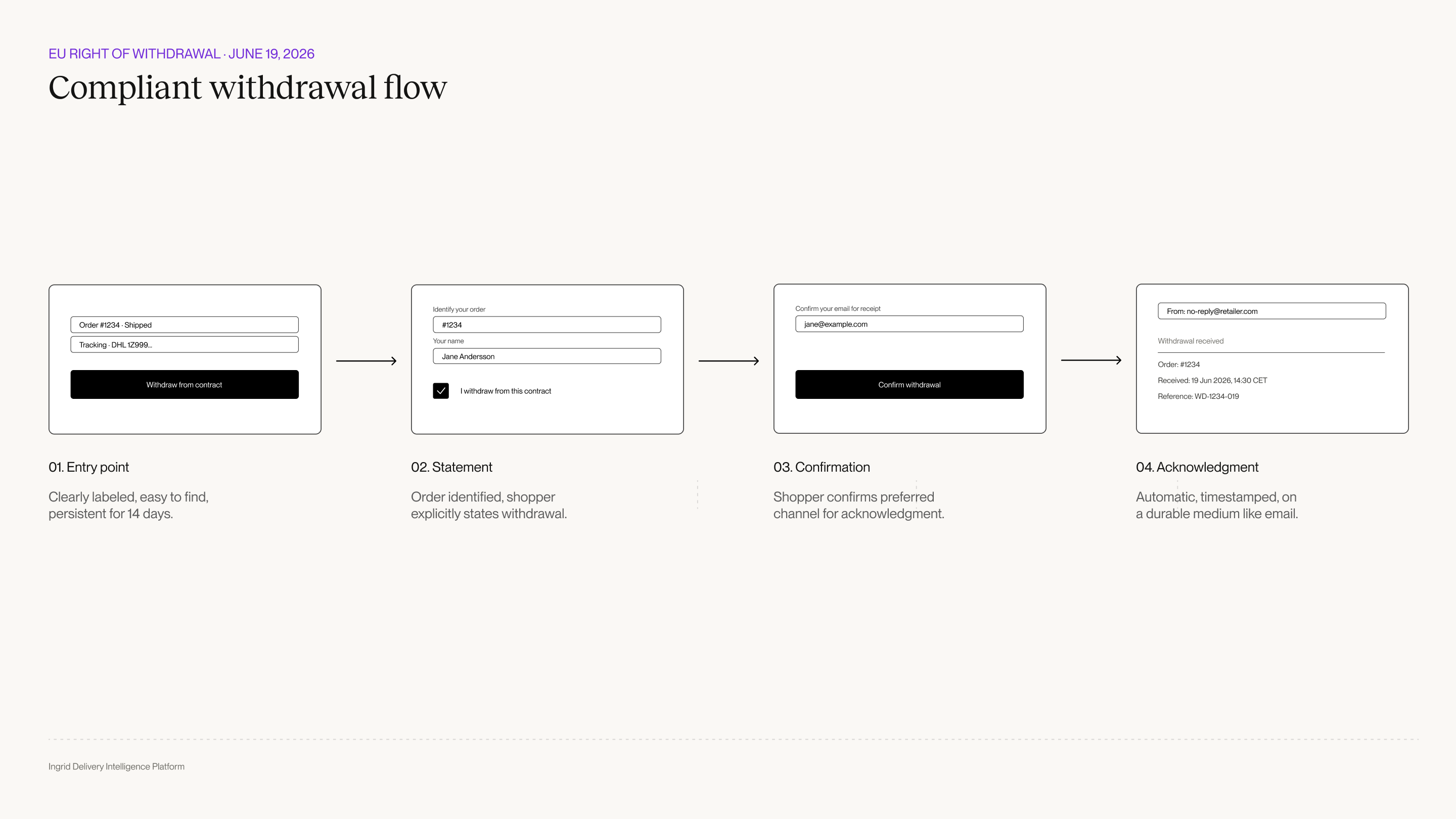
Strip the directive down to its operational essentials and a compliant flow needs four moving parts.The simplicity of the shopper-facing experience is intentional. The complexity sits in the retail operations behind it.
1. Clear withdrawal entry point
For example, a ‘Withdraw from contract’ button accessible from the same online interface where the contract was made and persistent throughout the 14-day window, starting the next day from delivery.
2. Withdrawal statement step
After the shopper clicks ‘Withdraw from contract’ the next screen has to do two things. First, identify the order or contract being withdrawn, typically by capturing or auto-filling the order number and the shopper's name and email. Second, capture an explicit statement of withdrawal, where the shopper has to actively confirm "Yes, I am withdrawing from this contract.”
3. Confirmation step
This step captures the channel on which the shopper wants to receive the acknowledgment, typically their email address.
4. Acknowledgment of receipt
Automatic and timestamped delivered on a durable medium, such as personal email address, sent without undue delay.
When does the 14-day clock start?
For goods, the 14-day period begins the day after the shopper takes physical possession of the order, i.e., the day after delivery, without any explanation or cost. If multiple items in one order are delivered separately, the clock starts the day after delivery of the last item.
The shopper can also exercise the right of withdrawal before delivery. The withdrawal period is anchored to physical possession, but the right itself exists from the moment the contract is concluded.
If they withdraw while the package is in transit, the retailer is still obliged to process the withdrawal and refund. The shopper's separate obligation is to return the goods within 14 days of submitting the withdrawal statement. In practice, that obligation is satisfied either by returning the goods on delivery, i.e., refusing the parcel, or by sending them back once they arrive.
In this case, retailers are not legally obliged to intercept or recall a shipment already with the carrier. They may choose to do so to avoid unnecessary delivery costs and transport risk, but it isn't required. The refund obligation still stands once the goods come back or the shopper provides proof of return shipment.
Where does internal ownership belong?
Among the operations leaders we've spoken with recently, some blockers come up consistently, and they line up with what we're seeing in the wider market. Most of these are solvable, but first they require a decision-owner and a clear view of the post-purchase stack before development starts. The withdrawal button sits across legal, e-commerce, CX, operations, and IT. In several organizations, none of them has formally picked it up, so that gap seems to be the biggest risk factor.
How Ingrid supports the withdrawal flow
Withdrawal compliance sits naturally inside the post-purchase experience shoppers already use to follow their order. See how Ingrid's Withdrawal in Tracking and Returns handles the entry point, the structured request, and the timestamped confirmation as part of the tracking and returns experience already running on the platform. Every request is captured and documented without a separate build.
For retailers using Ingrid Tracking, the withdrawal entry point can live on the tracking page or in the order confirmation email. For retailers using Ingrid Returns, the full flow is covered end to end. The right fit depends on the existing setup, the markets in scope, and how the team wants to separate withdrawal from commercial returns. Read more in the EU Right of Withdrawal implementation guide.
Disclaimer
This summary reflects Ingrid’s current understanding of the upcoming regulatory requirements based on available legal analysis. It’s intended for general informational purposes only and does not constitute legal advice. As the regulation has not yet entered into force and further guidance may emerge, the requirements described herein may be subject to change. Compliance with applicable laws, including the requirement to provide a compliant withdrawal function, is the sole responsibility of retailers. Retailers should consult their own legal advisors to ensure full compliance with applicable national laws.

FAQs
What does Ingrid Platform do?
Ingrid is the leading delivery intelligence platform that helps retailers turn delivery from a cost into a commercial advantage. Its modular platform connects retailers, carriers and shoppers across the whole shopping journey — discovery, checkout, tracking, transport, in-store and returns — so every delivery decision drives conversion, margin and loyalty on top of fulfillment and logistics.
How is Ingrid different from other delivery and shipping tools?
Most tools own a single touchpoint: logistics-led platforms stop at booking and labels, and post-purchase tools only start after the sale. Ingrid connects carrier choice to conversion and margin, with built-in A/B testing to prove what works. It gives retailers flexibility, choice and control instead of a fixed, one-size-fits-all setup.
Who is Ingrid for?
Ingrid is built for mid-market and enterprise e-commerce and omnichannel retailers shipping across multiple carriers, markets or delivery methods. Typically heads of e-commerce, logistics and operations leaders who want to turn delivery into a measurable revenue and margin lever. Retailers like Paul Smith, NA-KD, Apoteket, Nordic Nest and Mint Velvet use it to raise AOV, lift conversion, cut delivery-related support, implement direct exchanges, and increase delivery profitability.
Why does delivery intelligence matter?
Product and price used to decide the sale; now delivery does, too. Shoppers increasingly choose by delivery availability — same-day, next-day, pickup or in-store — while AI shopping agents rank retailers on delivery signals rather than branding. Ingrid helps retailers adapt with personalized delivery experience from checkout to returns. Back-end delivery intelligence contains cost and increases revenue, so delivery becomes a competitive advantage.
Related blog posts

Agentic DeliveryOS: Delivery ready for AI agents
The operating system for agentic-ready retail delivery that brings shopper, retailer and carrier intelligence together so every decision is made with full context.

A 20% better delivery experience is worth 5-10% more sales
Delivery drives 29-42% of satisfaction with a brand. What's it worth in sales?

Delivery, the most overlooked growth lever in e-commerce
Why delivery decides trust, conversion and repeat purchase, especially in agentic shopping.