

E-commerce last-mile delivery in Norway: the 2026 guide

Anastasiia Starchenko

Last-mile delivery in Norway is the final step that carries an online order from a local depot, store, or locker to the shopper. In a country this large and sparsely populated, it's the step that most often decides whether or not retailers keep their delivery promise.
Norway is a high-value but logistically demanding market: near-universal internet access, frequent shoppers, and a population spread across long distances.
For 2026, the carriers that matter most are Posten Bring, PostNord, Helthjem, Instabox (Instabee) and Porterbuddy (Instabee), with DHL, DPD and UPS covering cross-border volume.
Norwegian shoppers increasingly use service points and parcel lockers, but still prefer home delivery, with 51% having on occasion paid extra for it. On the other hand, 6 in 10 shoppers abandoned a checkout in the past three months, most often because shipping cost too much.
Whether you're a Norwegian brand auditing an existing setup or an international retailer sizing up the market, the same rule holds: a multi-carrier delivery strategy — matching the right carrier and method to each shopper, product, and postcode at checkout — beats locking into a single provider.
Who this guide is for
Mid-to-enterprise retailers in fashion, beauty, electronics, pharmacy, and home — both Norwegian brands interrogating whether their current delivery setup still fits how shoppers behave in 2026, and international brands investigating what to prepare and optimize for before they scale into Norway.
This guide covers the Norwegian last-mile landscape in 2026: the market, what shoppers expect, the main carriers, and why a multi-carrier delivery strategy is the foundation of an effective setup here. For the equivalent picture in nearby markets, see our guides to last-mile delivery in the Netherlands and the UK.
E-commerce in Norway: key statistics in 2026
Norway is one of the most digitally mature markets in the world, which raises the bar on delivery. As many as 86% of Norwegians shopped online in the last month, according to PostNord's E-commerce in the Nordics Spring 2026. We’re talking about a confident, high-expectation shopper base.
What makes Norway distinct from neighbouring markets is the combination of extreme distances, low population density, demanding weather, and a strong pull toward cross-border purchases from Sweden. These conditions shape how delivery performs and how reliably a retailer can meet the delivery promise it makes at checkout.
Top retail verticals
The three biggest are clothes and footwear (33%), beauty and health (17%), and home electronics (10%) with notable gender splits (women over-index on fashion and beauty, men on electronics). Among 18–29s, 41% say their most recent purchase was fashion.
Cross-border is the norm
Nearly 8 in 10 Norwegians (78%) bought from abroad in the past year. Sweden is now the top cross-border market, overtaking China, as shoppers gravitate to closer markets with faster deliveries, easier returns, and higher trust. That’s a direct competitive signal for both Norwegian and international brands.
What it means for retailers
This is a sophisticated shopper base with clear expectations about how an order should arrive and a willingness to buy from a neighboring country when delivery and returns are better there. They expect accurate delivery options at checkout and a delivery promise the retailer can keep. If you're already established here, the question is whether your setup still matches how shoppers behave now; if you're entering, it's what to build for from day one.
What Norwegian shoppers expect from delivery
Norway's geography shapes everything about last-mile delivery. It’s one of the most sparsely populated countries in Europe, with more than 80% of people living in urban areas. Remote municipalities mean long distances and hard-to-find addresses.
That’s why a large share of delivery problems in Norway have historically been carrier- and distance-related rather than retailer-related. In practice, it means Norwegian shoppers are realistic about speed but unforgiving about certainty. A reliable, clearly communicated delivery promise beats a fast-but-vague one.
Delivery methods: used vs. preferred (2026)
The most important nuance for 2026 is the gap between what shoppers use and what they prefer, per PostNord's E-commerce in the Nordics Spring 2026 research.
Service point pickup is the most used method, and still growing. Home delivery is the most preferred method, despite a dip in usage. Parcel lockers are the fastest-growing option — more than twice as common in 2026 as in 2024.
Norwegian shoppers use service points because they're offered and convenient, but home delivery is what they actually want according to surveys, and they already pay for it more than they expect to. Offering home delivery as a paid upgrade is a clear, validated revenue opportunity.

Delivery decides cart abandonment
The single most actionable finding for Norwegian retailers in 2026: 6 in 10 Norwegians abandoned a purchase at checkout in the past three months, up from 5 in 10 a year earlier. High shipping costs are the top cart abandonment reason.
Among 18–29s, it's 7 in 10, and they're quick to drop out if the delivery method doesn't suit them or the delivery time is too long. At the same time, 57% of shoppers say a smooth checkout is important to where they shop. Delivery isn't a post-purchase concern but a conversion lever that fires at the moment of sale.
Rising cart abandonment rates driven by delivery costs are both the risk and the opportunity. Presenting the right options at the right price, and A/B testing them, makes all the difference between a completed order and a shopper who buys from a Swedish site instead. That’s where a strategic delivery setup that adapts by shopper, cart and postcode pays for itself.
Willingness to pay for home delivery
Norwegians are most willing to pay extra for home delivery and, uniquely, the share who have paid for it (51%) exceeds the share who say they're willing to (48%). For other methods like same-day delivery (42% willing vs 27% paid) and next-day (28% willing vs 23% paid) willingness outruns actual spend. Younger shoppers (18–29) are the most willing to pay for premium options: 58% for home delivery and 64% for same-day.
Willingness to pay for sustainable delivery
Around 1 in 4 shoppers will pay extra for a sustainable delivery, but more than half are willing to wait longer for one. Shoppers value sustainability, but mostly when it doesn't cost them more — 67% of those who paid for their latest delivery would wait longer for a greener option.
Returns are part of the delivery decision
Returns are common and influence where Norwegians choose to shop. Nearly 3 in 10, with 44% in their 18–29s, returned a product in the last three months, and 71% say a clear return policy is important when deciding where to buy. Service points are the most used and preferred return method, closely followed by physical stores, with parcel lockers rising fast.
For retailers, a frictionless, clearly communicated returns experience should be part of the customer experience strategy beyond cost saving, especially in high-return categories like fashion. International brands in particular should note that easier Nordic returns are part of why shoppers favor Swedish and Danish sellers.
Last-mile logistics market in Norway
Two structural shifts define the Norwegian market in 2026. First, costs are still under pressure. The national carbon-tax increase and global fuel-price swings pushed road-transport costs up sharply in recent years. Carriers have passed these through, so retailers need delivery setups that actively manage cost per parcel instead of static shipping rules based on assumptions.
Stores are becoming logistics nodes. Nationwide chains are blending physical and online retail, using physical stores as frontline fulfillment points. Beyond standard click-and-collect, some retailers now run last-mile delivery from the nearest store instead of a central warehouse. This micro-fulfillment approach cuts delivery time and distance — a real advantage in a country as spread out as Norway.
How to choose last-mile carriers in Norway
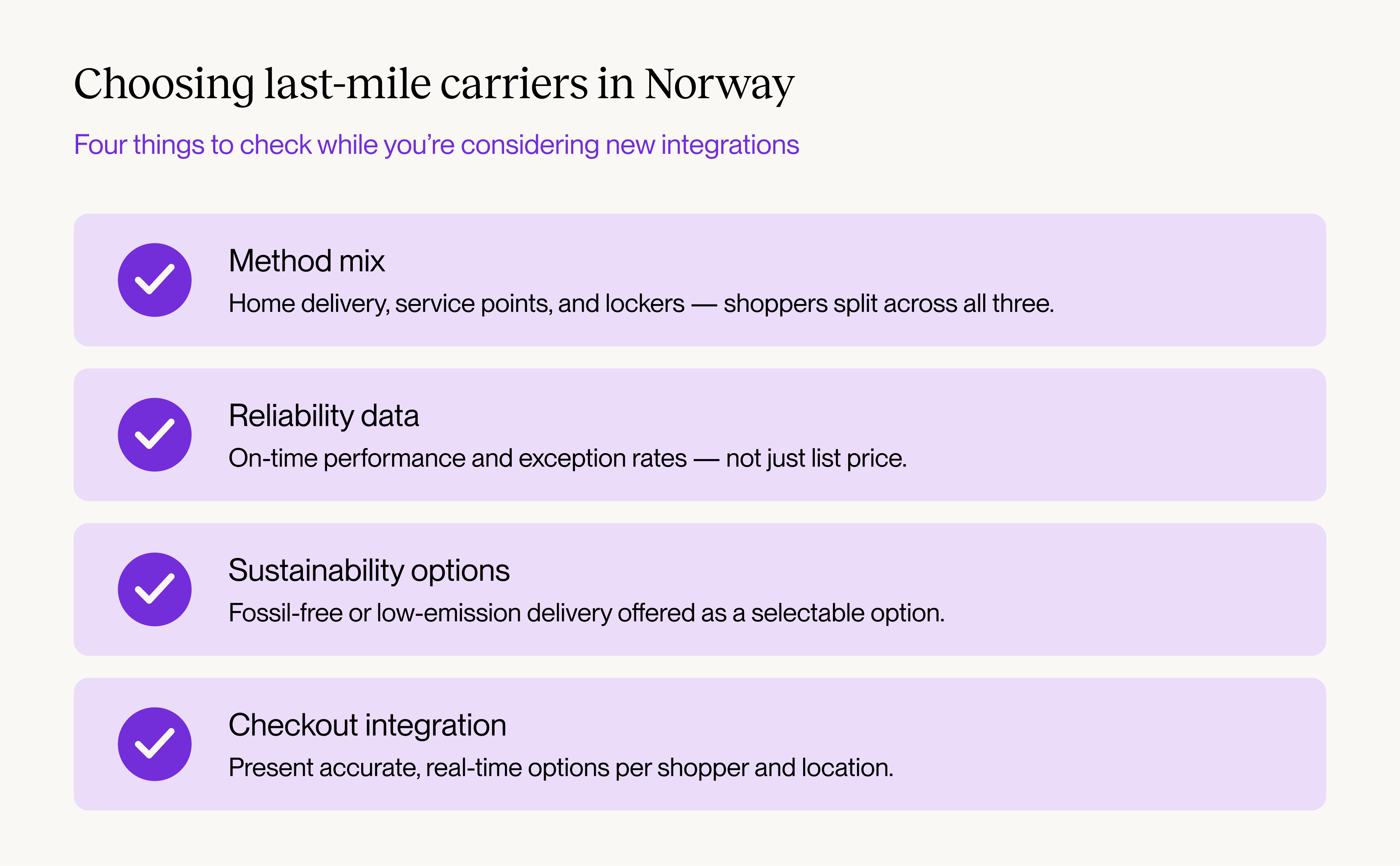
Don't rely on a single carrier. It's tempting to lock in one favorable shipping contract, but a multi-carrier strategy is what lets you boost conversion, protect margin, and scale reliably. It's as relevant to a Norwegian brand reviewing an aging contract as to an international one building from scratch.
Delivery is contextual and dynamic. How shoppers want an order delivered depends on what they're buying, when, and where, and carriers perform differently across Norway's regions. A carrier that's excellent in Oslo may be weak in the north; a locker network that's dense in cities thins out in rural municipalities.
The right mix also shifts by category. Fashion and beauty orders suit lockers and service points, where convenience and easy returns matter most. Electronics — higher value, often bulkier — lean toward tracked home delivery with a clear promise.
Pharmacy can carry compliance and speed requirements that favor reliable home or named-day delivery. Home and bulky goods need carriers equipped for larger formats. If your category sits across several of these, that's another argument against a one-carrier setup.
Ingrid Delivery Checkout presents accurate, intelligent shipping options — delivery times, price, available carriers and methods — for every shopper at checkout, with 350+ carrier products available in a single platform.
Norway's top last-mile delivery carriers in 2026
The Norwegian last-mile market is led by four domestic and Nordic carriers — Posten Bring, PostNord, Helthjem, and Instabox (Instabee) — supported by global players DHL, DPD, and UPS for cross-border volume. No single carrier is strongest everywhere, which is the core practical case for a multi-carrier setup. Here's how they compare at a glance.
- Posten Bring, national postal operator. Strongest for the widest domestic reach, rural coverage, and trust. Methods: home, service points, lockers.
- PostNord, the Nordic network. Strongest for multi-market Nordic shipping from one setup. Methods: home, service points, lockers.
- Helthjem, the specialist domestic challenger. Strongest for early-morning home delivery, including weekends. Methods: home, mailbox.
- Instabox (Instabee), the parcel locker network. Strongest for urban, convenience-led self-service pickup. Methods: lockers.
- Porterbuddy (Instabee), green home delivery. Strongest for same-day or evening attended home delivery. Methods: home (low-emission).
- DHL, DPD and UPS, the global carriers. Strongest for cross-border and international shipments. Methods: home, service points.

Posten Bring
Norway's national postal operator and the dominant force in the parcel market. Posten Bring, formerly Posten Norge, operates the consumer-facing Posten brand and the business/logistics Bring brand. Its strategy centers on fossil-free shipping, flexible delivery, and a large out-of-home (OOH) network of service points and parcel lockers. Strong brand trust and the widest domestic reach make it a default backbone carrier for most retailers selling into Norway.
PostNord
One of the most widely used parcel services across Scandinavia, including Norway. PostNord offers one of the most extensive Nordic networks and a broad range of flexible delivery options, which makes it a strong choice for retailers shipping across multiple Nordic markets from a single setup.
Helthjem
Norway’s specialist challenger, Helthjem operates a home delivery network that specializes in express e-commerce parcel, magazine, and newspaper delivery across Norway. They uniquely provide early-morning, pre-breakfast home deliveries, typically before 7AM CET, directly to customers' doormats and mailboxes, six days a week. It’s a strong early-morning home-delivery reach that larger operators struggle to match.
Instabox
Instabox is part of the Instabee group, formed by the 2022 merger of Instabox and Budbee. In Norway, Instabox runs a smart parcel locker network, powering fast, convenient self-service pickup for well-known names shipping into the market and continuing to expand its locker footprint. It’s a good fit for retailers targeting urban, convenience-led and sustainability-minded shoppers.
Porterbuddy
Porterbuddy is the Instabee group's home delivery brand in Norway, delivering to the door — often same-day or evening — by low-emission vehicles. It has been expanding its reach beyond the major cities, adding 17 new municipalities in 2025. Where Instabox covers locker pickup, Porterbuddy covers attended home delivery, so the two together give retailers a flexible, sustainability-minded pairing across both OOH and at-home options.
Global carriers: DHL, DPD, UPS
DHL, DPD and UPS maintain a strong presence in Norway and are most relevant for cross-border and international shipments — important given that nearly 8 in 10 Norwegians shop from abroad, with Sweden now the leading cross-border market.
How to build a multi-carrier delivery strategy
Whether you're scaling an established Norwegian operation or entering for the first time, the winning formula is the same — offer home delivery as a premium option shoppers will pay for, make service points and lockers easy defaults, and never depend on a single carrier.
Shoppers don't all want the same thing at checkout. Data across Ingrid Delivery Checkout shows that 32% of shoppers choose the cheapest delivery option, 17% prioritize speed, and 35% have no clear preference.
The remaining 15% decide on personal preferences such as a trusted carrier, pickup availability, named-day delivery, or climate-smart options. Preferences also shift over time — 34% are likely to change their delivery choice for repeat purchases. One delivery method based on a default carrier can only serve one of these groups.
The practical balance is to offer 3–5 delivery options per order — enough freedom of choice without overwhelming the shopper. Brands that offer multiple delivery options see a 27% increase in checkout conversion on average. Checkout A/B testing then fine-tunes the strategy, showing which offers and layouts work best for each audience, market, and shipping region.
Conversion and margin payoff of multiple delivery options
Nordic electronics retailer Elon raised conversion by 15% by giving shoppers tailored delivery options — by costs, times, methods, and carriers — at checkout. Fashion retailer Cellbes increased shipping revenue by 23% by reordering delivery options based on cost-effective shipping rules and real-time delivery pricing.
In pharmacy, Kronans Apotek improved net margin by 11% by A/B testing delivery pricing rather than defaulting to flat free shipping. In a market where shipping cost is the top reason for abandonment, how delivery is presented and priced is a direct commercial lever. They also increased the use of climate-smart delivery options by 25% by pre-selecting them for customers at checkout.
There's real room, for incumbents and new retail players alike, to exceed expectations, build a local competitive advantage, and earn repeat orders. For brands already shipping in Norway, that often means auditing whether today's setup still matches how shoppers behave; for those entering, it means designing for it from the start. Both depend on a delivery strategy that adapts to shopper, product, and location in real time.
That’s where Ingrid, the AI-powered delivery intelligence platform, comes in. We help retailers realize the power of delivery across the entire customer journey, from checkout and tracking to returns and exchanges.
Brands can present the right delivery options for every order, every postcode and every market, while managing everything from one platform. Ingrid is trusted by 250+ leading retailers and brands, including Paul Smith, Nordic Nest, GANT and NA-KD.
Book a demo →
FAQs
Why is a multi-carrier strategy important in Norway?
Because no single carrier performs equally well across Norway's geography or across every product type and shopper preference. A carrier strong in Oslo may be weak in the north; a dense urban locker network thins out in rural municipalities. A multi-carrier strategy lets retailers match the right carrier and method to each order. Presenting an intelligent set of delivery options at checkout lifts conversion, around 27% on average according to Ingrid Platform data, while protecting margin. It's the single most important principle for delivering profitably in Norway.
Who are the main last-mile delivery carriers in Norway?
The main carriers are Posten Bring (the national operator, dominant nationwide), PostNord (broad Nordic network), Helthjem (known for early-morning home delivery), as well as the Instabee group's Instabox (parcel lockers) and Porterbuddy (green home delivery). DHL, DPD and UPS cover most cross-border and international shipments.
What delivery method do Norwegian shoppers prefer?
Home delivery is the most preferred method, even though service point pickup is the most used. Parcel lockers are the fastest-growing option — more than twice as common in 2026 as in 2024. The gap between preference and usage means home delivery is an underexploited paid upgrade.
Will Norwegian shoppers pay extra for delivery?
Yes. 51% of Norwegian shoppers say they've paid extra for home delivery — more than the 48% who say they're willing to, making it the one method where actual spend outpaces stated willingness. Among 18–29-year-olds, 58% will pay for home delivery and 64% for same-day. Around 1 in 4 shoppers will pay more for a sustainable delivery, while over half will instead wait longer for one.
Why do Norwegian shoppers abandon checkout?
The most common reason is that shipping costs too much. In PostNord's 2026 research, 6 in 10 Norwegians abandoned a purchase at checkout in the past three months (up from 5 in 10 a year earlier), rising to 7 in 10 among 18–29s, who also drop out if the delivery method doesn't suit them or the delivery time is too long. With 57% saying a smooth checkout influences where they shop, delivery presentation at checkout is a direct conversion lever.
How important are returns to Norwegian shoppers?
Very. Nearly 3 in 10 Norwegians (and 44% of 18–29s) returned a product in the last three months, and 71% say a clear return policy matters when deciding where to shop. Service points and physical stores are the preferred return methods, with parcel lockers growing fast. Easy Nordic returns are part of why Norwegian shoppers increasingly favor Swedish and Danish sellers.
Why is last-mile delivery harder in Norway than elsewhere?
Norway has the lowest population density in Europe after Iceland. Long distances, remote municipalities, hard-to-find rural addresses, and harsh weather make deliveries slower and more exception-prone, so a large share of delivery issues are distance- and carrier-related. Reliability and a clear delivery promise matter more than raw speed.
Should retailers use one carrier or several in Norway?
Several. Carrier performance varies widely across Norway's regions, and shoppers split across home delivery, service points, and lockers. A multi-carrier strategy lets retailers match the right method and carrier to each shopper, product, and location — improving conversion and protecting margin.
How can a retailer offer the right delivery options at checkout?
By integrating a delivery intelligence platform that presents accurate, custom delivery options per shopper and location. Ingrid Delivery Checkout shows delivery times, price, available carriers, and methods for every order, with shipping rules handled automatically instead of through manual configuration. Retailers can leverage the commercial benefits of profit-optimized delivery option selection and increase conversion with predictive delivery times, both powered by AI.
How do delivery needs differ by category in Norway?
They differ meaningfully. Fashion and beauty orders suit lockers and service points, where convenience and easy returns matter most. Electronics — higher value and often bulkier — favor tracked home delivery with a clear promise. Pharmacy can carry speed and compliance requirements that point to reliable home or named-day delivery. Home and bulky goods need carriers equipped for larger formats. Brands spanning several categories benefit most from a multi-carrier setup.
I already sell in Norway — how do I know my delivery setup still works?
Audit it against current behavior, not the assumptions it was built on. Shopper preferences have shifted fast: parcel-locker use has more than doubled since 2024, service points keep growing, and home delivery is now a paid upgrade a majority will spend on. If your checkout still offers a fixed set of options regardless of postcode, category, or shopper, you're likely leaving conversion and shipping revenue on the table. A/B testing delivery options is the fastest way to find out what's actually working.

FAQs
What does Ingrid Platform do?
Ingrid is the leading delivery intelligence platform that helps retailers turn delivery from a cost into a commercial advantage. Its modular platform connects retailers, carriers and shoppers across the whole shopping journey — discovery, checkout, tracking, transport, in-store and returns — so every delivery decision drives conversion, margin and loyalty on top of fulfillment and logistics.
How is Ingrid different from other delivery and shipping tools?
Most tools own a single touchpoint: logistics-led platforms stop at booking and labels, and post-purchase tools only start after the sale. Ingrid connects carrier choice to conversion and margin, with built-in A/B testing to prove what works. It gives retailers flexibility, choice and control instead of a fixed, one-size-fits-all setup.
Who is Ingrid for?
Ingrid is built for mid-market and enterprise e-commerce and omnichannel retailers shipping across multiple carriers, markets or delivery methods. Typically heads of e-commerce, logistics and operations leaders who want to turn delivery into a measurable revenue and margin lever. Retailers like Paul Smith, NA-KD, Apoteket, Nordic Nest and Mint Velvet use it to raise AOV, lift conversion, cut delivery-related support, implement direct exchanges, and increase delivery profitability.
Why does delivery intelligence matter?
Product and price used to decide the sale; now delivery does, too. Shoppers increasingly choose by delivery availability — same-day, next-day, pickup or in-store — while AI shopping agents rank retailers on delivery signals rather than branding. Ingrid helps retailers adapt with personalized delivery experience from checkout to returns. Back-end delivery intelligence contains cost and increases revenue, so delivery becomes a competitive advantage.
Related blog posts

Agentic DeliveryOS: Delivery ready for AI agents
The operating system for agentic-ready retail delivery that brings shopper, retailer and carrier intelligence together so every decision is made with full context.

A 20% better delivery experience is worth 5-10% more sales
Delivery drives 29-42% of satisfaction with a brand. What's it worth in sales?

Delivery, the most overlooked growth lever in e-commerce
Why delivery decides trust, conversion and repeat purchase, especially in agentic shopping.