

Delivery & Returns Pricing Strategy
An analysis of the UK’s top fashion retailers
Download the report
Introduction
Over the last 12 months, many retailers have refocused their efforts on business profitability versus pure top line growth. As a result, the delivery and returns proposition and how the options are priced has become one of the main questions retailers are seeking to answer. This report aims to answer these questions and offer recommendations around achieving the best customer experience in the most profitable way. business profitability versus pure top line growth
Delivery Factors: More than price and speed
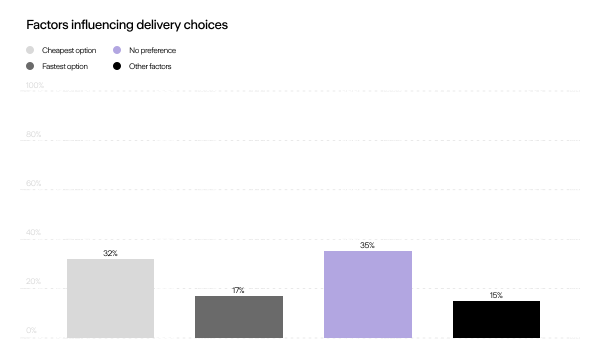
It was previously believed that price and speed were the primary factors influencing delivery choices for online shoppers. However, recent data suggests that this is only part of the story. While 32% of shoppers choose the cheapest delivery option and 17% opt to pay more for the fastest delivery, a surprising 35% of customers do not have a clear preference for either speed or price. For the remaining 15%, delivery choices are shaped by other factors — like pre-selected carriers, specific delivery types (pick-up or named day), trusted carriers, or sustainable delivery options. This challenges the assumption that price and speed are all that matter in the e-commerce delivery equation. The truth is, delivery preferences are heavily contextual, with more and more customers willing to pay for convenience.

Insights from Harper & Ingrid’s breakfast series with top UK retailers show a clear push towards more flexible delivery options. Many are testing parcel lockers and pick-up points to cut down on failed deliveries, while others see value in offering multiple delivery choices and click-and-collect to better cater to different customer needs. The idea of allowing customers to adjust delivery times with select carriers also emerged as a promising way to boost satisfaction and reduce missed deliveries.
Brands offering multiple delivery options achieve a 60% checkout conversion rate, compared to 47% for those with a single option. Moreover, 34% of customers change their delivery preference on repeat purchases. This shows that providing choices like express, standard, or sustainable delivery can directly boost sales by catering to different customer preferences.
The impact of returns per order
Return rates are climbing with e-commerce growth, driven by a shift from in-store to online shopping. Returns are more frequent with larger, pricier carts, and the likelihood of a return increases if a customer has returned a previous order—70% compared to 35% for those who have not. The expectation of free returns further adds to this trend, with 70% of UK customers expecting returns to be free. Given these dynamics, many retailers now focus on strategies to manage the financial impact of high return rates rather than attempting to reduce them outright.
£14.40 - £37.10
Total cost
£4.70 - £26.40
Discount & Liquidation*
£2.10 - £3.00
Warehouse processing
£2.10 - £3.00
Shipping & Transportation
c. £1.85
Customer care
*Discounting & Liquidation is the cost associated with items beingunable to be resold at full price due to the time it takes for unwanted items to be returned by customersand restocked by the warehouse. Data: The Business of Fashion: Online returns playbook


Related blog posts

AI in retail: know your craft, then automate | D-Congress 2026
The future belongs to retailers who protect their craft and delegate the rest to machines smart enough to handle it.

Delivery has entered the age of intelligence
Delivery has already transformed from a fulfillment function to a meaningful driver of conversion, margin, and customer trust.

Agentic commerce: delivery and returns as discovery layer
AI agents evaluate retailers based on accurate delivery estimates and delivery pricing, as well as clear returns policy.
